Every Iraqi prime minister since the fall of Saddam Hussein has inherited the same impossible job: Convince Washington that Iraq is not slipping entirely into Iran’s orbit while convincing Tehran that it is not becoming an American outpost.
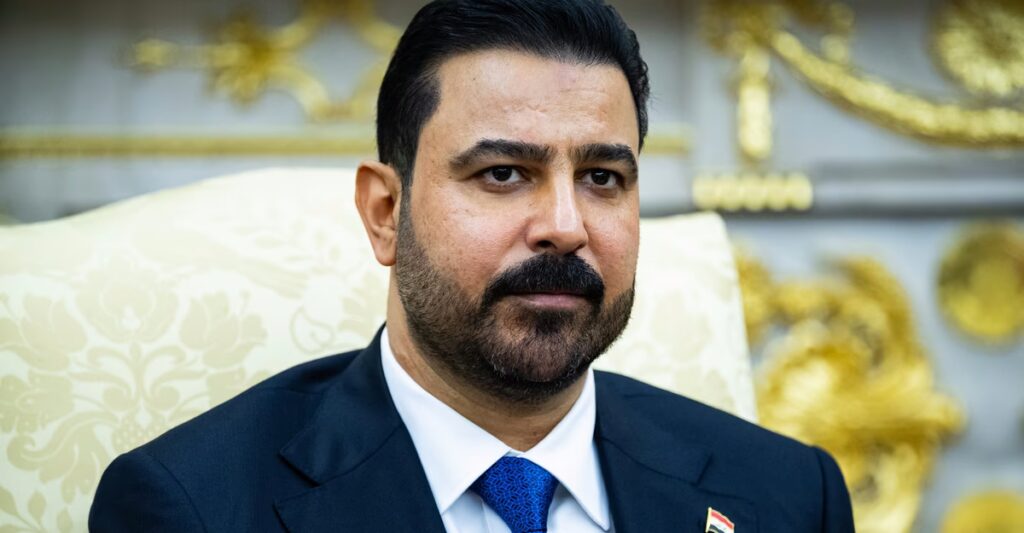
Iraq’s new prime minister now faces that challenge under the most trying of circumstances. The United States and Iran are at war—and Iraq sits between them. When I met with Ali al-Zaidi during his visit to Washington, D.C., last week, which included an Oval Office audience with President Trump, I was looking for signs that Iraq’s strategy had changed. Instead, I heard a familiar refrain: fewer American troops; more American business.
“Military presence does not create ties between societies,” he told me in a rare interview, conducted under heavy security in downtown Washington. “Economic engagement does.”
It’s an aspiration that’s running up against a challenging reality. Roughly 2,000 American troops remain in his country, advising Iraqi security forces in their fight against the Islamic State. Meanwhile, dozens of Iran-backed militias operate across Iraq, despite repeated government promises to bring them under state control. As of now, the U.S. troops are set to leave by the end of September, bringing a symbolic end to America’s war in Iraq after 23 years. Many experts I spoke with are skeptical, however, noting that if fighting continues to escalate between Washington and Tehran after the collapse of the recent cease-fire, those troops are strategically positioned to bolster America’s Middle Eastern presence—even if they are also among the most exposed to attack.
Around the time al-Zaidi and I spoke in Washington, three U.S. service members were reported dead in incidents in Jordan and Iraq, demonstrating how quickly Iraq can once again become a focal point of conflict. Trump “had the inclination to deliver a severe blow” to Iran after days of tit-for-tat strikes, al-Zaidi told me, though he declined to elaborate on what that might entail, or whether it involved ground troops. He would say only that Trump had asked for his opinion, and he advised to delay retaliation.
“Trump expressed his frustration, saying that despite the agreement reached with the Iranians, they failed to honor it—a sentiment echoed by the Iranians regarding the U.S.,” he said. “You can always resort to force later, but negotiation is what matters.” (A U.S. official didn’t address the exchange between Trump and al-Zaidi, but said in a statement that “these devastating blows will continue until the President deems otherwise.” The official added that talks between the U.S. and Iran continue.)
Over the past two decades, Iran has ratcheted up its influence in Iraq through political parties, economic ties, and armed groups affiliated with its Popular Mobilization Forces. The U.S., meanwhile, provides military training and intelligence support against the remnants of ISIS, and plays a key role in Iraq’s access to the global financial system through the dollar-based banking network. U.S. officials told me Iraqi intelligence played a key role in the U.S. operation that killed Iranian General Qassem Soleimani outside the airport in Baghdad in January 2020, a military achievement from Trump’s first term that he still celebrates. (Iraq has denied any involvement.) Yet that strike triggered a crisis in U.S.-Iraq relations, fueling demands from powerful Iraqi factions to expel American forces altogether.
[Read: Inside the decision to kill Iran’s Qassem Soleimani]
Iraq matters to Washington for reasons that extend far beyond Baghdad. American troops stationed there provide logistical and intelligence support to Iraqi security forces, making their bases frequent targets whenever tensions escalate with Iran. Every escalation raises the same question: Can Baghdad disarm the militias, most of which take their orders from Iran’s Islamic Revolutionary Guard Corps? Al-Zaidi repeatedly insisted, his voice rising with anger, that “there is no option except surrendering weapons.” He is not prepared to accept a failed state.
On almost every issue with Iraq that has frustrated Washington for two decades—corruption, militias, sovereignty, and Iranian influence—al-Zaidi claimed the situation was changing. Yet each pledge echoed promises made by nearly every Iraqi prime minister before him. He acknowledged as much, but insisted that some of his early crackdowns on corrupt public servants have succeeded, indicating that this time is different.
At 41 years old, al-Zaidi is the youngest Iraqi prime minister. A political outsider and multimillionaire businessman, he belongs to a generation shaped by the wars that remade modern Iraq. He was born during the Iran-Iraq War of the 1980s, when Saddam sought to take advantage of the political chaos in Iran following its 1979 Islamic Revolution. Saddam ordered an invasion of Iran the following year on the assumption that Tehran’s military had been depleted by the domestic upheaval. But Iraqi forces faced stiff Iranian resistance, and the war dragged on for about eight years, killing hundreds of thousands of soldiers on both sides and devastating both economies.
Today’s confrontation, between the United States and Israel on one side and Iran on the other, has made commercial shipping and global energy supplies central targets, with oil tankers again caught in the crossfire, as they were 40 years ago. When I asked al-Zaidi what Iraq had learned from its own war with Iran, his answer was striking: “Even the winner loses,” he said, while taking a drag from his vape.
[Read: The forever negotiation]
The answer reflected Iraq’s experience. The Iran-Iraq War ended without a decisive victor but left Iraq heavily indebted, politically weakened, and socially scarred. Those burdens helped set the stage for Saddam’s invasion of Kuwait in August 1990, which triggered the Gulf War and, ultimately, the chain of events that culminated in the 2003 U.S. invasion of Iraq, when al-Zaidi was 18 years old. The removal of Saddam by the U.S. was followed by the rise of militias with deep ideological, security, and economic dependence on Tehran.
Iraq, al-Zaidi told me, should be “a meeting point, not a place for hostility” between the U.S. and Iran. His country can bridge the divide by getting U.S. forces to leave and then by ensuring that any rogue militia groups disarm. He insisted that economic opportunity is the answer to Iraq’s problems: If people feel they have a future, they won’t turn to warfare or sectarianism. He acknowledged he will likely face resistance and said he could die trying to make it happen. “We will accept nothing less,” he told me.
Throughout our conversation, which was in Arabic, al-Zaidi sounded less like a career politician than a chief executive pitching a turnaround strategy. Iraq has resources. America has capital and technology. Replace soldiers with investors, and the relationship becomes sustainable.
But signs of recovery last year have been snuffed out by the latest conflict, which has disrupted trade routes, strained public finances, and prompted the International Monetary Fund to forecast that Iraq’s economy will shrink by 6.8 percent this year. Al-Zaidi pointed to new energy agreements signed in Washington as evidence that investors should look beyond the war. But he also acknowledged that his country’s economy is suffering greatly from the closure of the Strait of Hormuz, losing about $50 billion in revenue because of halted oil exports, he said.
Al-Zaidi emerged as a compromise candidate for prime minister in late April after months of political deadlock. He has vowed to forgo a government salary, avoid forming a political party, and serve only one four-year term. Since taking office, he has paired those promises with high-profile anti-corruption raids, including the June arrest of dozens of officials, among them the deputy oil minister, inside Baghdad’s Green Zone, the heavily fortified district in central Baghdad now controlled by the Iraqi government.
Before politics, he built a business empire spanning agriculture, logistics, and energy. A bank where he served as chairman later lost access to U.S.-dollar transactions after American authorities raised concerns over alleged Iran-linked money laundering. Trump, who described al-Zaidi as “handsome” when they met last week, appears receptive to a leader who speaks in the language of investment rather than ideology. Al-Zaidi pitches Iraq, first and foremost, as a business opportunity, though he avoids the term deal, saying investment will naturally follow because the two countries want to work together.
“We are discussing an investment partnership between Iraq and the U.S. that would span 30 years,” he added. “The fighting could cease in months, days, or even hours—that rests with the politicians.”
[Read: ‘We may sleepwalk our way back to war’]
Al-Zaidi’s own rise to power reflects Washington’s enduring influence. After months of political paralysis, former Prime Minister Nouri al-Maliki, an influential hard-liner with close ties to Iran, was pushed aside earlier this year after Trump publicly threatened to cut U.S. assistance if al-Maliki returned to office. Al-Zaidi emerged as the alternative because he was acceptable to Iraq’s competing political factions and, just as important, was unlikely to face resistance from Washington. His challenge now is to prove that political compromise can translate into actual authority over a state where many of the most heavily armed actors still operate outside government control.
Al-Zaidi has pledged that by September 30, independent armed factions will either surrender their weapons or be absorbed into Iraq’s official security forces. The coming months will determine whether al-Zaidi’s vision survives contact with the region’s oldest reality: Iraq rarely gets to choose the wars that shape its future.
The post Iraq’s Man in the Middle appeared first on The Atlantic.