Over the past year, the Trump administration has made deals to acquire equity stakes in more than two dozen firms, an unusual practice that has extended the government’s influence over industries including semiconductors, nuclear energy, minerals, quantum computers and steel.
Artificial intelligence executives are increasingly wondering if they will be next.
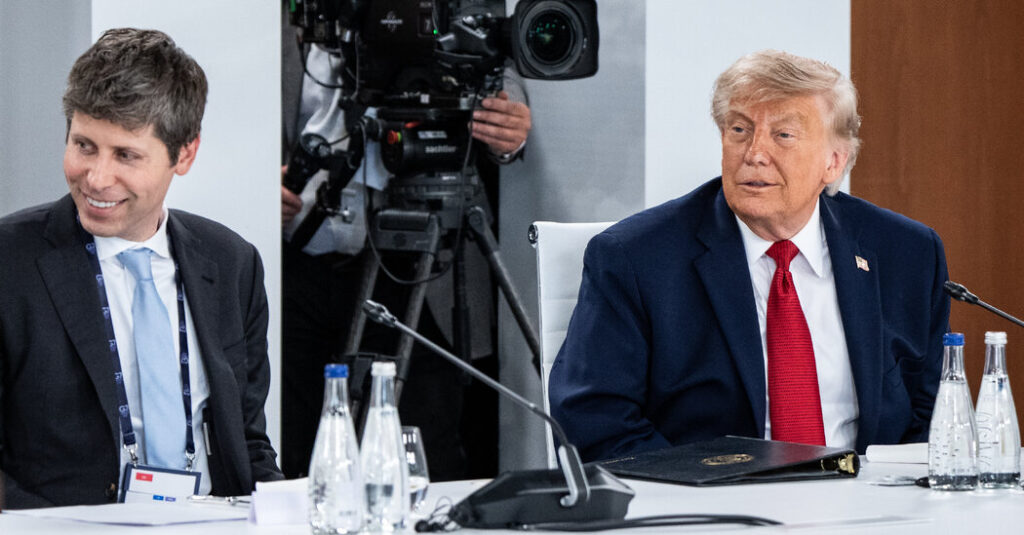
Sam Altman, the chief executive of OpenAI, has long floated the idea of having A.I. companies give the country equity, including in meetings in Washington last month. And President Trump has mused publicly about the possibility of having A.I. companies provide the United States with stakes in their business.
So far, the administration does not appear to have decided on any formal plan for the government to own a piece of A.I. companies. But Trump officials have discussed the possibility of taking direct stakes in A.I. companies or using equity from those firms to seed new Trump investment accounts for children, according to people familiar with the discussions.
The discussions are prompting interest and anxiety among A.I. executives. Both Anthropic and OpenAI, the makers of the country’s most advanced models, have publicly talked about the possibility of some kind of arrangement that would share A.I. wealth directly with taxpayers, similar to the Alaska Permanent Fund, a sovereign wealth fund that uses oil profits to invest in the stock market and pay dividends to the state’s residents.
But there are growing concerns about what that relationship could look like and the pressure it could exert on A.I. firms, given that the administration has already taken a heavier hand in recent weeks to regulating Anthropic, one of the industry’s leading companies.
Still, some A.I. firms believe allowing the public to share in the technology’s wealth could help stem rising public opposition, at a time when more Americans are concerned about the technology’s leading to job losses, higher energy costs and environmental effects from data centers.
But some executives appear more concerned about an arrangement that would simply give their shares to the Trump administration, without a clear way for that wealth to be distributed to ordinary Americans. That model could be similar to the equity stakes the administration has taken in other firms, where it has built up a portfolio worth billions of dollars held by the Pentagon, the Department of Commerce and the Department of Energy.
Most companies seem to have entered into their equity deals with the administration willingly, believing ties with the government will help their business. And Trump officials say the ties are helping to strengthen critical industries in the United States. But critics say the administration has sometimes extorted firms into giving it their shares, by holding out the threat of regulation that could help or hurt the company.
The Trump administration has also frequently used heavy tariffs as a cudgel against industry, sometimes lifting those levies in return for promises by companies to invest in the United States. And in exchange for approving the sale of Nvidia’s advanced chips to China, Mr. Trump also arranged to take a cut of that revenue, arguing that if the company was going to profit, taxpayers should, too.
Some fear the administration could turn a recent regulatory crackdown on A.I. models into a similar cudgel against the industry.
Last month, the Trump administration suddenly forced Anthropic to take its newest models offline, and it has pressed Meta to submit its A.I. models for review. OpenAI also said last month that it would limit its newest model to a small group of customers approved by the Trump administration, though it released the model last Thursday with no restrictions.
Advanced A.I. models, like Anthropic’s Fable 5 and Mythos 5, can be used in military and intelligence settings, including to assess cybersecurity vulnerabilities. But the U.S. government’s measures against Anthropic were unusually extensive, cutting off its ability to share the model with any non-U.S. citizens, including the company’s own foreign employees.
Some officials and executives say these national security measures are unrelated to any conversation on government ownership of A.I. company stakes. But executives say the step-up in regulation is in practice a powerful lever over them.
One executive said he worried that the administration might deny A.I. companies the opportunity to get frontier models out to customers in a timely way, unless the government also got some kind of cut. Another said that the Trump administration had never explicitly linked regulation of A.I. models with equity stakes, but that companies would be “naïve” to think they wouldn’t be connected in practice.
The executives spoke on the condition of anonymity to discuss a sensitive topic for their industry. The White House did not respond to requests for comment.
Who shares in the upside?
The question of the government’s role is particularly pertinent now that A.I. companies are generating huge returns for their shareholders, and a backlash among Americans concerned about potential threats to white-collar jobs or hulking data centers moving into their neighborhoods.
Anthropic and OpenAI are both preparing for initial public offerings set at roughly $1 trillion. Senator Bernie Sanders, independent of Vermont, has proposed parking some A.I. company shares in a sovereign wealth fund that could make direct annual payments to Americans. Gavin Newsom, the Democratic governor of California, has also suggested creating a national public equity fund with A.I. wealth.
In an interview with CNBC on Friday, Mr. Altman confirmed that his company was in talks with the White House about a possible government stake, but said that reports that the discussion centered on a 5 percent stake contained “a lot of inaccuracies.”
Anthropic has also suggested using equity from A.I. companies to expand investment accounts for Americans, like the Trump accounts that were created with last year’s tax bill. Anthropic has said that if A.I. leads to higher unemployment, the equity could be used to make the accounts permanent and extend them beyond children to young adults and others who need retraining or relocation after job losses. Such a change could require congressional approval.
Administration officials, including Treasury Secretary Scott Bessent, appear to favor the idea of using A.I. company investments to seed Trump accounts. Micron, SpaceX and Michael Dell, the founder of the technology giant Dell, have already announced donations to Trump accounts. But no one has yet written off the possibility that the president would want a more direct stake in A.I. companies, in which the government would own the equity outright.
That situation has raised more concerns that the government could use its regulatory power to help favored firms or hurt their competitors. Some have questioned, for example, whether the government could have incentives to block new A.I. models that would compete with companies it has invested in, or whether it would be as eager to impose needed safety restrictions on such firms.
The government’s equity stakes are facing challenges in other areas. Lawmakers have recently taken steps to impose guardrails on some of these investments, adding language into a draft version of the military spending bill that would impose restrictions on the Pentagon’s ability to take equity stakes.
The bill stipulates that the government can make equity investments only in certain critical areas. It also says that the Department of Defense may not hold more than a 50 percent stake in the entity, and that officials should consider whether the investment would harm or hinder competition in the defense industrial base.
The administration’s equity stakes could also face more challenges from company shareholders. In a lawsuit filed in March this year, for example, a shareholder of Intel claimed that the Trump administration had extorted the company into giving the government a 10 percent equity stake last year, without the proper legal authority.
According to materials prepared for Intel’s board of directors last August, a Commerce Department official told Intel that the company should not make the “mistake of thinking that this is a negotiation,” the shareholder lawsuit said.
The official said that Intel’s board could choose not to accept the government’s offer, but that rejection would have consequences he could not predict, and that Intel’s board “needs to consider benefits of having a friend in this administration and what the administration can do to help Intel,” the lawsuit said, citing minutes from Intel’s board meeting.
The U.S. government disputed those arguments, saying in a counterfiling that the government was empowered to enter into the agreement, and that the deal had helped boost Intel and address the country’s national security concerns.
Peter Harrell, a visiting legal scholar at Georgetown and a former technology official in the Biden administration, said he believed that government equity stakes might be valuable in some circumstances. For A.I., the government might want a bigger role in the industry to capture more value for society or to offset potential social harms that could come out of the technology.
But a proposal by OpenAI executives to give the government a stake seemed more like an effort by the company to “buy itself out from regulatory scrutiny” rather than create a sustainable solution to the downsides of A.I., Mr. Harrell said. Other analysts have suggested the offer of equity could be an effort by A.I. companies to have a government backstop in case an A.I. bubble bursts.
“Just as it kind of makes sense for a restaurant in South Jersey to pay a percentage to the mob guys who show up on Fridays so that their restaurant doesn’t get burned down, it probably would make sense to pay a percentage to the government in order to avoid the government arbitrarily export controlling you, or taking other action to shut down your business activities,” Mr. Harrell said.
“I don’t think that’s the right way to regulate this industry,” he added. “We should have clear, transparent regulatory processes, ideally blessed by Congress.”
Sheera Frenkel and Tyler Pager contributed reporting.
The post Trump Administration Is Snapping Up Stakes in Private Companies. Could A.I. Be Next? appeared first on New York Times.