Except for the portraits of Jesus, the chapel in California’s oldest prison is reminiscent of a high school gymnasium, with cinder block walls and a high, narrow strip of windows. On a recent day, it was the venue for an unusual six-hour event in which the people in prison had a chance to talk to the people who put them there.
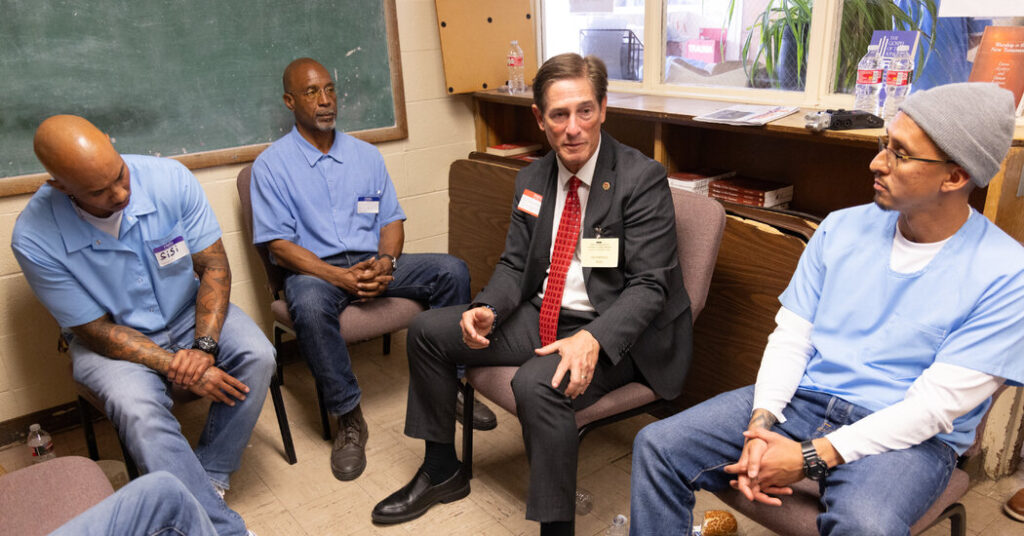
About 60 men in dusky blue work shirts — referred to as “inside people” — congregated with about 20 people in darker business attire — “outside people,” a contingent of district attorneys and their staff members.
It was the first time that Erik Nasarenko, the district attorney for Ventura County, had visited a prison in his 18 years as a prosecutor. Gripping and grinning, he worked the crowd. “What high school did you go to?” he asked one inmate, who was from Long Beach.
“Wilson,” the man said, affably. “For one day. Then I went to juvenile hall.”
Prosecutors rarely visit prisons, and even more rarely converse at length with people doing hard time. This was the second annual such meeting convened by Brooke Jenkins, the top prosecutor in San Francisco, who said that both sides stood to gain from the experience.
Prosecutors could ask prisoners for ideas about what interventions might have prevented their younger selves from committing crimes. And prisoners could tell their stories of redemption to the very officials who might review their requests for parole or a shortened sentence.
The location itself, on a stretch of Bay Area waterfront, was a draw for the outside people. Once the infamous home of California’s death chamber, the prison has undergone a rebrand. Three years ago, its name was changed from the San Quentin State Prison to the San Quentin Rehabilitation Center, where prisoners have access to therapeutic and job training programs and can work on the hit podcast Ear Hustle, The San Quentin News, which is distributed at prisons around the state, or in a soon-to-open cafe.
Prosecutor visits to San Quentin began in 2012 with George Gascón, Ms. Jenkins’s predecessor. Understanding the rehabilitation process helped prosecutors make better decisions, Mr. Gascón said then. For her part, Ms. Jenkins has supported proposals by San Quentin prisoners to ensure that the money they pay to the courts goes to crime victims first — before fines and fees — and for single-occupancy cells, to make prisoners safer and more productive. The first idea became state law, the latter passed in the State Assembly last year.
After bagels and coffee, a microphone was passed around the chapel for introductions. The chief prosecutor for Merced County turned out to be seated between a man convicted of carjacking and another convicted of murder; the acting district attorney for Yolo County was rubbing elbows with a former police officer who had kidnapped and raped women, and a man who had killed his own son.
Many of the residents had worked their way from rougher institutions to San Quentin, where they are encouraged to come to terms with the harm they had caused. Several mentioned their victims by name and made a point of saying they had been “rightfully convicted.”
The day’s chosen moderator, an inside person, invited everyone in the room to take two deep breaths, in unison. “We just heard a lot of accountability,” he said, “and I really believe in self care.”
State prison officials permitted The New York Times to observe the event on the condition that prisoners not be identified, except for a handful who were selected to give interviews.
After a panel discussion, the outside people were given a tour of a new learning complex with floor-to-ceiling windows and benches fashioned from gargantuan wooden beams.
Stephen Wagstaffe, the district attorney of San Mateo County, who has been a prosecutor for 49 years, was attending for the second time.
“In California at large, I’m one that would be described as one of the public safety, law-and-order, harsh types. I fully acknowledge that’s what I am,” he said. But, he added, “This is spectacular. This is what we ought to be doing.”
Mr. Wagstaffe said he did not approve of recent changes to California law that allowed prisoners to seek relief from sentences that can exceed 100 years, even in crimes where no lives were lost.
But he had made one adjustment since his last visit, he said. “I went back to my office and I put in a rule that nobody in my office can request a three-digit sentence without my review and approval.”
He gestured toward a San Quentin resident. “I see people like this gentleman and I think, ‘You know, he doesn’t have to die here.’”
For the next two hours, the inmates and the prosecutors gathered in smaller sessions that one D.A. described as “inmate-led focus groups.” Among the topics: the difficulty of determining when a prisoner is truly rehabilitated, whether prosecutors could hire people with the “lived experience” of having done time, ways to expand prisoner mentoring of at-risk youth, and how to get hip-hop songs, recorded by prisoners and aimed at deglamorizing violence, into the hands of DJs. Prosecutors asked what might have kept the inmates from committing crimes in the first place.
“To be honest, I don’t know if I could have told anything to my younger self to stop the journey that I was on,” said Ryan Pagan, who was serving 77 years for a murder he committed as a teenager. Now, he makes podcasts and documentary films. People had tried to scare him straight, he said, but he did not listen. “I feel like I needed prison.”
Ms. Jenkins protested. “That makes me feel hopeless,” she said.
Jason Jenkins said it might have helped if someone had been around to cultivate his talent for basketball. But his mother had gone to prison for dealing drugs when he was 5, and his father had been shot and killed by the police. “No one ever showed up to my basketball games,” he said.
Taiosisi Matangi, who regularly speaks to high school students as part of a San Quentin mentorship program, said it was more important to listen to kids than to scare them.
If he could talk to his younger self, he would say that the abuse he experienced as a child was not his fault.
“But,” he would add, “we can do something to get you out of there and stop thinking that violence is OK.”
The post Prosecutors Went to Prison to Ask the Prisoners How to Fight Crime appeared first on New York Times.