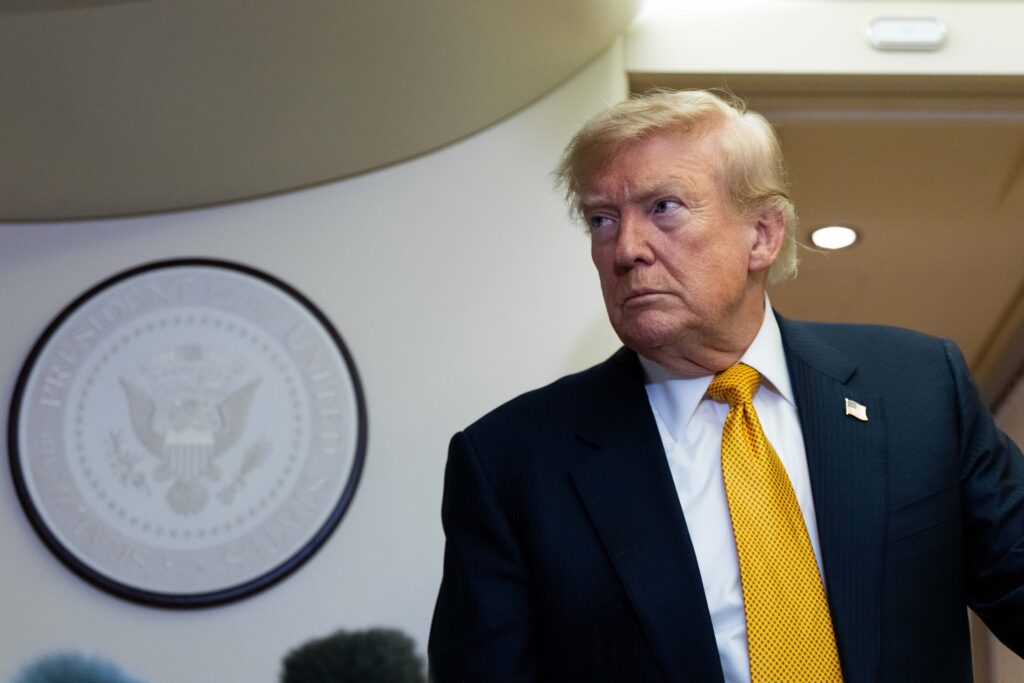
President Donald Trump is warning of a “resurgence of the communist menace” as the Democratic Party shifts to the left, invoking historical memories of terror, collectivization and poverty in a bid to regain voter support ahead of the November congressional elections.
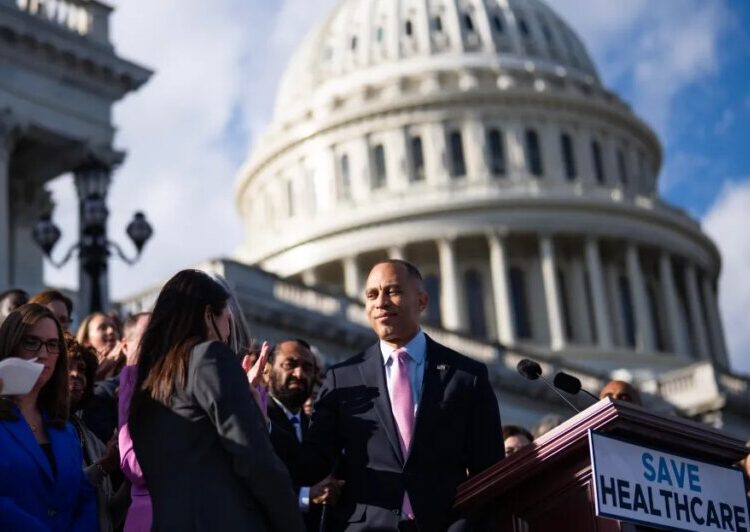
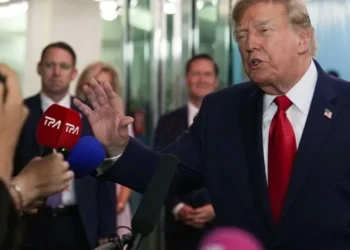
Speaking at last week’s NATO summit in Turkey and earlier in front of Mount Rushmore, the president assailed Democrats as “godless” people and “lunatics” who will confiscate private property and deliver “squalor.” Trump’s attacks have escalated since several candidates aligned with the left-wing Democratic Socialists of America won their June 23 primaries in New York after advocating higher taxes on the rich, rent control, and universal health care.
The president’s apocalyptic language conjures up Cold War images of dictators such as Joseph Stalin of Russia and China’s Mao Zedong, whose economic stewardship produced famines that killed tens of millions of their citizens while immiserating the survivors. If Democrats gain power, Trump has said, “everyone will suffer or die.”
Yet, Trump’s aversion to the heavy hand of the state has not kept him from wielding it himself. The president has had the federal government take partial ownership of nearly two dozen companies since he returned to the White House, including chipmaker Intel and MP Materials, a leading producer of rare earth minerals.
Outside of war or financial crisis, Washington has never been so eager to buy stakes in private companies. Critics warn that state capitalism is a recipe for cronyism, waste and inefficiency. But some businesses are volunteering to partner with the government. OpenAI, which is eyeing an initial stock offering later this year, this month offered to give Washington a 5 percent stake when it lists.
“This is changing the Overton window about the structure of the American economy and the concentration of economic power,” said Stephen K. Bannon, the self-declared economic nationalist who served as White House strategist in Trump’s first term. “The future is populism on the right and populism on the left.”
That’s what worries Scott Lincicome, vice president of general economics at the Cato Institute, a libertarian think tank. Having the government act as an owner, rather than a regulator or tax authority, he said, distorts the economic playing field and leads to companies that aim to satisfy politicians, not customers or shareholders. Likewise, poor-performing government-backed companies that should be allowed to fail may instead be kept alive by regulatory preferences or other government favors, he said.
“Far from being a bulwark against creeping American communism, Trump is laying the groundwork for more of this in the future. The president himself has said that he thinks it’s very American to take these government equity stakes based on what the country needs. It’s almost comical how much that sounds like ‘seizing the means of production’ [or] ‘to each according to his needs’,” said Lincicome, referencing traditional Marxist lingo.
Republicans cite New York Mayor Zohran Mamdani’s call for city-owned grocery stores as evidence of Democrats’ collectivist bent, though the municipal leader says he is aiming for increased competition, not a government monopoly.
Trump’s anti-communist critique lumps together what he sees as Democrats’ cultural and economic beliefs, according to a White House official who spoke on the condition of anonymity to discuss the president’s thinking.
To the president, prominent Democrats’ endorsement of wealth taxes, including on unrealized capital gains; rent control; Medicare-for-all; and the “Green New Deal” demonstrate an anti-market philosophy. Likewise, support for transgender rights and a belief that White people oppress minorities constitute a pseudo-Marxist intellectual framework, the official said.
Polls show growing support for socialist-backed policies, though not socialism itself.
Just 8 percent of Americans call themselves “socialists,” according to a recent Economist/YouGov poll. By more than two-to-one, respondents said capitalism is a better economic system than socialism.
But majorities of those surveyed back government-provided health care as a replacement for private insurance, as well as free college tuition and public housing. By 39 percent to 35 percent, poll respondents favored a bigger government providing more services over a smaller public sector doing less.
Trump’s embrace of government ownership represents a break with Republican economic orthodoxy, and is drawing some unexpected reactions.
Bannon, one of the most prominent voices in the Trump-supporting media, said he is “100 percent against government ownership” of private companies. Instead, he wants major artificial intelligence companies to give half of their shares to “John Q. Public,” he said.
“People need actual equity ownership. Citizens, not the government, need ownership,” he said in an interview.
Sen. Bernie Sanders (I-Vermont), a socialist and Trump foe, has introduced legislation requiring AI-related companies with more than $200 million in annual revenue to hand over half their stock to the government. The shares would be held in a new sovereign wealth fund that would distribute an annual dividend of $1,000 to each American.
Washington’s investment portfolio encompasses steel, semiconductors, quantum computing, nuclear power, rocket motors and minerals. The nearly two dozen deals that the administration has announced are worth about $60 billion, according to Peter Harrell, a former Biden administration official who is now a visiting scholar at Georgetown Law School.
Administration officials have indicated they plan additional investments. By the end of the president’s term, the taxpayer could hold stakes in up to 200 companies, Harrell said. Officials have released scant information about the legal authority for the transactions or their details, he said.
“What I actually find most troubling about the Trump equity deals is the way they are completely opaque and non-transparent. We’re talking about a fairly significant thing the Trump administration is doing at this point, not just a onesie or twosie,” he said.
In May, the Commerce Department signed letters of intent to provide more than $2 billion to nine quantum computing companies in return for minority stakes. The signings were the latest indication of the Trump administration’s remaking of the CHIPS and Science Act, a 2022 bill designed to promote greater domestic semiconductor production.
Under President Joe Biden, the government provided billions of dollars in grants for chipmaking production and research. Trump has converted some of those grants to equity stakes.
He struck his first ownership deal in July 2025, when the government put up $400 million for 15 percent of MP Materials, a critical node in Washington’s efforts to re-create a rare earths supply chain. The U.S. currently depends on China to supply the minerals, which are needed to make products such as electric vehicles and jet fighters.
One month later, Trump obtained a 10 percent share of chipmaker Intel after the president publicly criticized Lip-Bu Tan, the company’s CEO, and suggested he be fired. Tan emerged from a private White House meeting a few days later having agreed to surrender a minority stake to the government as the president crowed on social media: “I PAID ZERO FOR INTEL.”
To critics, it looked as if the president had made the company an offer it couldn’t refuse. In March, Richard D. Paisner, an Intel shareholder, sued the company, its board of directors and Commerce Secretary Howard Lutnick, alleging that the company had given the government “$11 billion worth of Intel stock for no meaningful consideration in response to extortionary threats by the government.”
All of the companies that agreed to equity deals with the government did so “voluntarily,” the White House official said.
Intel’s share price has soared to $112 from around $20 when the deal was reached, securing a nice profit — on paper — for the U.S. government. But the terms of Trump’s deal give the government no control over Intel’s decisions, unlike arrangements that the president has reached with other companies, said critic Todd Tucker, director of industrial policy and trade for the Roosevelt Institute, a left-of-center think tank.
In the Intel deal, the government agreed to vote as directed by the board. But when Trump approved Nippon Steel’s acquisition of U.S. Steel last year, he demanded a “golden share” giving him veto rights over relocation of the company’s headquarters, plant closings and capital investments. The power is more than theoretical: In September, the president used the golden share to block the closure of a steel plant in Granite City, Illinois.
Biden also pursued industrial policy, including securing more than $1 trillion for infrastructure improvements. But his business-as-usual approach did not deliver visible results in time to reap electoral rewards. Trump deserves credit for taking a more direct approach, Tucker said, rather than trying to influence corporate behavior via traditional methods of regulation, antitrust enforcement or taxation.
“It kind of gets over that problem that Biden and previous administrations have had, which is that you have to move quickly if you want the American public to see what you’re doing. You need to be able to execute quickly,” he said. “This tool of equity stakes is one way to do that.”
The post Trump attacks ‘communists.’ Both want a bigger government role in the economy. appeared first on Washington Post.