The endless security lines at the airport may seem torturous — but they are child’s play compared with what heretics and criminals faced in the Middle Ages. Medieval torture was used both to extract confessions and to punish the convicted before execution. Torturers (who were often clergy) had a huge tool kit with which to practice their bleak black arts.
Nowadays, ridiculous torture exhibits are cleverly marketed all over Europe. They’re equipped with scary and gory gear — but most of it isn’t genuine. The purveyors make lots of money by appealing to the lowest desires of dumbed-down travelers willing to pay $15 to ponder the creative ways in which people have maimed and mutilated others through the ages.
But in a handful of places, more thoughtful displays can be an insightful (if creepy) window into medieval criminal justice. At the Tower of London, for example, instructive exhibits re-create the Tower’s bloody history of torture and execution. Standing high above the rest of old London, the Tower was a gleaming reminder of the monarch’s absolute power over his subjects. If you made the wrong move here, you could be feasting on roast boar in the Banqueting Hall one night and chained to the walls of the prison the next.
The limb-stretching rack was a favored device in the Tower. Like many instruments of torture, the threat of the device could be almost as effective as actually using it. Just the sight of the rack intimidated many a prisoner (guilty or not) into making a full confession. If you visit the Tower of London, be sure to take one of the included tours, led by a beefeater guide who tells the Tower’s history with macabre enthusiasm.
The Medieval Crime and Justice Museum in Rothenburg, Germany, specializes in everything connected to medieval criminal justice: the police, criminal law, and instruments of punishment and execution. In the Middle Ages, European courts considered torture to be a legitimate way of extracting confessions, names of accomplices or the details of a plot — typically relating to the crime of treason against a king or nobleman. When it came to the Inquisition, the Church saw deviations from its doctrines as a treason against God — the King of kings — and in that way justified its own use of torture.
In southwest France, the fortress called Maison Forte de Reignac is scenically tucked into a rock face high above the Vézère River. Seen from the outside, you wouldn’t suspect that its rooms catalogue more than 60 instruments of torture. On view is an “iron maiden,” a coffin-shaped box lined with iron spikes. A variant was the torture chair, covered in spikes.
This harsh medieval justice was tinged with superstition. Petty sinners were publicly humiliated: Bakers who turned out undersize loaves were consigned to ridicule in the baker’s chair — a too-small metal chair. An iron mask with a mouth clamp stilled the tongues of libelers and nags. Drunkards were outfitted in a barrel and made to parade up and down the streets to proclaim their sorry ways.
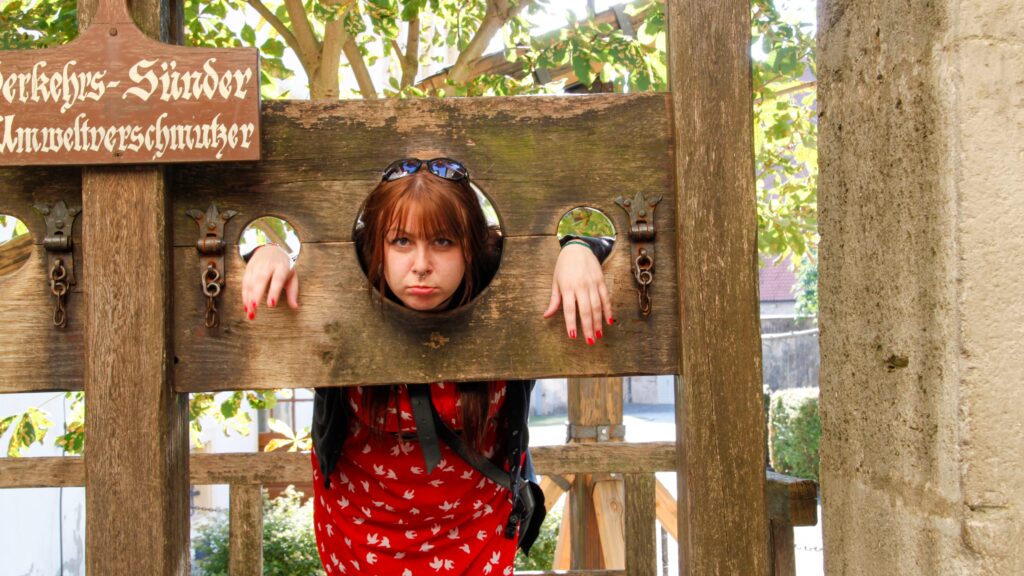
More serious offenders would be dragged to the churchyard to face a “trial by ordeal.” To decide their guilt or innocence, alleged criminals might be forced to grab a red-hot iron or pull a stone from a cauldron of boiling water. If they were unharmed, they were innocent. If it hurt like heck, they were really punished — whipped, tortured, locked into wooden stocks or pillories, or simply executed. Today’s tourists will encounter stocks and pillories set up as props for photo ops — a far cry from their original punitive purpose.
A fortress, Belgium’s grim and sturdy Gravensteen, was designed in 1180 by its prince to intimidate the citizens of Ghent. Today, visitors to this torture museum can view instruments of “persuasion,” some of which were employed at the castle and even on the road. Because it’s small and portable, the finger screw was a favorite of traveling medieval interrogators. Another display shows how waterboarding was practiced in the Middle Ages. Jailers poured liquid down the throat of the prisoner. The modern variation could be described as “slow-motion drowning.”
What do these displays (and our fascination with them) say about humankind? Medieval or modern, human cruelty and torture haven’t gone away. Today, although 146 members of the United Nations have ratified an international convention against torture, it is practiced around the globe.
When we visit medieval torture museums in Europe, we can marvel at how far civilization has progressed since the Dark Ages, but we also see how much further we still have to go.
This article is used with the permission of Rick Steves’ Europe. Rick Steves writes European guidebooks, hosts travel shows on public TV and radio, and organizes European tours.
The post 4 torture museums in Europe that will spook even history buffs appeared first on Washington Post.