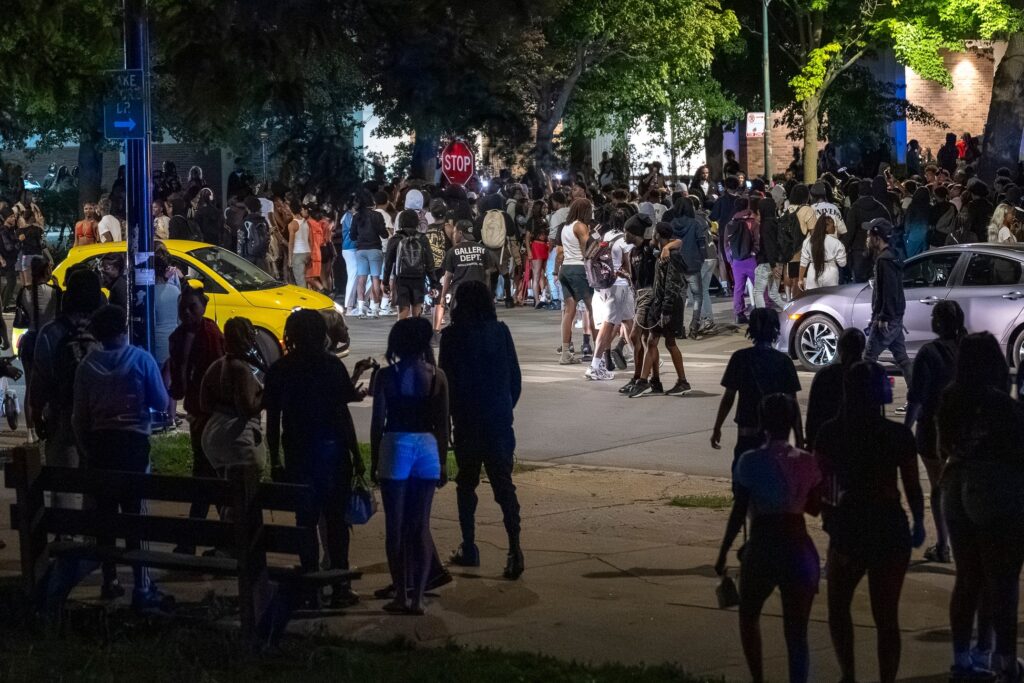
RALEIGH, N.C. — The scene unfolding outside his patrol car at 1:30 a.m. on Sunday startled even the veteran police chief.
“It was chaotic,” Chief Rico Boyce recounted to city leaders at a public meeting days later. “Something I had never seen in my 26 years here at the Raleigh Police Department.”
Authorities had planned for large crowds in North Carolina’s capital over the holiday weekend, Boyce said, but this went beyond that. He described hordes of rowdy young people — police estimated as many as 8,000, many juveniles, many from outside the city — that gathered first in one commercial area, then converged later on another known as Glenwood South.
What followed was a night marred by disorder and violence, one that police say left nine people injured by gunfire, led to the seizure of nearly a dozen guns, resulted in 29 arrests of young adults and delinquency cases against multiple minors. The scenes soon spread across social media and news coverage of overflowing sidewalks and streets, of shouting and cursing, of blaring sirens mixing with blaring music, of crime scene tape and people face down being handcuffed.
Boyce, who described the episode as “heartbreaking and unacceptable,” said he leaped to break up a fight at one point, only to discover one of the youths involved had a gun.
“We were prepared for the crowd size,” Boyce said this week, as he and other city officials grappled with how to head off a repeat of the mayhem. “What we were not prepared for was the amount of firearms we were recovering off individuals.”
Raleigh is among the latest places to wrestle with so-called “teen takeovers,” events largely coordinated over social media that result in swarms of young people flocking en masse to public places such as a downtown area, mall or park.
The gatherings — and the turmoil that sometimes accompanies them — have caused alarm, bewilderment and an array of responses in cities around the country.
Among commentators on the right, they have become a symbol of the breakdown of law and order in cities, a failure of teen parenting and the corrosive power of social media. But some researchers have warned that the incidents that garner widespread news coverage are the exception, and that as in the past, most youth gatherings are largely nonviolent events that pass with scant attention.
Still, violent incidents have continued to generate headlines around the country.
In Newport Beach, California, police officers on July 4 clashed with a crowd after “social media posts drew a large influx of juveniles and young adults” to the area, according to the city. Video of the dramatic scene showed officers, some on foot, others in vehicles or on horseback, charging the crowd as people scattered. City officials said the incidents resulted in the arrests of 402 people.
Pittsburgh has been dealing with a recent series of unruly gatherings, including last holiday weekend, when more than a hundred young people were fighting and shot fireworks at each other and police.
And in Pensacola, Florida, last weekend, a 19-year-old man was fatally shot and six other young people were injured amid a massive late-night gathering downtown.
Under pressure to do something, local leaders around the country are struggling to enact measures that ensure public safety, yet also acknowledge that most young people are not lawbreakers but instead need places to gather in more constructive, less disruptive ways.
There is no consensus on what comprises a “teen takeover,” said Almethia Franklin, a sociologist at Concordia University in Chicago, who has drafted a working paper on the takeover phenomenon.
Franklin’s basic definition is some combination of crowd size and social media: hundreds of teenagers drawn to a single location by fliers or announcements distributed online.
The events give a generation of young people, many of whom grew up during the lockdowns of the covid-19 pandemic, a chance to socialize offline, said Lily Robin, a senior researcher at the Urban Institute.
“A lot of kids that have been interviewed talk about it: They just want to be out in public, outside, socializing — not online,” Robin said. “With the pandemic, I think a lot of kids missed out on that for a long time.“
Robin also noted that attracting large crowds has become easier than it once was.
“Technology and social media are allowing kids to organize across so many people,” Robin said. “The ability to do it exists now and didn’t exist in the past.”
Franklin, who has attended takeovers in Chicago, said teens overwhelmingly come not to be violent, but because they are bored with community spaces in their neighborhoods. But if a takeover does get out of control, Franklin said, it allows some to flex their rebelliousness. “When something disruptive happens, it becomes the draw,” she said.
Portrayals of the events in media coverage often carry racial undertones, she added, noting that large gatherings of teens have long provoked angst in cities. In the late 1980s, the rape of a jogger in Central Park spawned the term “wilding,” or setting out to deliberately commit crimes and spread fear, even as the teens accused in the incident were later exonerated. Gatherings of young people in the 2010s were often dubbed “flash mobs.”
“Because it’s Black youth gathering, because it’s Brown youth gathering, we see it as being a threat,” she said of teen takeovers, adding that the prevalence of online videos today have made recent gatherings even more conspicuous. “It’s a new word, but it carries the same type of responses.”
The phrase’s surge in popularity appears to have been fueled in part by a sudden spike in online mentions this year among high-profile conservative politicians, commentators and influencers, according to a Washington Post analysis.
The terms “teen takeover” or “street takeover” were almost completely absent from the online conversation as this year began, but discussions of the topic have surged in recent months. Mentions of teen takeovers were more than 17 times more common among prominent right-leaning political figures than they were among liberals, the analysis found.
As with earlier iterations of youth gatherings, many cities have responded by adopting curfews, though Robin said there is a lack of evidence that approach meaningfully reduces crime.
Still, public officials have vowed crackdowns on violent behavior.
“We are taking a zero-tolerance policy on this,” Tampa’s police chief, Lee Bercaw, warnedlast month after a slew of arrests at a recent takeover. “There are better choices out there.”
Some cities are experimenting with ways to entice teens toward those better choices.
Chicago, where a proposed curfew was vetoed by Mayor Brandon Johnson (D), has hosted late-night basketball games and a block party. In Tampa, organizers in recent months have promoted numerous late-night alternatives to takeovers, including a video game competition and supervised sports games. In South Fulton, Georgia, officials launched a free “Lit Teen Takeover” festival with food trucks and a live DJ.
Newly elected Detroit mayor Mary Sheffield (D), in addition to enforcing a curfew, held a meeting with organizers of a large teen takeover in April and formed a youth advisory board. The city offered 16-year-old Danasha’ Tidwell, one of the teens behind the takeover, an internship.
Tidwell soon helped teens take over the downtown again, but this time, the city helped. Tidwell and some friends planned a “kickback” along the Detroit River — with free food, local rappers and a DJ. The city lined up sponsors to foot the bill and sent police to supervise.
Separately, Detroit has pumped another $1.5 million toward programming for 10 summer Fridays, including a bike giveaway and an entrepreneur contest inspired by “Shark Tank,” the reality TV show. Nine recreation centers are staying open until 11 p.m., and the city sponsored a late-night basketball league.
“They want to be seen. They want to be heard,” Sheffield said of the teens. “They need more positive outlets and productive things to do.”
Back in Raleigh, city leaders this week were trying to walk a line that so many of their urban peers have navigated recently.
On the one hand, they made clear what happened last weekend could not become the norm. “It’s unacceptable and really won’t be tolerated here,” said Raleigh Mayor Janet Cowell (D), who said she is willing to use her authority to impose an emergency youth curfew until the city likely adopts one later this summer.
Raleigh’s police department said it plans to “continuously monitor social media platforms” as part of a broader plan to be aware of and respond to future gatherings.
Boyce, the police chief, advocated for a curfew. But even he acknowledged that research shows curfews “are not a single solution,” and that a crackdown on unruly crowds must be accompanied by more creative options.
“We want to provide opportunities so that young adults or teens can find their ‘why,’ find something that allows them to thrive, not just survive,” Stephen Bentley, Raleigh’s parks and recreation director, told council members.
On Thursday evening, the pandemonium that had descended on Glenwood South over the Fourth had given way to calm. People walked dogs and rode bikes down the strip. Revelers came and went in small groups from beer gardens and half-empty clubs.
Angel Garcia said he hoped the coming weekend would be better than the last. A manager at a lounge known as Bodega, Garcia said the chaotic scene had cost his business and others significant income.
He also worried that coverage of the violent episode would keep customers away from the area. Garcia had gone to the city meeting days earlier to show support for a youth curfew, for some assurance of order.
“I hope it doesn’t happen again,” he said. “It’s something we aren’t used to here. It’s not normal.”
The post ‘Teen takeovers’ confound cities struggling to define the problem — and find solutions appeared first on Washington Post.