The Israeli settlers had guns and Representative Ro Khanna was scared.
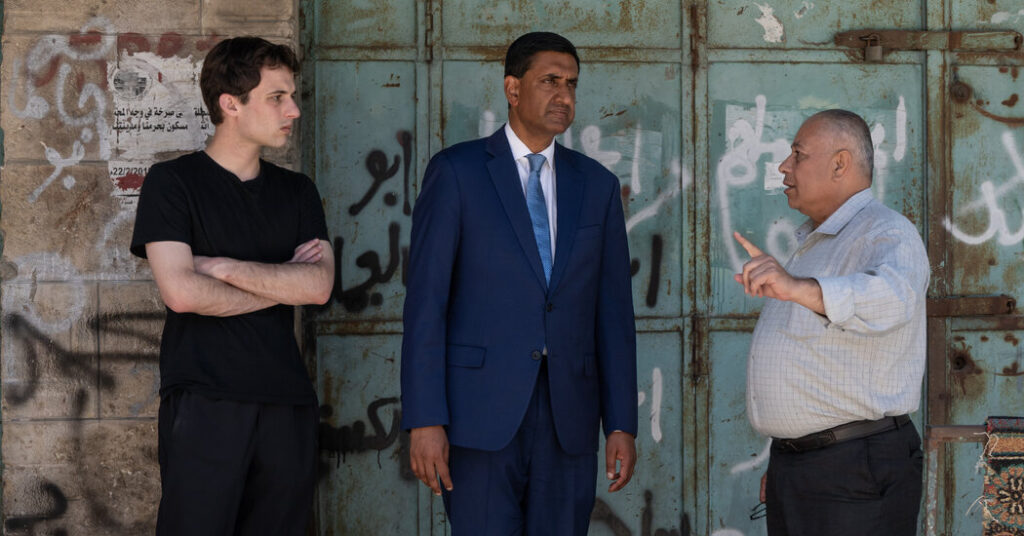
On Wednesday afternoon, Mr. Khanna, the congressman from Silicon Valley who is exploring a 2028 presidential run, was visiting the ruins of Khirbet Zanuta, a tiny Palestinian Bedouin village in the southern West Bank that was abandoned after escalating attacks from settlers and then demolished.
Suddenly, a car of men holding guns pulled up and blocked the narrow road out of the village. The men began taunting the congressman and his team, swearing at them in Hebrew and Arabic and kicking the tires of their minibus, according to accounts, photographs and video footage from Mr. Khanna, an aide and his security guard. A photographer for The New York Times traveling in a different vehicle also saw the interaction. Soon, a Jeep with more men arrived.
When two cars from the Israeli military pulled up, Mr. Khanna assumed the soldiers were there to help him pass. Instead, the soldiers smoked cigarettes, chatted with the men and after the settlers left, moved a car to block the road, he recounted.
“I felt powerless in that situation, which is not an easy thing, as I have a lot of privilege in life,” said Mr. Khanna, who was eventually allowed to continue his journey after calls to the U.S. embassy and Israeli police. “Imagine how people feel every day, Palestinians under the occupation, if they could make an American congressperson feel powerless for 90 minutes.”
Mr. Khanna said the experience was the most frightening part of a three-day trip organized by a member of his staff. Representatives of the Israeli military did not immediately respond to a request for comment.
At a time when Israel is hemorrhaging support among Americans and particularly among Democrats, a tour of the West Bank is a new way for progressive politicians to signal their concern.
For decades, potential presidential aspirants made pilgrimages to Israel in hopes of burnishing their foreign policy credentials. Their trips followed a familiar itinerary: meetings with Israeli political leaders, sightseeing at the Western Wall, a tour of an Israel city damaged by Palestinian rocket fire and visits with Palestinian leaders in Ramallah, a city in the West Bank. The goal was to demonstrate their commitment to the United States’ special relationship with a longtime ally.
But where past Democratic leaders headed to the region to show their support, so far today’s Democratic presidential aspirants are going to bolster their credentials as critics.
Mr. Khanna said what he observed in the West Bank would inform his politics and perhaps his run for president. If he mounted a campaign, Palestinian rights would be a key focus, he said.
“I have something unique to offer about the injustices of Palestinians,” he said “I’m going to go to every corner of America, regardless of whether I run or not, and tell their stories and tell the story of what is happening in the West Bank.”
Violent attacks by Israeli settlers on Palestinians in the West Bank have intensified since the Hamas-led attack on Israel on Oct. 7, 2023, that set off the war in Gaza. The responses of the Israeli authorities have generally ranged from unkept promises to address the problem, to blame shifting, to outright denial.
As Mr. Khanna was being blocked by settlers in the West Bank, Rahm Emanuel, another potential presidential candidate, was speaking at Tel Aviv University, where he delivered his own critique of Israel and “a 23-state solution” for Israel and all the Arab nations. He had been invited to give a speech at the university and also met with leaders in the country.
“The prime minister and his government have led Israel into a dead end,” said Mr. Emanuel, the former Chicago mayor and White House chief of staff, who called for an end of U.S. military aid to the country.
Opposition to Israel has emerged as a key factor in midterm races from Michigan to New York, as a progressive wing has positioned the issue as a central moral test for Democratic candidates. The visits this week by Mr. Khanna and Mr. Emanuel indicate that presidential aspirants are preparing for America’s relationship with Israel to become a litmus test in 2028.
Democratic voters are now more likely to be critical of Israel and its government than they are to be supportive, according to several recent polls, a monumental change in American sentiment.
Mr. Khanna, too, has shifted on the issue. He has visited Israel three times, including in October 2024 as part of a bipartisan delegation that met with Prime Minister Benjamin Netanyahu and King Abdullah II of Jordan.
Mr. Khanna says he still supports Israel’s right to exist as a Jewish state, but criticism of the country has become increasingly central to his public image. He has repeatedly accused the country of genocide and endorsed calls to cut off U.S. support even for the Iron Dome missile-defense system.
Last month, Mr. Khanna went from a target of Track AIPAC, a group that opposes the American Israel Public Affairs Committee, to winning its endorsement in his race for re-election this year.
What he saw in the West Bank, Mr. Khanna said, convinced him that the region’s problems won’t be solved just by replacing the Israeli leadership.
“One of the things it’s made me realize is how hard a two-state solution is going be in practice, that it’s going require the removal of a lot of violent settlers,” he said. “The on-the-ground reality is so much more brutal and hard and difficult.”
On his trip, Mr. Khanna visited a number of Palestinian towns and met with families and local business owners. The mayors of Bethlehem, Beit Shair and Beit Jala described the restrictions on their freedom of movement and access to water. They told Mr. Khanna that they had never met a member of Congress, according to video recorded by his team, and would welcome his colleagues.
In the southern West Bank village of Umm al-Khair, he met with the family of Awdah Hathaleen, a well-known Palestinian activist whose work was featured in the Oscar-winning documentary “No Other Land,” and who was killed by an Israel settler. On his final day, he visited a school where a 14-year-old was gunned down in broad daylight by a settler and met with Palestinian Americans, who described stories of being beaten and threatened.
Mr. Khanna, who is Indian American and grew up in Pennsylvania, said he had never been so aware of his race as on this trip.
“In Palestine, I felt first as someone who was brown,” he said. “We really saw the apartheidlike conditions, the inequality.”
He added: “No American would support this if they knew the details of what was going on here.”
Mr. Khanna’s trip was organized by Cameron Kasky, a Parkland school shooting survivor, who ran for Congress with a platform of opposing what he called Israel’s genocide in Gaza. Mr. Kasky, 25, withdrew from the race to work with Mr. Khanna on combating settler violence in the West Bank. He now works for Mr. Khanna on digital strategy.
The idea of the trip grew out of an interview that Mr. Khanna did with Jasper Nathaniel, an independent journalist who focuses exclusively on the West Bank.
Daniel C. Kurtzer, a Princeton professor who was ambassador to Israel under President George W. Bush and has been involved with trips for U.S. dignitaries, said Mr. Khanna had apparently received a particular view of the region.
“He got an earful in the company of people who, I would say, are probably not objective analysts,” said Mr. Kurtzer.
But Mr. Khanna described the visit as an “uncurated,” “Palestinian-led” glimpse into the West Bank and is one he believes more members of Congress — and potential presidential candidates — should experience.
He also left with some parting words for the Israeli government.
“Free advice to the Israelis: It’s not a good idea to detain long-shot presidential candidates,” he said. “Not how you’re going to build good will with the next American president, whoever that is.”
The post An American Politician is Blocked by Israeli Settlers in the West Bank appeared first on New York Times.