Regarding the July 7 front-page article “White House report heavily critical of Smithsonian”:
Sixty-one years ago, I began my museum career as a curator at what is now called the National Museum of American History (NMAH). Much has changed in the United States since then. What hasn’t is the professionalism and dedication of the American museum community.
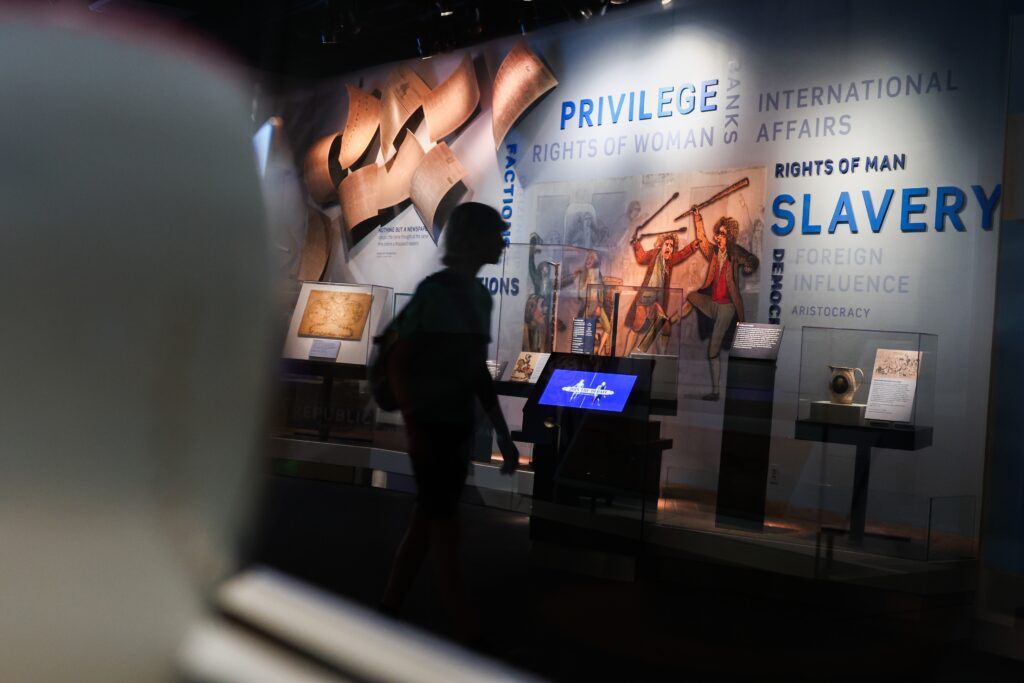
The White House’s report, “Saving America’s Story,” is just the most recent attack on the Smithsonian Institution. It incorrectly claimed that the NMAH “erases our heritage” when in fact it helps Americans understand the diversity that has powered the nation’s evolution.
The Smithsonian and the NMAH do not serve one party or one ideology, nor do they act as the propaganda arm of the left or right. They serve all Americans by telling the nation’s story using the historical material they preserve and interpret with rigorous scholarly research.
All Americans should therefore be concerned by efforts to control how we understand our past and present. We should reject attempts to bludgeon the Smithsonian into something not representative of our country’s ideals.
Robert R. Macdonald, Mt. Pleasant, South Carolina
The writer is a director emeritus of the Museum of the City of New York and a former president of the American Association of Museums.
Regarding Philip Kennicott’s July 7 Style column, “A clear-eyed view of U.S. history”:
When I moved to the DMV in the 1980s, I spent many weekends exploring the Smithsonian museums. One of my favorites was the National Museum of American History. At the time, it had two spectacular exhibits: “We the People” about American political campaigns and “A Nation of Nations” about how immigration has enriched our country. I would take out-of-town friends there to see those exhibits, which are now long gone. Last year, I revisited the museum and was aghast. The intelligence and comprehensiveness of those exhibits have been replaced with simplistic leftist drivel.
I would never take a visitor there now. Kennicott’s viewpoint seems to have missed the forest for the trees. Many of those sadder trees are well documented in other Smithsonian museums, but the National Museum of American History should focus on the forest of American ideals.
Glenn Ackerman, Fairfax
U.S. founded on these principles
Dale Butland’s July 5 letter to the editor, “Follow the founders,” pointed to a small segment of Article 11 in the Treaty of Tripoli, ratified in 1797, as a “dispositive statement” proving the United States was not founded as a Christian nation. The intent of Article 11 was to stipulate that the United States was not a Christian theocracy and would not wage war on Tripoli solely because it was a Muslim nation. Just as important, the 1797 treaty was superseded by the Treaty of Peace and Amity in 1805, which omitted the language.
The fact remains that the U.S. was founded on Judeo-Christian principles. This is made evident, for example, by the clear and deliberate language in the preamble to the Declaration of Independence (i.e., “all men are created equal, that they are endowed by their Creator with certain unalienable Rights”); the official motto of the United States, “In God We Trust”; and the assignment of the first chaplain to the Continental Congress in 1776. George Washington also recognized the importance of religion. His farewell address stated: “Of all the dispositions and habits which lead to political prosperity, Religion and Morality are indispensable supports.”
It’s not mere happenstance that freedom of religion is codified in the First Amendment. A constitutional republic such as ours relies on moral codes that have their basis in religion, specifically the Judeo-Christian principles upon which the U.S. was founded.
Chris Bahret, Alexandria
World Cup could elevate American football
The 2026 World Cup grass rollout is a subsidized proof-of-concept for the National Football League.
NFL Players Association data has shown injuries occurring at a slower rate on natural grass fields as opposed to artificial turf, and 92 percent of players prefer grass. The NFL mandated that playing surfaces meet enhanced safety standards by 2028. Yet stadiums maintain artificial surfaces for lucrative non-football events. Turf may be financially beneficial. So is a roster of healthier starters in December.
The immovable roadblock to sustaining indoor natural grass has long been the required capital expenditure. The World Cup eliminated this. FIFA-funded research positions NFL owners to upgrade suboptimal artificial surfaces with vacuum ventilation and transportable trays for roughly $2 million per field. A $2 million infrastructure upgrade is a marginal cost to mitigate injury risk to a roster into which hundreds of millions are invested each season.
Infrastructure built for global sporting events rarely yields lasting value. This World Cup can buck that trend by leaving behind a surface that elevates American football as well.
Peter Gariepy, Richmond Heights, Missouri
Letter submissions
Send letters to [email protected].
Submissions must be exclusive to The Post and should include the writer’s address and day and evening telephone numbers. Letters are subject to editing and abridgment. Please do not send letters as attachments. Because of the volume of material we receive, we are unable to acknowledge submissions; writers whose letters are under consideration for publication will be contacted.
Post Opinions wants to know: What do you wish you had known earlier? What nuggets of wisdom, gleaned from years of experience, would you share with your younger self? Send us your response, and it might be published as a letter to the editor.
The post The Smithsonian serves all Americans appeared first on Washington Post.