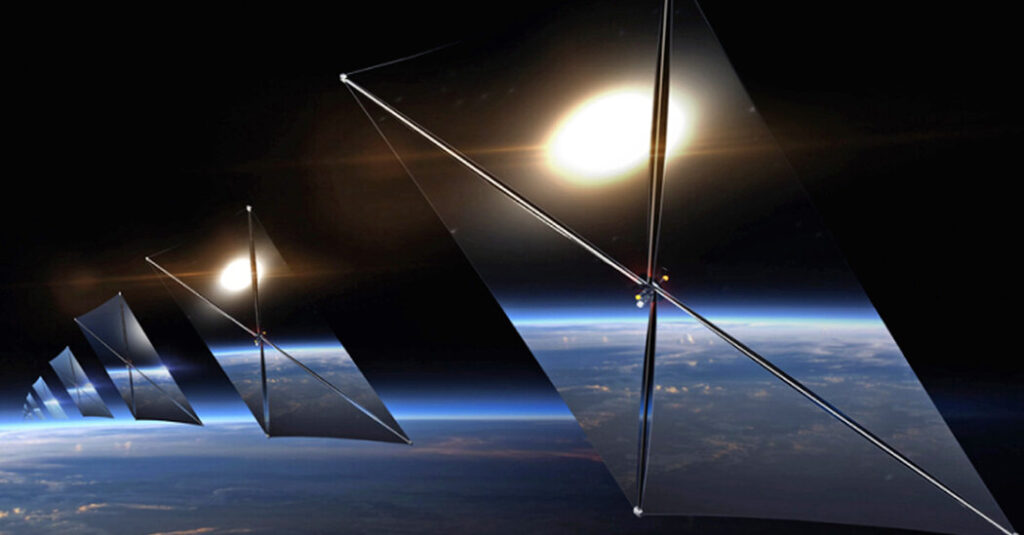
The federal government has approved plans by a start-up company to test a satellite that would use a 60-foot mirror to reflect sunlight back to Earth after dark, as part of a project the company says would power solar farms, provide light for rescue workers and illuminate city streets.
In a license issued on Thursday, the Federal Communications Commission gave the green light for Reflect Orbital of Hawthorne, Calif., to launch its Eärendil-1 satellite into low Earth orbit. The company plans to deploy its test satellite this year but has said it eventually wants to send as many as 50,000 big mirrors into space.
The approval came despite a flood of opposition from astronomers, wildlife experts and others who say the light from the mirrors could distract airplane pilots, wreak havoc on astronomical observations and interfere with circadian rhythms, the light-and-dark cycles that help people, animals and plants know when to wake and sleep, to bloom or to migrate.
“It’s terrifying to me that one country can change the night sky for everybody in the world,” said Samantha Lawler, an astronomer at the University of Regina in Saskatchewan, Canada. “I need access to dark skies in order to do my research. If you’ve got giant mirrors shining down, then we’ve lost that.”
In a letter to the F.C.C. sent last month, the American Astronomical Society, said the endeavor “cannot be considered to serve the public interest” and in fact would waste taxpayer dollars by wrecking the work of federally funded astronomical facilities, even as it brought untold risks to people and wildlife.
“It is clear that the activities that Reflect Orbital is proposing will have an impact on the Earth environment, including on human health, agriculture and wildlife, in addition to astronomy,” Roohi Dalal, the society’s director of public policy, wrote.
Roughly the size of a dorm fridge, Reflect Orbital’s first prototype, once in space about 400 miles up, would unfurl a square mirror nearly 60 feet wide. The mirror would bounce sunlight to illuminate a circular patch about three miles wide on the Earth’s surface.
Reflect Orbital hopes to launch 1,000 larger satellites by the end of 2028, and 5,000 others by 2030. The largest mirrors are planned to be nearly 180 feet wide, reflecting as much light as 100 full moons.
The F.C.C. stressed, however, that it was approving only “a single demonstration satellite” that would test a technology that could advance American leadership in outer space. “Reflect Orbital’s demonstration satellite is an example of a potentially groundbreaking technology,” the commission said in its order granting the license.
The wider concerns over the project lay beyond the purview of the commission, which issues the licenses needed to deploy satellites, the F.C.C. said. In reviewing satellite applications, it generally checks to ensure that a spacecraft’s radio communications do not create interference problems for others, and that the vessel will be safely disposed of at the end of its operational lifetime.
The federal government’s overall stance is that activities in space are not subject to environmental regulations and review, which apply only to Earth. “Even if the commission had authority to review and condition these operations (which it does not), these harms are unlikely to occur,” the F.C.C. said.
Ben Nowack, Reflect Orbital’s co-founder and chief executive, said in a statement that he was “grateful to the F.C.C. for recognizing the importance of testing novel technologies in space.” The mission would enable Reflect Orbital to test and collect data on both the satellite and deployable mirror, as well as the “built-in safeguards governing precisely how, where and when its service is delivered.”
The license was “the first step toward rigorously testing our technology’s efficacy and the safeguards we have developed,” he said. “We’re excited to demonstrate how our technology works and to introduce transformative, clean technology the world urgently needs.”
The approval follows other contentious decisions by Brendan Carr, the chairman of the F.C.C. He has been a huge supporter of the space industry, backing SpaceX and Amazon’s plans to launch thousands of satellites for space-based internet connectivity. He has also moved to loosen regulations for telecommunications and media companies, describing the F.C.C. as too big and heavy-handed with rules.
Mr. Nowack said in an interview in March that the company would charge about $5,000 an hour for the light of one mirror if a customer signed an annual contract for at least 1,000 hours. Lighting for one-time events and emergencies, which might require numerous satellites and more effort to coordinate, would be more expensive. For solar farms, he envisions splitting revenue from the electricity generated by the additional hours of light.
He said that Reflect Orbital’s satellites could be a tool to reduce the burning of fossil fuels and thus slow climate change. One of the biggest weaknesses of solar power is that electric generation stops when the sun sets, although batteries are enabling the ability to tap into stored solar power after dark.
The satellite could accelerate construction projects, with crews working more safely through the night, and farmers could grow more food per acre, the company said.
It’s not the first time someone has thought of reflecting the sun’s light onto the Earth at night.
In 1993 a Russian satellite carrying a mirror about 80 feet wide briefly reflected a narrow beam of sunlight across the planet as part of an experiment to extend daylight hours in Arctic Siberia. But the Russians abandoned the project less than a decade later, after a subsequent test flight failed.
Cecilia Kang and Kenneth Chang contributed reporting.
The post F.C.C. Approves Test of Space Mirror to Light Night Sky Despite Outcry appeared first on New York Times.