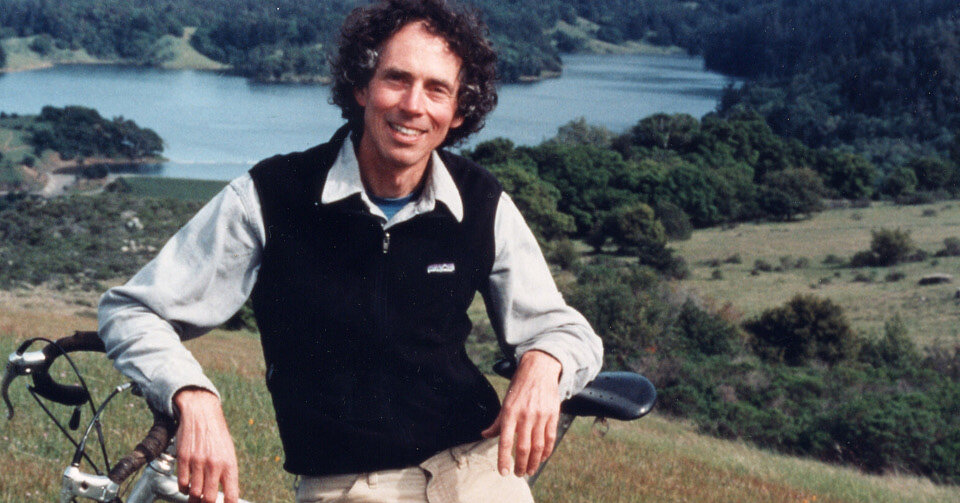
Charlie Cunningham, a pioneer of modern mountain biking who viewed bicycles as a means of combining technology and nature in a friendly symbiosis that the automobile could never match, died on June 2 in San Anselmo, Calif., north of San Francisco. He was 77.
His death, at a care facility, was from complications of a 2015 biking accident in which he sustained severe head trauma, said his wife, Jacqueline Phelan, a writer and former national off-road biking champion who is his only immediate survivor.
While cyclists have ridden on dirt roads and trails since the 1800s, the era of modern mountain biking began in the late 1960s and early ’70s. In Marin County, Calif., enthusiasts bombed down unpaved fire roads on what were known as klunkers — single-speed cruisers with balloon tires.
As the sport became more sophisticated, bikes began to be built specifically for off-road terrain. The term “mountain bike” was coined, and downhill races were organized. Mr. Cunningham, who had a background in engineering, joined other germinal figures in the sport — including Gary Fisher, Joe Breeze, Tom Ritchey and Charlie Kelly — in creating innovative designs and developing this emerging branch of cycling.
Starting in 1978, he built the CCproto, which is considered the first mountain bike with an aluminum (rather than steel) frame, made of oversized tubes that were light and strong. His other innovations in off-road biking included knobby tires built for traction and control; a unique braking system that allowed for controlled stopping; and a patented lubrication system that flushed out old grease, water and dirt from a bike’s sealed bearings, injecting fresh grease.
“To put it bluntly, if it had to do with mountain bikes and it was either invented or became popular before 2000, there is a good chance that Charlie Cunningham had either filed the patent, sketched a drawing, made a prototype or discarded the concept as fruitless,” Richard Cunningham, a bike designer and cycling journalist who is not related to Charlie Cunningham, wrote in 2018 on Pinkbike, a biking website.
He added, “Cunningham laid down the DNA of the modern mountain bike so early in its history that many so-called inventors are still congratulating themselves for reinventing his inventions.”
Mr. Cunningham and Ms. Phelan belonged to the first class inducted into the Mountain Bike Hall of Fame, in 1988. Yet he seldom raced or wore traditional cycling gear, preferring corduroy pants and collared shirts.
Mountain biking, for him, was more than a sport: It was a way of expressing his love of nature and his concern about the effect of cars on the environment.
Hiking in the San Juan Mountains in Colorado, the one and only time he dropped acid, Ms. Phelan said in an interview, Mr. Cunningham peered down at the town of Silverton and was overcome by the feeling that “cars were the boss and people were the servants of the cars.”
In the 1970s, he had been known for wearing a mask around the Bay Area, breathing with an oxygen tank to protect his lungs from air polluted by cars. Other machines could also drive him to distraction. He and Ms. Phelan, who married in 1988, regularly slept in what was essentially a treehouse outside their home in Fairfax, Calif., near San Anselmo — for the fresh air and the nightly respite from the plugged-in world of cellphones, fax machines, televisions and computers.
Mr. Cunningham “had a strong belief that the bicycle has a role in saving people and the planet, health-wise and mentally, too,” Ms. Phelan said. “Everybody that rides a lot knows it’s hard to maintain a bad mood on a bike.”
His interest in mountain biking also stemmed from his attempt to recover from a shattering experience in 1972, when his brother, Doug, his only sibling, died by suicide after receiving a low draft number and facing the possibility of having to fight in the Vietnam War.
For Mr. Cunningham, off-road cycling became a way to “get on top of the grief,” Ms. Phelan said.
Charles Burr Cunningham was born on Aug. 23, 1948, in Washington, D.C. His family eventually settled in the Bay Area.
His mother, Carol (Snell) Cunningham, was a highly regarded book artist who printed miniature books at her company, Sunflower Press, in Mill Valley, Calif. His father, Bruce Cunningham, was a World War II fighter pilot who also served in the Korean War, then became an avid outdoorsman and a surveyor for an engineering firm; he built the family home in Mill Valley after reading do-it-yourself books.
He shared his expertise with Charlie, who became an accomplished plumber, electrician and woodworker, and went on to study mechanical and aerospace engineering at the University of California, Berkeley, leaving one semester from graduation, irritated that he was not permitted to take a course on nutrition.
Mr. Cunningham began building bikes in 1977, turning his garage in Fairfax into a workshop.
In 1982, he and two partners, Steve Potts and Mark Slate, founded Wilderness Trail Bikes, one of the first companies to design and produce components for mountain bikes. After Mr. Cunningham left the company in 2002 amid a legal dispute, he continued to build custom bikes and did freelance engineering work.
On Aug. 3, 2015, he was riding alone on a twisty road in Fairfax when he fell from his bike, perhaps after colliding with a deer, Ms. Phelan said. He suffered broken bones and a head injury that impaired his vision and scrambled his sense of direction. He struggled to read, but was able to write in journals and, eventually, to take walks by himself. He also rode on tandem bikes with his wife.
In a 2002 interview with Rivendell Reader, a cycling magazine, Mr. Cunningham called bicycles the “perfect means for ‘right living.’”
“They make people healthy and happy, and they free us from the tyranny of cars and the guilt of waste,” he said. “Of course, there’s a time and place for cars, but most of us use them too much.”
The post Charlie Cunningham, Mountain Bike Innovator, Dies at 77 appeared first on New York Times.