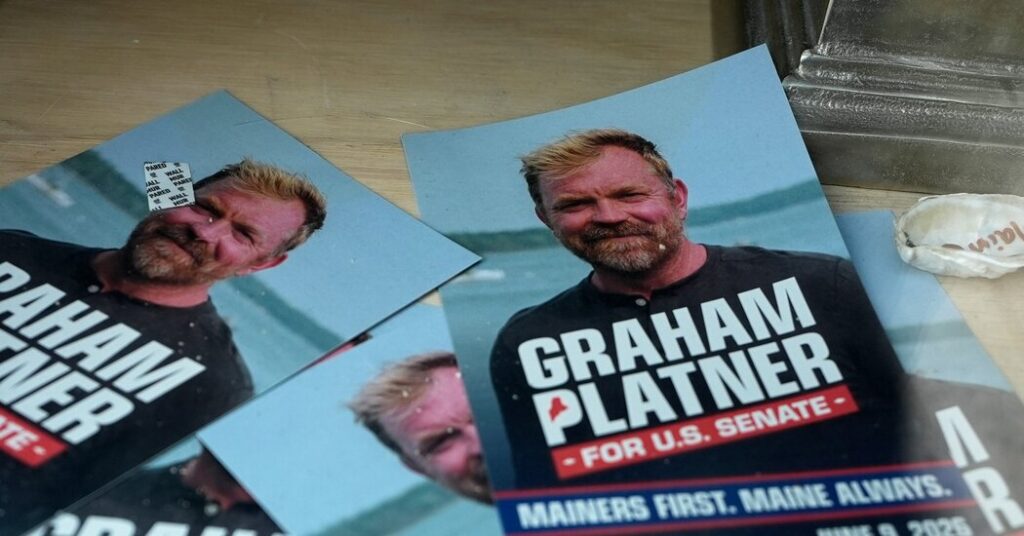
As Graham Platner’s Senate campaign imploded this week following an allegation of rape, Democratic women across the country processed a range of emotions: revulsion, anger, disappointment and, for a number of his supporters, grief.
But for some seasoned veterans of Democratic politics, who have spent years watching female candidates try and fail to crack that “highest and hardest glass ceiling,” as Hillary Clinton once put it, Platner’s trajectory was also a painful reminder of the double standard women still face in American politics.
Putting aside the allegation that ultimately doomed him, they argue that no woman with Platner’s thin work history, record of incendiary comments or taste in tattoos would have gotten near a Senate nomination, no matter how many times they claimed they had changed after past misdeeds. (Platner has strenuously denied the rape allegation as well as an accusation reported in The New York Times that he was physically rough with at least one other woman.)
“Female candidates do not get the opportunity to reinvent themselves and to go on a redemption tour,” said Donna Brazile, the former chairwoman of the Democratic National Committee, saying that was even more true for women of color. “I cannot find a female candidate running for the United States Senate, with the kind of red flags that he exhibited, being able to even get past what I would often call the smell test, let alone the electability test.”
“Platner received so much grace,” she added. “I mean, so much grace because he was supposedly an ordinary person leading an ordinary life with the ability to shake things up.”
His candidacy, and its dramatic end this week, have revived longstanding tensions among Democrats over both gender and what it takes to win back voters who have bolted the party.
For much of the past decade, Democrats have grappled with how to attract white working-class voters who were once a core part of their coalition, until Donald Trump came along. That effort was supercharged after devastating losses in the 2024 election among working-class voters more broadly.
Now, some strategists are focused on recruiting candidates who come from far outside the political system, who look and sound like some of those voters.
How much does a certain scruffy image — one that is far easier for gravelly voiced men to pull off — matter in that effort?
Platner’s allies thought “we needed the Brawny paper towel man, the guy with the burly beard,” Jessica Mackler, the president of the Democratic group Emily’s List, which had supported Gov. Janet Mills against Platner in the Senate primary, told me. “That therefore we should ignore all flags, and all of these clear red flags, to anoint him as this leader.”
There is no question that Platner had inspired and excited many Democrats with his angry indictments of the political system and his energetic campaigning style. He sparked a grass-roots movement as he rose from obscurity to handily topple Mills in the primary. Many voters, in a fiercely anti-establishment mood, believed he would fight hard for them.
But whether all of that would have translated to support among working-class voters in a general election is a different, and now unknowable, question. A New York Times/Portland Press Herald/Siena poll released last month found him trailing Senator Susan Collins, a Republican, with men (45 percent to 52 percent) and getting crushed among white voters with no college degree, nearly 60 percent of whom said they supported Collins.
Of course, relating to and reflecting one’s community is vital, Mackler said. She pointed to female candidates running in crucial seats from Minnesota and Maine to Arizona to Alaska who, she said, are doing just that, whether or not they sport Carhartt jackets.
As Platner collapsed, I remembered a conversation my colleague Lisa Lerer and I had with Nancy Wanderer at a Portland campaign event for Mills shortly before she dropped out.
Wanderer, a professor emerita at the University of Maine School of Law who was in the same class as Clinton at Wellesley College, told us that the Mills-Platner race was giving her flashbacks to the 2016 presidential campaign.
Clinton “knew what she was talking about, she was better prepared than anybody in the room,” she said. “And then somebody comes along, in this case it was Bernie Sanders, I don’t know why, who dazzles people. And then, of course, Trump.”
I caught up with her this afternoon and asked how she was thinking about double standards for female candidates now.
“It’s right smack in front of our faces,” she said. “This race has made that so clear. Misogyny has been the name of the game.”
She worried about whether experienced female candidates like Shenna Bellows, the Maine secretary of state, would also be overshadowed in the process to replace Platner on the ticket, as some on the left have clamored to elevate Troy Jackson, a former president of the Maine State Senate who had been Platner’s top pick in the Democratic primary for governor. (Jackson this week urged Platner to step aside.)
“Everything,” Wanderer said grimly, “is worse than the last time I saw you. Like, exponentially.”
quote of the day
“I reject the notion that one party is covering up more than the other. It’s a bipartisan problem.”
That was Representative Kat Cammack, Republican of Florida, who is helping lead a bipartisan effort to deal anew with sexual misconduct on Capitol Hill.
Nearly a decade after the #MeToo movement, American politics appear to be in a new reckoning over sexual violence, and how best to respond when prominent or powerful figures stand accused.
Read more from my colleague Lauren McGaughy.
One Number
$147 million
That’s how much the leading Senate Democratic super PAC and an affiliated nonprofit raised from April through June, notching its best-ever second-quarter haul as the party seeks to win back control of the upper chamber in this fall’s midterm elections.
My colleague Bayliss Wagner has more.
take our quiz
This question comes from a recent article in The Times. Click an answer to see if you’re right. (The link will be free.)
Which ill-fated past campaign is bubbling up in many political strategists’ minds this week as a comparison to current events, according to my colleague Reid Epstein?
The post How the Platner Drama Is Reviving Debate Over an Old Double Standard appeared first on New York Times.