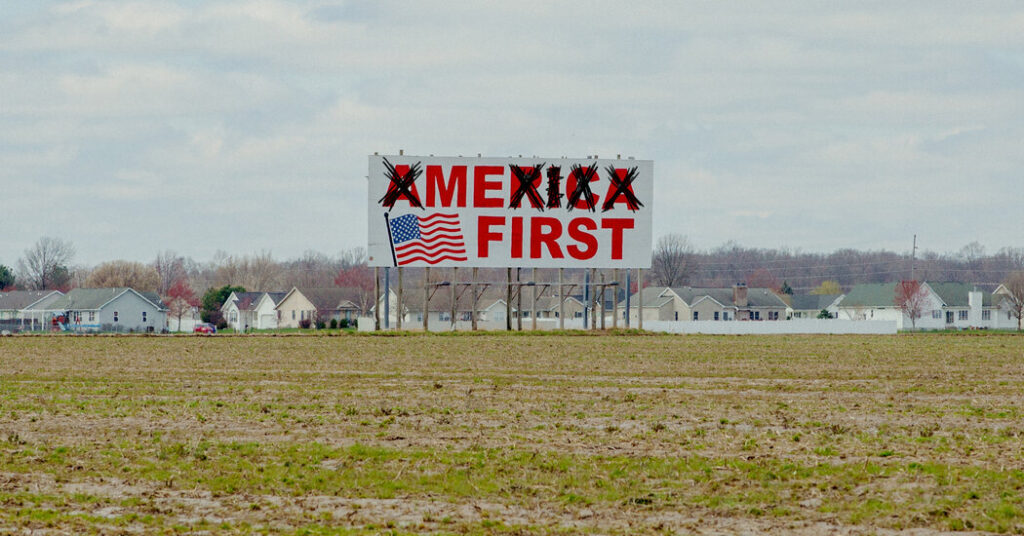
The rupture of the world order is going much better than expected.
At first there was rage at America’s betrayal, when President Trump called for the annexation of Canada, threatened Greenland, imposed tariffs on its friends and began his campaign to undercut NATO, which continued at its latest meeting this week, in Ankara, Turkey. Now, a strange feeling is emerging in some of the countries that used to be known as America’s allies: Optimistic determination. There’s an established principle in chess that applies to geopolitics as well: “The threat is stronger than the execution.” The possibility of U.S. abandonment of the world order was terrifying. The reality turns out to be a new beginning.
Canada, America’s neighbor, was the first to see it, naturally. Since the beginning of Mr. Trump’s second term, American bullying on trade has been ferocious. As a result, Canada has had to consider what American favor or disfavor is worth. The Bank of Canada recently ran a scenario in which the United States imposed a 25 percent tariff on everything Canada exports to the United States. Canada’s growth of its gross domestic product would slow by about 2.4 percentage points, which over a period of adjustment is well within Canada’s capacity. A disaster, to be sure, but not the end of the world. That’s the worst-case scenario.
A recent study by economists at the Canadian Shield Institute, commissioned for the podcast “Gloves Off,” which I host, found that Canadian merchandise exports to the United States last year fell by over 30 billion Canadian dollars, (21 billion U.S. dollars), or over 5 percent of exports to the United States. But that loss was offset by nearly 29 billion Canadian dollars in new demand from the rest of the world. When services were included, total exports from Canada increased by almost 7 billion dollars. America can make whatever threats it likes, but if you have the aluminum or oil or potash, somebody will buy it.
It’s not just Canada. European equities outperformed American equities in 2025, and surged in the first two months of 2026. The European Defense Industrial Strategy, put in place in 2024, is keeping more of Europe’s rapidly expanding military spending within the continent. And after the threat of the European Union’s anti-coercion instrument, the so-called trade bazooka allowing rapid counter tariffs, forced Mr. Trump to back down from his early round of Greenland threats, the Europeans now know that they have their own Strait of Hormuz — their own pain point that can make America flinch.
American military threats have the same diminishing power. If recent history has taught us anything, it’s that when the United States decides to achieve a geopolitical aim by means of military force, you can make a pretty safe bet that aim will not be achieved. Against all odds in a war with the United States, Iran’s corrupt and cruel regime has maintained its power and is now receiving sanctions relief. While the U.S. military invents whole new genres of defeat, the Gulf states, and their airports, have now learned during the Iran war exactly what an American security guarantee is worth.
At the NATO meeting in Ankara, where Mr. Trump berated allied nations — especially Spain — and repeated his call for U.S. control of Greenland, the leaders of Spain and Denmark took Mr. Trump’s comments as the idle threats they self-evidently are. Prime Minister Mark Carney of Canada may well say that Mr. Trump “won the argument” on NATO members raising their spending levels for defense. The reason they are spending more now may be that they know that American military power is in retreat. American support, whatever that even means anymore, guarantees nothing.
It’s not just NATO. Bureaucracies once defined by their lethargy are moving at surprising speed to limit their exposure to both the U.S. government and the companies that serve as outposts of American power. Since taking office a little over a year ago, Mr. Carney’s government has made just over 100 international trade deals. The European Union has expanded its defense procurement deliberately to avoid integration with American military forces. Disentanglement from American technology will be the thorniest knot to undo, but the work is already underway on this, too: The European Union has switched from Google to the French Qwant as a default search engine in its official systems, while Belgium and Finland have both moved away from Amazon Web Services.
The post-American reality is not a world without America, of course. As a geopolitical actor, the United States has become a kind of lumbering zombie — a beast that can be startled into reflexive actions but lacks higher functions. Much of the world understands that another round of elections in the midterms or in 2028 won’t solve anything. The American people are so divided that the future will be chaotic whoever wins, many outside the United States feel. They fear a sane Republican or Democratic president would not be able to guarantee a stable American policy or consistent application of even the vaguest principles in international relations.
“What is America?” is no longer a grand theoretical question. It is a practical matter. Governors of a number of U.S. states have rational political programs. American institutions survive. Some Americans have even kept their ideals. But as for the entity known as the United States of America, there’s no there there. There’s no America to deal with. An increasingly isolationist America is no longer the leader of the free world. How can it be, when it’s no longer the leader of itself?
Zombie America creates, at least in the short term, contradictions. In Canada, the North American Aerospace Defense Command, jointly operated with the United States, continues to be our most important alliance. Yet civil servants here have also started training with drones for the possibility of asymmetrical conflict with the United States. Real security can be found only by removing your country from American influence, on every front as far as possible.
“The threat is stronger than the execution” was the wisdom of Aron Nimzowitsch, a leading figure of the hypermodern school of chess. The reason it applies to the chessboard is that all the time and energy you spend trying to figure out how to avoid a disaster turns out to be worse than the disaster itself. Once the worst has happened, you can focus on incremental improvement rather than avoidance. You can become active rather than passive. In geopolitics, too, so much of power is the appearance of power.
Everybody who believes in freedom and democracy and the dignity of the person and the right of nations to self-determination should be working toward the destruction of the United States’ capacity to project power — to end the strange hold it has over the world so we can all move on. So far, no one is helping more than the United States itself.
Stephen Marche is the author, most recently, of “The Next Civil War.”
The Times is committed to publishing a diversity of letters to the editor. We’d like to hear what you think about this or any of our articles. Here are some tips. And here’s our email: [email protected].
Follow the New York Times Opinion section on Facebook, Instagram, TikTok, Bluesky, WhatsApp and Threads.
The post The World Is Marching Past an Isolationist America appeared first on New York Times.