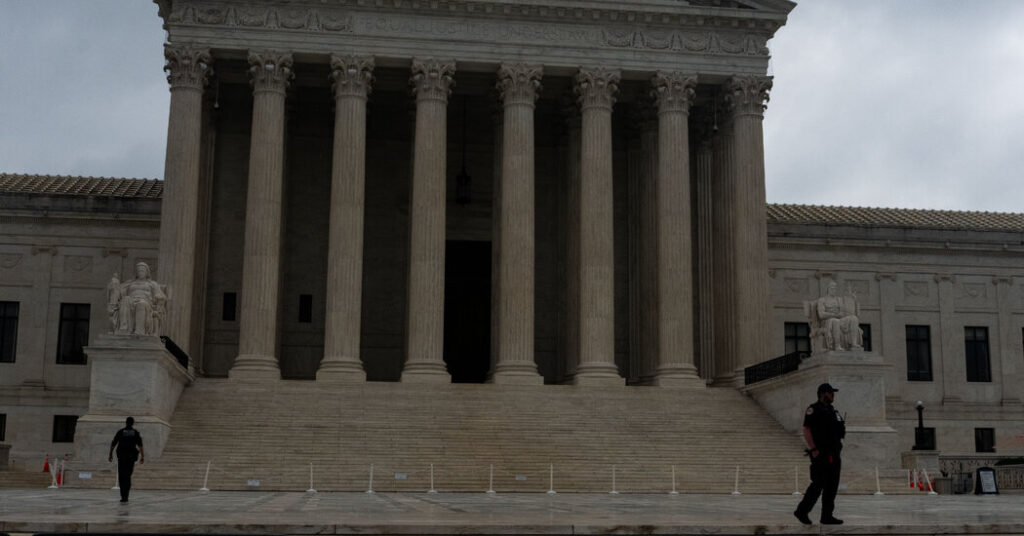
The Supreme Court cleared the way on Monday for Texas to enforce a new state law that requires Apple and Google to verify the age of app store users as part of an effort to give parents more control over the content their children download.
The court’s brief order came in response to an emergency request from the tech companies and a group of students, who had told the justices that the law violated their free speech rights and asked that it be blocked.
The order is a temporary place holder that sets the rules while litigation continues in the lower courts over the constitutionality of the Texas law. The justices did not include their reasons, which is typical when they issue emergency orders, and there were no noted dissents.
Texas is one of 20 states that has passed or considered similar age-verification laws for electronic devices, placing new burdens on tech giants to restrict children’s access to apps amid a rising backlash against social media and its impact on young people.
Under the Texas law, app store companies must create a way for users younger than 18 to obtain parental consent to download apps or make purchases within apps.
Ken Paxton, the Texas attorney general, told the court in a filing that the law protected the rights of parents to make decisions about their “children’s upbringing in the modern world.”
The law, his office said, applies regardless of content, requiring parental consent before minors can buy any product from app stores — from calculators and measuring tools to social media and e-books.
The Texas requirement was challenged by the Computer and Communications Industry Association, a trade group whose members include Google and Apple, as well as Students Engaged in Advancing Texas, which advocates for student involvement in education-related policymaking.
They argue that the law unconstitutionally “deputizes app stores to police both minors’ and adults’ threshold access to vast amounts of online speech.”
The companies said in a court filing that they already provided parental controls that allow parents to lock their children’s screens for bedtime, block unwanted apps, filter content by age and set up an approval process for purchases and downloads.
In response to the court’s order on Monday, Matt Schruers, the C.C.I.A. president, said in a statement that the organization would continue to press its case in the lower courts, where “we will demonstrate how the Texas App Store Accountability Act violates the First Amendment.”
“Accessing the internet should not require surrendering personal data, just as entering a bookstore should not require showing government identification,” he wrote.
In December, a federal judge in Texas temporarily blocked the state from enforcing the law. Judge Robert Pitman of the Federal District Court for the Western District of Texas said the law probably violated the First Amendment. He compared it to a proposal that bookstores be required to verify the age of customers and obtain parental consent before minors enter or buy a book.
“It restricts access to a vast universe of speech by requiring Texans to prove their age before downloading a mobile app or accessing paid content within those apps and requires minors to obtain parental consent,” he wrote.
A three-judge panel of the U.S. Court of Appeals for the Fifth Circuit then paused that ruling and said it would allow the law to take effect, writing that the “need to protect children is intensified in the digital world.”
The panel said regulation of commercial transactions like app store purchases that does not target a particular type of content should be subject to a less demanding form of judicial scrutiny than the district court judge applied.
Last year, the Supreme Court upheld a different Texas law meant to shield minors from adult material on the internet by requiring people to prove they are at least 18 before accessing sites that contain a certain amount of “sexual material harmful to minors.” Challengers had argued that adults would be wary of supplying personal information for fear of identity theft, tracking and extortion.
The court divided along ideological lines in that case, finding that the measure did not violate the First Amendment.
Justice Clarence Thomas, writing for the majority, said the law’s age restriction was needed in the internet era.
“Unlike a store clerk,” he wrote, “a website operator cannot look at its visitors and estimate their ages. Without a requirement to submit proof of age, even clearly underage minors would be able to access sexual content undetected.”
The post Supreme Court Allows Texas Age-Verification Law for App Stores, for Now appeared first on New York Times.