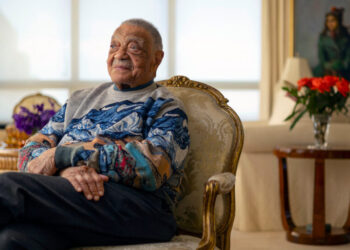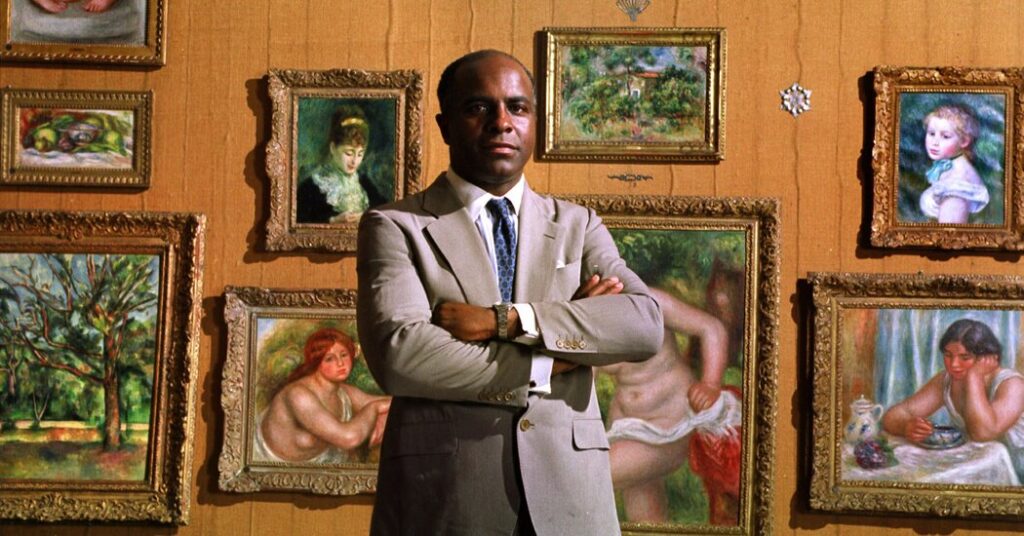
Richard H. Glanton, a combative president of the Barnes Foundation who in the 1990s went against the wishes of the institution’s eccentric founder by taking 80 French artworks outside of its neoclassical home for a first-ever tour to raise funds, died on June 21 at his home in Princeton, N.J. He was 79.
His wife, Eileen Glanton, said the cause was a heart attack.
Mr. Glanton, a lawyer, wanted to turn the Barnes — long an insular art school and museum in the Philadelphia suburb of Merion with one of the world’s greatest private art collections — into a higher-visibility institution, like the Frick Collection in Manhattan.
But with its endowment shrinking and its long-neglected building in urgent need of repairs, Mr. Glanton turned his focus in 1991 to raising some $15 million for a renovation.
“The problems at the Barnes were so obvious,” he told The New York Times in 1993, “Ray Charles could see them in a swamp at midnight.”
The heart of the vast collection of paintings and sculptures amassed by Albert C. Barnes, a patent-medicine millionaire who died in 1951, consisted largely of works by Impressionist, Post-Impressionist and early modern masters like Renoir, Cézanne, van Gogh, Picasso, Manet, Gauguin and Matisse. Mr. Barnes had arranged them idiosyncratically, seeking to appeal to ordinary people rather than scholars and emphasizing the works’ connections to everyday life.
He stipulated that after his death, nothing could be moved — neither from nor beyond the gallery walls.
When he became president, Mr. Glanton initially proposed selling some works, knowing the sale could bring in millions of dollars, even if it meant violating the conditions that had been set by Mr. Barnes. In 1991, he and the Barnes’s trustees asked the Montgomery County Orphans’ Court, where Mr. Barnes had filed the collection’s trust, for permission to sell up to 15 works.
But the plan was dropped after a flood of bad publicity, some of which came from the Friends of the Barnes Foundation, a group of former students from the institution’s art-appreciation courses, who wrote in a petition to the court that the proposed sale would be as “illogical and misguided a plan as can be envisioned.”
A year later, Mr. Glanton returned to court seeking approval to take 80 of the museum’s works on a tour. The court said it would be a one-time exception to Mr. Barnes’s trust, not a permanent change. The exhibition, Great French Paintings From the Barnes Foundation, opened at the National Gallery of Art in Washington in May 1993, and traveled to museums in Paris, Tokyo, Fort Worth, Toronto, Philadelphia and Munich into 1995.
The tour brought in about $17 million and gave the museum time to close and renovate. When the building reopened in 1995, the works were returned to their original places.
“Overall, the effect of the renovation makes the Barnes look what you might call spanking old,” the critic Michael Kimmelman wrote in The Times, noting that its galleries had been “obsessively restored,” including their burlap wall coverings and bronze fixtures, which were redesigned to produce brighter lighting.
In a 2002 article about the Barnes in The New Yorker, Jeffrey Toobin captured Mr. Glanton’s unwavering belief in himself and the changes he had made.
“Glanton may have been immodest,” Mr. Toobin wrote, “but he wasn’t wrong when he asserted that ‘the Barnes had languished in darkness since his death, until I arrived and turned the lights on.’”
Richard Howard Glanton was born on Nov. 21, 1946, in Villa Rica, Ga., about 35 miles west of Atlanta. He was one of 11 children of Herbert Glanton, a farmer who later worked in a mill, and Norace (Hawkins) Glanton, who managed the home. All the children worked on the farm at one time or another.
Richard was one of the first Black students to graduate from West Georgia College (now the University of West Georgia). After earning his bachelor’s degree in English in 1968, he received his law degree from the University of Virginia in 1972.
He worked at the Equal Employment Opportunity Commission and United Airlines before being appointed deputy counsel to Gov. Dick Thornburgh of Pennsylvania in 1979. After four years, he moved into private practice at Wolf, Block, Schorr & Solis-Cohen (now WolfBlock) and then Reed Smith Shaw & McClay (now Reed Smith), where he remained a partner while running the Barnes. During the 1990s, Mr. Glanton, a Republican, briefly considered running for mayor of Philadelphia.
He joined the Barnes through its unusual relationship with Lincoln University, a historically Black liberal arts college in Oxford, Pa.
Mr. Barnes, a believer in integration, had stipulated that Lincoln nominate four of the foundation’s five trustees as the institution’s original board members died or retired. By 1989, the college’s appointees held four of the five seats, and in 1990, Mr. Glanton, a former Lincoln trustee with no formal art credentials, joined the board as a trustee and president.
“I never purported to know anything about art,” he told The Philadelphia Inquirer Sunday Magazine in 1990. “But I can lead.”
Edward J. Sozanski, the chief art critic of The Inquirer at the time, argued that what the Barnes needed was a full-time, “art-wise” director.
“Glanton consolidated in his hands the administrative power than he came to wield so authoritatively,” Mr. Sozanski wrote in 1998. “But what the institution needed was a strategic thinker and a person who might have been able to reconcile Barnes’ vision with present realities.”
Mr. Glanton found himself embroiled in a number of lawsuits.
In 1992, a female associate at Reed Smith accused him of sexual harassment and sought at least $2 million. A federal jury sided with her, awarding her $125,000 in damages for statements he had made about her. Appeals ended in a settlement.
Mr. Glanton battled local residents over parking and traffic issues after the Barnes reopened. In early 1996, the Barnes sued Lower Merion Township and its commissioners for holding up approval of a parking lot to accommodate more visitors, alleging that the move was discriminatory because Mr. Glanton and most of the Barnes trustees were Black. Shortly after a federal judge tossed out the lawsuit later that year, an agreement was reached to permit the lot.
But a dozen commissioners sued Mr. Glanton for defamation, citing his comments about racism; he agreed to a settlement in which he made a “conditional” retraction and paid the commissioners’ lawyer $400,000 in fees.
He resigned as president of the Barnes in 1998, and never again held a position of the same public profile. In later years, his posts included senior vice president of Exelon, a utilities company, and chairman of ElectedFace, a social media website that he created, which connected constituents to elected officials.
In addition to his wife, the former Eileen Candia, Mr. Glanton is survived by their daughter, Georgia Glanton; a daughter, Morgan Glanton, and a son, David, from his marriage to Scheryl (Williams) Glanton, which ended in divorce; two sisters, Effie Nalls and Daisy Dansby; and four brothers, Rhonnie, Anthony, Derek and Barrett Glanton.
In 2002, four years after departing the Barnes, Mr. Glanton responded to an article that stated he had left the institution “under a cloud.” But he wrote that his tenure had been “a period of rebirth and excitement,” and added, “I predicted the foundation would be bankrupt in a short period of time because of the management practices adopted following my departure.”
The Barnes struggled financially in the years after his departure. That changed when an orphans’ court ruling in 2004 let the institution move to downtown Philadelphia to survive.
Three major foundations had agreed to raise $150 million for the relocation, and the Barnes reopened in a new building in 2012.
The post Richard H. Glanton, Combative Head of Barnes Foundation, Dies at 79 appeared first on New York Times.