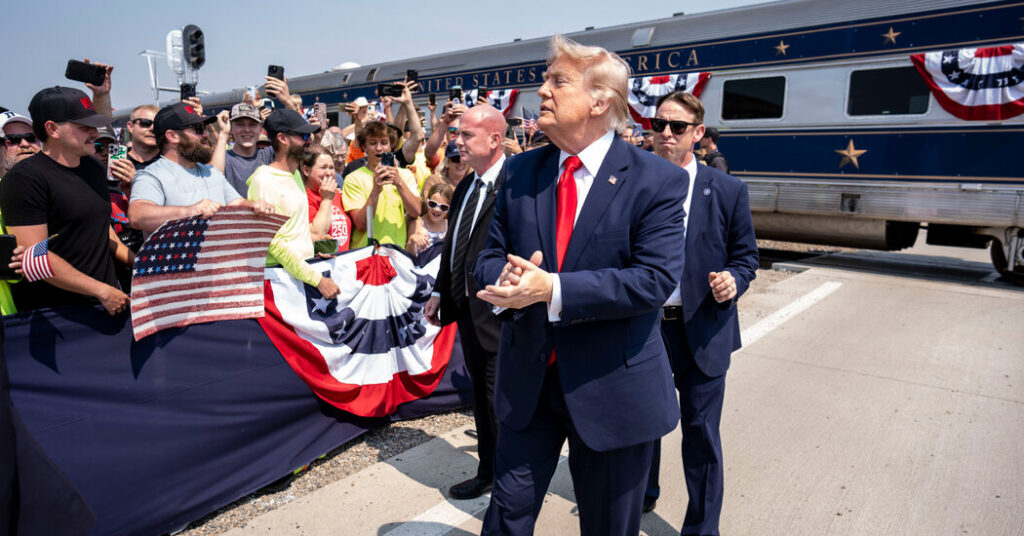
The celebration of the 250th anniversary of America’s independence was marked with the pomp and outsize circumstance that President Trump promised, and throughout it he paid homage to the person he cast as an embodiment of patriotism: himself.
Mr. Trump capped off the weekslong celebration with a speech on Saturday night on the National Mall, where he praised those who founded the country and shed blood fighting for it. But as he had in virtually every other commemoration speech, he couldn’t help but dwell on his own battles and portray the state of the union as stronger than ever under his leadership.
“Unlike so many others in the world, in this country we have freedom of speech, freedom of religion, equal justice under the law — although I wasn’t treated that well,” Mr. Trump said. “But we won’t get into that.”
“We had the American dream,” he added. “We never had the American dream, however, like we have it right now.”
Branding himself onto America’s semiquincentennial celebration seemed his plan from the start. Mr. Trump propped up a commission aligned with his agenda in place of one funded by Congress to organize festivities. His face was splashed on commemorative items like passports and coins. He even billed the July 4 celebration at the Lincoln Memorial and Washington Monument as “the most spectacular TRUMP RALLY of them all,” and boasted that some of the “patriotic melodies” came from his personal playlist.
In the process, he frequently seemed to conflate allegiance to him with patriotism.
When he announced in May that he would headline a rally in place of several musicians who dropped out of the Great American State Fair, which his commission created, he referred to himself as “the man who loves our Country more than anyone else.” As for his desired attendees: “Only Great Patriots invited,” he wrote.
Jon Meacham, the presidential historian, said that Mr. Trump was confusing patriotism with something else entirely.
“Broadly put, nationalism is about allegiance to one’s own kind; patriotism is allegiance to a creed,” he said. “The Age of Trump — and that is what historians will have to call this — is a nationalistic one.”
The White House defended Mr. Trump’s oversight of the celebration.
“President Trump is ensuring that America gets the spectacular birthday it deserves,” Davis Ingle, a White House spokesman, said in a statement. “The celebration of America’s 250th anniversary is going to display great patriotism in our nation’s capital and throughout the country, and the president is proud to participate in our historic semiquincentennial celebration. Only people who suffer from a severe case of Trump derangement syndrome would find a problem with that.”
Mr. Trump has a long-established pattern of defining patriots on his own terms. A review of his interviews, speeches and social media posts shows that in addition to the military, it comes down to whom he sees as unquestionably on his side.
Among those Mr. Trump has identified as “patriots” include the rioters who stormed the Capitol and beat police officers in an attempt to overturn the election he lost in 2020, Republican members of Congress and politicians he has endorsed in local races.
He has repeatedly used the word “patriot” to describe law enforcement and immigration officials who have carried out his crackdown on immigration, and the air traffic controllers who worked without pay during the government shutdown that he played a large part in creating.
Other “patriots,” according to Mr. Trump, include fans who attended rallies in states that he has won; those who erected a gold statue of him in Doral, Fla.; and the business executives, workers and officials who support his remaking of the capital to his specifications, including the renovation of the Lincoln Memorial Reflecting Pool and the new ballroom he is building at the White House.
Among those Mr. Trump has deemed “unpatriotic” are the people whom President Joseph R. Biden Jr. pardoned before he left office. Mr. Trump has also used the word to describe his political foes, from John R. Bolton, his former national security adviser turned fierce critic, to Senator Chuck Schumer of New York, the Democratic minority leader. Mr. Trump has lobbed the insult at his own appointees on the Supreme Court who voted against his tariff policies.
Mr. Trump also has repeatedly characterized media institutions whose coverage he does not like as “treasonous.”
More recently, including in speeches pegged to the 250th anniversary, Mr. Trump has issued dark warnings about the “menace” of communism re-emerging in the country, his new political attack line to describe democratic socialists and other progressives who are seeing a surge of support in Democratic primaries in New York and other states.
Historians said Mr. Trump’s celebration of the 250th anniversary put on display his aggressive push to revert to eras he considers to have embodied American greatness.
He has compared himself to presidential generals like George Washington and has reminisced approvingly about the post-World War II, pre-civil rights era. And he has sought to revise and erase history, particularly Black history, which he has deemed unpatriotic and “divisive” while demanding that schools and institutions teach “patriotic” history.
On July 4, the White House released a scathing 162-page report, called “Saving America’s Story,” that condemns the Smithsonian’s National Museum of American History for what it deemed a failure to celebrate the nation’s heritage.
“His version of patriotism is rooted in his narcissism,” said Chad Williams, a historian and professor of African American and Black diaspora studies at Boston University. “It’s self-aggrandizing on the one hand, but it’s also deeply ahistorical, and I think this entire commemoration has been reflective of this.”
The 250th celebration — during which a Confederate flag was hung at a fair booth and white nationalists marched near the Capitol — put on display a troubling direction for democracy, other historians said.
David W. Blight, a professor of American history at Yale University, said the president was hosting a “puerile celebration,” but noted that the underpinning of Mr. Trump’s self-reverence was an attempt to dictate how Americans should feel about the country.
“He’s completely engineered the weight and the power of the executive government to tell Americans how they should conceive of their past,” Mr. Blight said.
Linda Lee Tarver, a Republican activist who has written two books about Mr. Trump, said that she embraced the president’s attempts to “repatriate” a country that she said had become “unrecognizable” under his predecessor.
Ms. Tarver, who serves as a “Project 21” ambassador at the National Center for Public Policy Research, a research group that aims to promote conservative viewpoints among African Americans, said that Mr. Trump’s enthusiasm was “infectious.”
“His policies speak to his patriotism and love of this nation,” she said. “We definitely need a boost of patriotism, and our biggest cheerleader is the one that we elected — and he was certainly duly elected.”
Mr. Trump is not the first president to assert himself in planning the country’s milestone birthdays, said Tevi Troy, a presidential historian and senior fellow at the Ronald Reagan Institute. He noted that President Gerald R. Ford took over planning the country’s bicentennial in 1976 from his vice president, and used the occasion as a political platform in his primary race against Ronald Reagan. But there was a notable difference between the two celebrations, he said.
“There was much more of a nonpartisan sense of patriotism back then,” Mr. Troy said.
On Sunday, Mr. Trump shared on social media a photo of a pair of three-story banners of him and George Washington that are now hanging on the front of the Interior Department.
“The wording above Washington is ‘America’s First’ in reference to him being America’s first president,” he wrote. “The wording above President Trump is ‘America First’ — which needs no explanation!”
Mr. Trump paid special tribute to President Theodore Roosevelt, attending the opening of his library last week. Mr. Trump cast Roosevelt as his presidential alter ego, whom he deemed “a great he-man,” and compared Roosevelt’s ethos and accomplishments to his own.
But Mr. Trump and Roosevelt may disagree on one thing.
“Patriotism means to stand by the country,” Roosevelt wrote in 1918. “It does not mean to stand by the president or any other public official save exactly to the degree in which he himself stands by the country.”
“It is unpatriotic not to tell the truth,” he added, “whether about the president or anyone else.”
Dylan Freedman contributed reporting.
The post How Trump Put Himself in the Middle of America’s 250th appeared first on New York Times.