After intense speculation that the five-week murder trial of Lindsay Clancy would end Thursday, the jury is set to return to court after the judge spurned a defense lawyer’s request to eject a holdout member.
Spectators were called into the courtroom at about 3 p.m., after jurors had been deliberating about six hours, with many anticipating a hung jury. Jurors have twice informed the judge this week that they were unable to come to a unanimous decision.
Instead, the judge and lawyers revealed that jurors had complained that one person among them refused to follow the law, an announcement that drew gasps from the courtroom. Ms. Clancy’s lawyer, Kevin Reddington, pushed for the removal of a juror who “refuses to listen to the law that you’ve given him or her on reasonable doubt,” he said, citing a note from the jury’s leader.
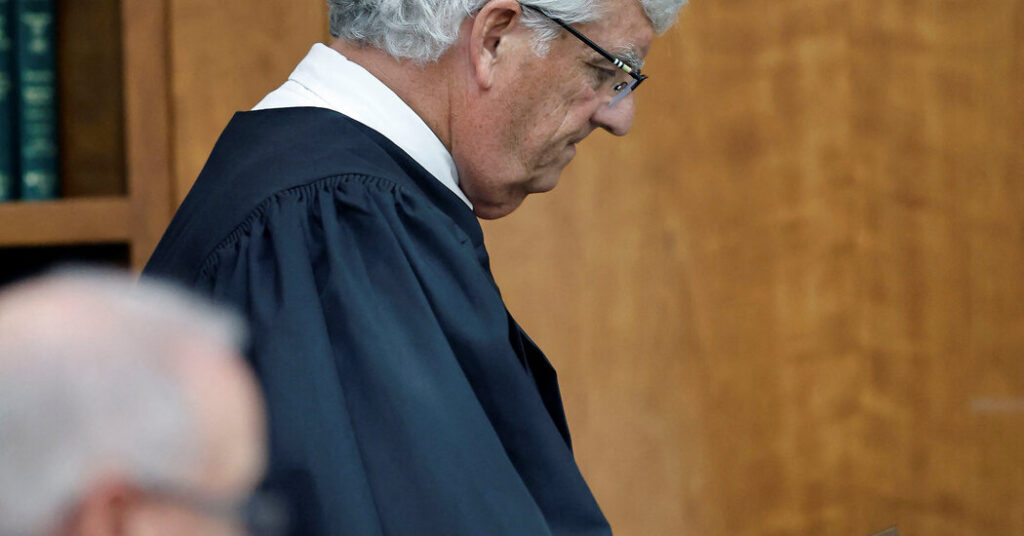
The judge declined. “I don’t feel that is proper for me to side with one side or the other of the deliberations,” said the judge, William Sullivan. “I don’t feel it’s appropriate for me to say I agree with one juror or 11 at this point.”
Later, he asked jurors to return at 9 a.m. on Friday. Mr. Reddington told reporters outside the courthouse that there would be “an inquiry by the judge.” He hoped it would be in open court, he said.
During the sixth day of jury deliberations, spectators thronged the hallway in the courthouse where, after a month of intense and at times harrowing testimony, jurors had spent about 36 hours deliberating the fate of Ms. Clancy.
Ms. Clancy, a 36-year-old Massachusetts woman, is charged with murder in the strangling deaths of her three children in 2023. She does not deny killing her two sons and daughter using exercise bands. Her lawyers say she was suffering psychosis at the time and is not criminally responsible. Prosecutors have disputed her mental state, saying she planned to kill the children, who ranged from 8 months to 5 years old, after asking her husband to leave the house. She then tried to kill herself.
Jurors have told the court at least twice that they are deadlocked and unable to reach a consensus, but Judge Sullivan has repeatedly sent them back to keep deliberating.
Intense public debates about Ms. Clancy’s trial — which have raged for weeks online — have boiled over in verbal confrontations outside the normally quiet courthouse in Plymouth, Mass., just a couple of miles from Plymouth Rock. Many who have attended court frequently are in support of Ms. Clancy, or are there to call attention to what they see as systemic failures of the mental health system. A few people have come to the building calling for a first-degree murder conviction for Ms. Clancy.
Around 3 p.m. on Thursday, the judge called the lawyers into an extended and highly animated sidebar conversation, which spectators and reporters in the courtroom could not hear; crackling white noise plays over the room’s speaker system during sidebar conversations. Mr. Reddington eventually left the gaggle to wheel Ms. Clancy into the conversation.
A court officer then brought jurors to the judge one at a time, where the judge questioned them under oath about whether they would be able to follow his instructions on reasonable doubt. All of them appeared to answer yes.
The judge reminded them in open court that they were obligated to follow his instructions and the law.
“The evidence must convince you of the defendant’s guilt to a reasonable and moral certainty, a certainty that convinces your understanding and satisfies your reason and judgment,” he said.
The judge then sent the jurors back to deliberate for about 30 minutes before sending them home at 4 p.m., as usual.
A prosecutor, Jennifer Sprague, said in court that the judge’s general instruction about reasonable doubt was an appropriate way to handle the note from the jury’s leader about the tensions in the jury room. But the judge’s admonition was not good enough for Mr. Reddington.
“It does not allow any foundation for a motion to remove or remove the juror who refuses to accept your instructions on the law on reasonable doubt,” Mr. Reddington said. He added that if there were a mistrial “because of a juror that has just spurned the instructions of this court, it’s a shame. It’s a real shame.”
Jenna Russell, Remy Tumin, Maya Shwayder, Jacey Fortin and Heather Beasley Doyle contributed reporting.
The post Holdout Juror Throws the Clancy Murder Case Into Disarray appeared first on New York Times.