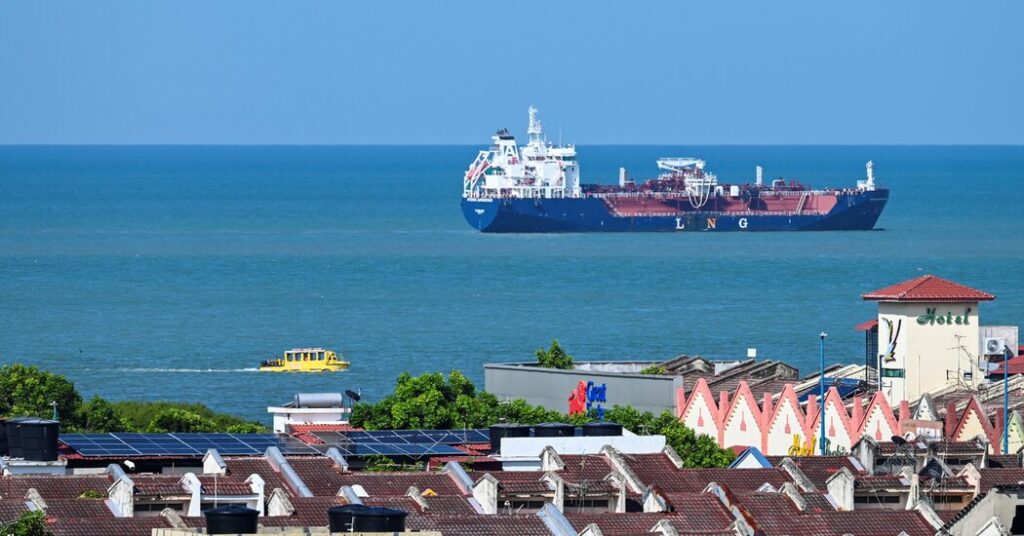
As Iran and Oman explore ways to charge ships transiting the Strait of Hormuz, attention has turned to another maritime choke point, roughly 3,000 miles away, as a model for how it might work.
The Strait of Malacca in Southeast Asia is a crucial artery for global energy supplies. It carries about 23 million barrels of oil a day, compared with 21 million through the Strait of Hormuz before the war in Iran; it also serves as a main route for crude bound for China, Japan and South Korea. Both waterways narrow at geographic bottlenecks, leaving them vulnerable to disruption.
That is where the similarities mostly end.
The Strait of Malacca links Europe and the Middle East with East Asia and handles a third of global trade. It is especially important for China: About 80 percent of the country’s imported oil passes through the strait, a vulnerability that its leaders often refer to as the “Malacca Dilemma.”
At roughly 560 miles, the funnel-shaped Strait of Malacca is far longer than the Strait of Hormuz. Its traffic is also more diverse. Some 100,000 vessels pass through each year carrying, beyond oil, everything from furniture and toys to electronics. What’s more, the Strait of Malacca, at its narrowest point, presents a considerably tighter journey for ships than the Persian Gulf waterway.
Shipowners have regional alternatives to the Strait of Malacca, including the Lombok Strait between the Indonesian islands of Bali and Lombok, though these routes add time and cost. By contrast, the Strait of Hormuz is the only maritime gateway to the Persian Gulf. That gives Oman and Iran, which border the waterway, greater leverage because shipping companies have no practical alternative.
Oman has proposed that it and Iran collect payment from ships transiting the Strait of Hormuz, according to officials and diplomats familiar with the discussions. One diplomat said any payment would be voluntary, while an Iranian official said they would be mandatory. The proposal was partly modeled on arrangements in the Strait of Malacca. It’s unclear whether it will advance as U.S. and Iranian delegates try to resolve their differences on a range of issues.
A plan to impose fees for passage through the Strait of Hormuz was once unthinkable. Longstanding principles that govern global shipping hold that international waterways should remain free to navigate.
“But I think everyone’s starting to shift because they recognize that they’re not going to have any kind of restoration of freedom of navigation unless Iran feels like they’re walking away with something,” said Michelle Wiese Bockmann, a maritime intelligence analyst at Windward, a shipping data firm.
For decades, the Strait of Malacca has been jointly administered by the three countries bordering it — Singapore, Malaysia and Indonesia — mostly without major conflict.
“Words like ‘blockade’ are taboo,” said Nazery Khalid, a maritime expert at the University of Malaya in Kuala Lumpur. “If one party is not happy, everyone is unhappy.”
When an Indonesian official remarked in April about imposing a levy, Singapore and Malaysia rejected the idea.
The three countries have avoided interstate war for six decades. Their last conflict ended in 1966, when Indonesia concluded its confrontation with the newly formed Federation of Malaysia.
Ships do not pay for passage through the Strait of Malacca. Instead, they pay fees when they need specific services, such as towing assistance or help navigating the strait’s narrowest stretches. The channel, near Singapore, constricts to just under two nautical miles, compared with 21 nautical miles for the Strait of Hormuz.
Even for experienced mariners, piloting the Strait of Malacca can be difficult, and collisions have occurred. Ships sometimes hire so-called harbor pilots in Singapore to help guide them through, according to Collin Koh, a senior fellow specializing in maritime security at Singapore’s Nanyang Technological University.
Analysts point to another reason the Strait of Malacca offers only a limited model for the Strait of Hormuz: The political and security environments surrounding them are fundamentally different.
“They will need to come up with their own formula,” Mr. Nazery said. That would require the countries around the Strait of Hormuz to agree on an approach, “which is going to be very difficult, because it is already a very divisive region,” he added.
Ms. Wiese Bockmann put a fine point on the issue. “In the Strait of Hormuz, Iran is the threat to navigation,” she said, citing the country’s attacks on ships and placement of sea mines in areas of the strait. “To me, that is the key differentiator,” she said.
The cooperative model emerged from Southeast Asia’s broader transformation in the 1960s. Indonesia, Malaysia, Singapore, Thailand and the Philippines founded the Association of Southeast Asian Nations, agreeing to try to resolve disputes through dialogue rather than war.
One problem at the time was the Strait of Malacca, then a chaotic and lawless shipping lane. Several accidents involving Japanese supertankers had resulted in enormous oil spills.
The countries bordering the strait proposed establishing dedicated lanes, regular dredging, better traffic controls, navigational aids and a shared maritime police force. But paying for those improvements proved difficult.
Malaysia and Indonesia, which had underdeveloped economies, were far poorer than Singapore and struggled to shoulder the costs.
Japan’s Nippon Foundation, a private philanthropic group with ties to the government, stepped in to help. Beginning in 1969, the organization financed surveys of sea lanes, nautical charts and maritime equipment to improve safety in the strait. Decades later, when piracy emerged as a growing threat to shipping, the foundation extended its support to security initiatives.
By the mid-2000s, surging global trade had rekindled concerns over how to finance the strait’s upkeep. In 2007, Yohei Sasakawa, chairman of the Nippon Foundation, proposed that ships make voluntary contributions when transiting the strait, estimating that the plan could raise $40 million a year.
The proposal stalled. Maritime lawyers warned that it could violate the United Nations Convention on the Law of the Sea, while the shipping industry feared it would encourage countries overseeing other strategic waterways to introduce similar charges.
Instead, the Nippon Foundation, the International Maritime Organization and the three bordering countries reworked the idea. Later that year, they started a new cooperative, which Singapore described as a milestone framework for jointly managing one of the world’s busiest shipping lanes.
Going forward, an entity known as the Aids to Navigation Fund would accept voluntary contributions from countries that depend heavily on the strait, including Japan, China, South Korea, India and the United Arab Emirates. The money would be used to pay for lighthouses, buoys and digital routing systems.
The Singapore government said the fund had raised more than $23 million as of 2023.
Arsenio Domínguez, secretary general of the International Maritime Organization, a U.N. body that sets standards for global shipping, said in an interview this week that the establishment of a voluntary fund in the Strait of Hormuz might be workable, although mandatory payments for passage would run counter to the longstanding principle of free passage through international waterways.
The Strait of Malacca and the Strait of Hormuz are not “like-for-like,” Mr. Domínguez said.
The post Why One Global Shipping Choke Point Isn’t a Blueprint for Another appeared first on New York Times.