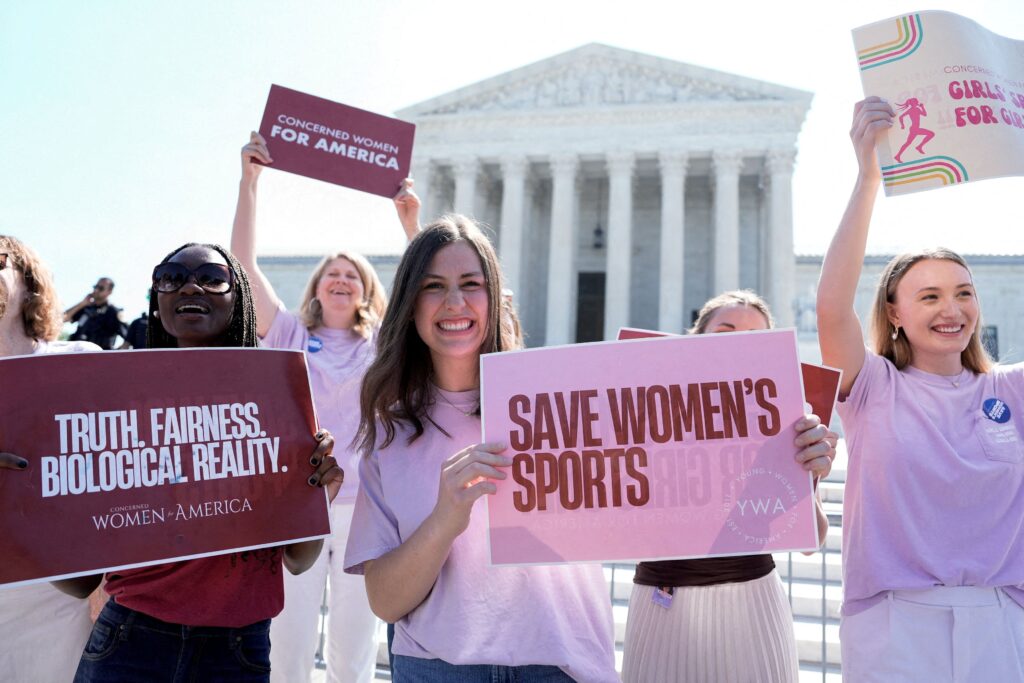
The conservative campaign to stop transgender girls and women from competing in female sports notched a major victory this week — and its leaders made immediately clear they will push for more.
The Supreme Court ruled Tuesday that states may ban trans athletes from girls and women’s teams, affirming policies in 27 states. But it said nothing about the Democratic states that allow transgender students to compete.
Now the Trump administration and conservative advocacy groups are pressing forward in pursuit of a coast-to-coast ban as the fight shifts to another set of court cases. The Alliance Defending Freedom, which won Tuesday’s case, is backing three pending cases, while three cases filed by the Justice Department are also making their way through lower courts.
And more may be coming, conservative activists said.
“Blue states with boys on girls’ podiums … you’re next,” Kristen Waggoner, president of the Alliance Defending Freedom, posted on X moments after Tuesday’s ruling was announced.
The Education Department also pledged to continue to fight for bans against transgender girls in sports. It already has launched dozens of investigations of state athletic associations and school districts since President Donald Trump took office. On Thursday, Defending Education, a conservative advocacy group, filed a new complaint with the department against the California athletic association and two school districts for allowing transgender girls to use girls’ locker rooms and compete on girls’ teams.
Education Secretary Linda McMahon suggested that the court’s decision validated the administration’s approach. “This is a tremendous victory,” she said in a statement Tuesday. “We look forward to ensuring that every educational institution in America abides by the law of the land.”
In a brieffiled in this week’s case, leaders in Democratic states told the court that at least 21 states plus D.C. and 395 other municipalities offer protections against discrimination based on gender identity in areas including education, and that many have policies that allow transgender youths to participate on sports teams consistent with their gender identity.
After Tuesday’s ruling, both sides found encouragement in the reasoning laid out by the Supreme Court, and several Democratic governors said the protections would continue in their states.
“The Supreme Court has allowed states to be as cruel as they want to be to transgender people,” Minnesota Gov. Tim Walz told reporters Tuesday. “They’ve also allowed states like Minnesota to be as kind and welcoming as they can.” He said “nothing will change” regarding the state’s treatment of transgender athletes.
While the battle is set to span the nation, the number of people directly affected by these policies is tiny. In Mississippi, a 2023 statewide survey of superintendents found no trans students were participating in sports. The Washington state superintendent told reporters last year that fewer than 10 of approximately 250,000 student-athletes in the state are trans. In Florida, state records show that just two trans girls have played girls sports over the last decade.
But the politics is loud, with Republicans led by Trump amplifying the issue to a public that generally agrees. A Pew Research Center survey last year found two-thirds of Americans favored laws that require trans athletes to compete on teams that match their sex assigned at birth, up eight percentage points from 2022.
Weeks after taking office last year, Trump signed an executive order to deny federal funding for schools that allow transgender athletes to play on girls’ and women’s teams. Several states refused to comply, and the Justice Department has filed suits against Maine, California and Minnesota.
Meanwhile, a lawsuit filed in Connecticut on behalf of four cisgender female high school track athletes who objected to trans athletes has dragged on since 2020. Another case is pending in Minnesota, filed by the group Female Athletes United. Minnesota won the most recent round in April, when a federal appellate court said the group had not proved that state officials had acted with discriminatory intent when allowing trans athletes to compete on girls teams.
And in June, the Alliance Defending Freedom filed a lawsuit against leaders in Washington state on behalf of a teenage wrestler who said a transgender competitor sexually assaulted her during a tournament.
Controversy once swirled around college athletics, but the NCAA changed its rules almost immediately after the Trump administration made its position clear, which forced most colleges to fall in line, as well. Today, most of the cases involve K-12 athletics.
Lawyers on both sides of the debate saw cause for hope embedded in the Supreme Court’s 6-3 opinion issued Tuesday.
Conservatives said they were encouraged by the court’s interpretation of Title IX, the law banning discrimination on the basis of sex in federally funded schools. The court said that “sex” means biological sex, not gender identity, as some have argued. The court also made clear that it sees inherent physical differences between boys and girls that are relevant to sports.
The decision will be useful in the pending cases, predicted Jim Campbell, chief legal counsel at Alliance Defending Freedom, which defended the state laws banning trans athletes in West Virginia and Idaho that were at issue in Tuesday’s case.
“We think that that ruling will be very helpful to us as we move forward with our challenges,” he said. “I’m sure there are people on the other side who will say the exact opposite.”
The decision may also bolster challenges to school policies that let transgender students use bathrooms and locker rooms that correspond to their gender identity rather than their biological sex, said Ian Prior, senior counsel at America First Legal, a conservative legal advocacy group.
“We’re going to see a blizzard of litigation on all of these issues moving forward,” he predicted.
On the other side, advocates for transgender athletes were encouraged that the court made clear that states may ban trans athletes but stopped short of mandating it. Likewise, the relevant federal law cited by the court says schools are allowed to separate athletics by sex but does not require it. And in his opinion, Justice Brett M. Kavanaugh wrote that these are policy questions best left to the states, not the courts.
“The legislatures and the schools are better equipped — and under the Constitution, are the more appropriate entities — to assess the competing medical and scientific considerations and draw appropriate lines,” he wrote.
That was encouraging, said Joshua Block, senior counsel for the American Civil Liberties Union’s LGBTQ & HIV Rights Project, who argued before the Supreme Court on behalf of Becky Pepper-Jackson, a West Virginia transgender teen who competed in discus and shot put on her school’s track-and-field team.
He said that the states rights argument will be relevant in cases being litigated and also in fighting the Trump administration’s effort to force school districts to ban trans athletes from girls sports.
“The reasoning dramatically undermines the argument that the Trump administration is making,” Block said.
As the legal fight shifts to the Democratic state policies, another factor may come into play: whether states allow all trans athletes to compete or impose criteria. Transgender women who have not blocked their testosterone typically have physical advantages over cisgender women, while research suggests those who have undergone hormone therapy have both advantages and disadvantages. To mitigate concerns, some states consider hormone or other treatments in deciding eligibility. Other states do not.
Some experts said that states with stricter rules may have an easier time winning approval at the Supreme Court because they may be able to show that they are addressing concerns about fairness and safety.
Meanwhile, the matter also will be fought out at the ballot box, with voters in Arizona, Washington state and Colorado set to consider initiatives this year.
Colorado’s Initiative 109 will ask voters in November to restrict students to teams that align with their sex recorded at birth.
Some LGBTQ+ advocates also were looking for ways to navigate the issue outside of the courts, including mobilization around these ballot initiatives.
“We should not be under any illusion about how this [Supreme] Court intends to treat transgender litigants that come before them,” said Shawn Thomas Meerkamper, managing attorney at the Transgender Law Center. “We all need to start focusing on alternative ways of promoting our rights and seeking safety and building community together.”
Casey Parks contributed to this report.
The post Conservatives seek blue-state bans on trans athletes in wake of Supreme Court win appeared first on Washington Post.