Beef is a July 4 staple: Americans bought more than a billion dollars of it for last year’s holiday, far more than they spent on pork or chicken.
But for grill masters who want to take the climate into account, nearly everything other than beef starts to look better. Here’s our guide.
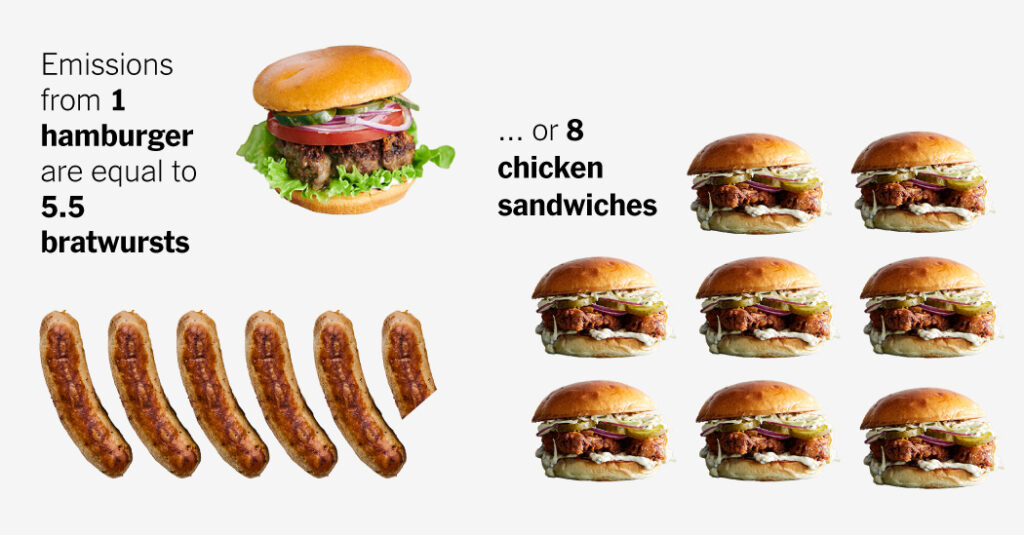
A quarter-pound beef patty takes about 6.8 kilograms of carbon dioxide-equivalent to produce, according to a meta-analysis of hundreds of studies on food production. An equally sized bratwurst sausage made from pork would take a little over one kilogram. That means one burger is equivalent to about 5.5 bratwursts — not counting the bread, tomatoes or any of the stylings.
This isn’t a perfect measure. It’s difficult to calculate the exact emissions that go into different foods. And we’re looking at global medians; food emissions vary widely depending exactly on how and where you produce the beef (or pork, or fish).
For example, beef from Europe and the United States — and from dairy cows at the end of their lives — is responsible for significantly fewer greenhouse gas emissions than beef produced on deforested Amazon land in South America. That means producing beef has by far the widest range of emissions.
But even relatively low-carbon-emitting beef still outstrips almost every other source of protein on this measure. That is, some of the “best” beef still has higher emissions than most brats.
The short answer for why: Cows eat and burp a lot, and take up a lot of land.
The biggest contributor to beef emissions is the “farm stage” — namely, the methane that cows emit from digesting food.
Land-use emissions are the second largest contributor to beef’s carbon footprint. Cattle need a lot of land, either to graze on or to grow the food they eat. Clearing forest or other wild lands to create pastures and cropland produces emissions. (Studies on agricultural emissions often take the carbon costs from each land clearing, spread them over many years, and compare them with how much food is produced.)
Pigs have a smaller farm-stage footprint: They have stomachs with one compartment, like humans, not four, like cows, so they produce a lot less methane. A good chunk of the greenhouse gases related to pigs is emitted while growing the food they need — unlike cows, they can’t survive on grass.
Eating meat directly from your local farm probably doesn’t make a big difference when it comes to total emissions. For most foods, transportation is a tiny slice of the climate cost: It makes up half a percent of beef emissions.
Eating American beef does make a difference: Beef produced in the U.S. has a smaller carbon footprint than beef produced in many other countries.
Eating grass-fed beef isn’t necessarily better for the climate: Raising cattle on grass is generally better for cow welfare, and it leads to less pollution than industrial feedlots, but some studies suggest those cows produce more emissions because they live longer and emit more methane.
Not just emissions
Then there are the other ways that beef draws on resources, besides creating greenhouse gases. For one, aside from how we use the land for cows, there’s just the sheer physical space required to raise them. Beef cattle take up more space per unit of food than almost anything we eat, which has consequences for, among other things, plant and animal biodiversity.
Based on the meta-analysis, a quarter-pound burger needs almost 400 square feet of land, on average — roughly the size of a two-car garage. A similar amount of space could yield almost 20 pork sausages.
There’s also water: Producing meat takes a considerable amount of freshwater, for the animals to drink and to grow the food they eat.
Here, beef is more favorable than on other metrics.
It takes around 42 gallons of freshwater to produce your burger — less than for pork but twice the impact of chicken.
Cheese is particularly water intensive. Dairy cows eat high-protein food that uses a lot of water to grow, and it takes a lot of milk to make a little cheese.
Beef is also the largest contributor — per pound of food — to eutrophication, the pollution of waterways with excessive nutrients. Farmed fish are close behind.
All those numbers point to the fact that the biggest change Americans can make to their diets’ planetary footprint is cutting beef. Just replacing beef (and lamb) with pork and poultry could reduce diet greenhouse gas emissions anywhere from 10 to 40 percent, one analysis found. Some people seem to be making the switch already: Americans eat less beef than they did in the 1980s and ’90s. Chicken consumption, meanwhile, is up.
Additional work by C.J. Robinson.
Image sources: David Malosh for The New York Times (burger, grilled cheese); Linda Xiao for The New York Times (bratwurst, chicken sandwich); Christopher Simpson for The New York Times (fish sandwich); and Jason Henry for The New York Times (Impossible Burger).
The post Burger vs. Bratwurst: A Climate Guide to Your July 4 Cookout appeared first on New York Times.