In 1939, Adolf Hitler celebrated the construction of a new, massive government headquarters he had commissioned in Berlin, calling it “the first structure of the new Great Germany.”
He told 8,000 workers who had created the building and attended the dedication ceremony for the 1,300-foot-long, three-story structure known as the New Reich Chancellery, “Everyone, can take with him the consciousness that he has helped to build a monument that will outlast many centuries.”
About six years later, Berlin was occupied by Allied forces that had defeated Germany in World War II; the building was in ruins and Hitler was dead, having killed himself in a bunker nearby ahead of his country’s surrender.
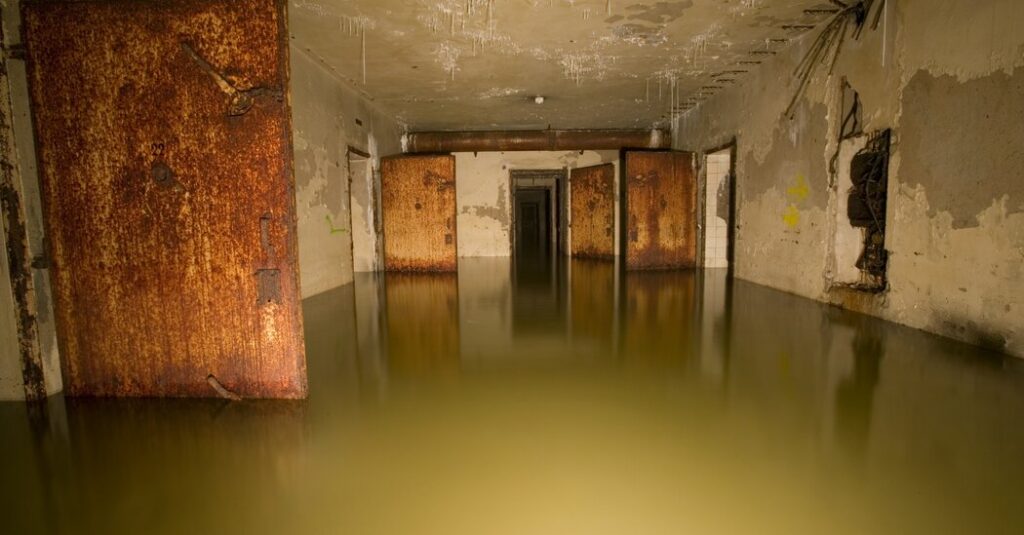
Now, little remains of the edifice save part of a bunker that had been used by other members of the Nazi regime — and this too may soon be demolished, the German publication Bild recently reported, revealing that a Hamburg developer has received official approval to put up apartments and an office in the area.
Preservation experts say the move to develop the bunker site reflects a tension in German society — where a “culture of remembrance” has long been emphasized — between the need to preserve historically significant monuments and the need to develop and modernize. And it comes at a time when the number of living witnesses to the Nazi era is dwindling, making protection of historically significant sites all the more important, some contend.
While the general area where the Reich Chancellery once stood is marked with signs about the site’s history, the bunker has never been officially listed as historically significant. The site above it is nondescript: an undeveloped piece of prime city center property.
In part because of that — and the fact that it is underground — the bunker doesn’t really feature in the collective consciousness of Berliners, according to Stephanie Herold, chair of the Urban Conservation and Cultural Heritage department at Technische Universität Berlin.
“I’m really astonished because I think it’s a really important heritage and an important object,” Dr. Herold said in an interview.
In a memo last year, the Berlin State Monument Council expressed concern about plans to demolish the bunker and recommended it be assessed for protection, saying, “The New Reich Chancellery was the planning and starting point of the Second World War and also stands symbolically for the catastrophic end of the Nazi regime.”
However, there has long been a plan for development at the site — for the last two decades, said Martin Pallgen, a spokesman for Berlin’s Senate Department for Urban Development, Building and Housing. The Berlin Parliament adopted the land-use plan, he added, “even after considering monument protection.”
More recently, officials committed to the landowner that construction would be allowed.
The development department’s current head, Senator Christian Gaebler, “has made it clear that he prioritizes residential construction at this location,” Mr. Pallgen said. Mr. Gaebler did not respond to a request for comment.
The debate about the bunker comes at a time of conflicting impulses in Germany. The country prides itself on its culture of remembrance of uncomfortable truths, like the Holocaust and World War II. And many Germans are reckoning with questions about their family histories as new tools have made researching old records revealing Nazi party affiliations easier than ever.
Hildburg Bruns, who reported on the plans in Bild, said in an email that, as a resident of Berlin, she felt “we should remember” the Nazi era.
Simultaneously, the far-right party, Alternative for Germany, is gaining ground, with some of its most vocal leaders arguing that the country needs to stop looking back. The party’s leader, Alice Weidel, has denounced what she has called a Holocaust “guilt cult.”
There is also pressure to modernize, and the traditional view that anything with historical significance should be preserved is increasingly facing “a strong movement challenging it” to create more residential spaces or meet other needs, said Sebastian Conrad, a Berlin lawyer who handles historical protection cases.
The property in the city center slated for development is “very valuable,” he said, but to him “it’s quite obvious that the bunker has historical significance.”
Preservation and urban development do not have to be mutually exclusive, experts said. Berlin is facing a housing shortage, and preservation laws do mandate balancing competing public interests, like the need for homes and the need to protect historical monuments, Dr. Herold acknowledged.
But members of the public who want to see the bunker preserved have no way to challenge the authorities’ decision, Dr. Conrad said.
The Berlin Underworlds Association, which documents the history of the city’s underground architecture and makes it accessible to the public, is campaigning to preserve the bunker and create a memorial at the site, which is a symbol of Germany’s surrender. The bunker was captured in an iconic image taken in May of 1945, showing the Berlin defense commander, Gen. Helmuth Weidling, emerging to give himself up to Soviet forces after Hitler’s death.
The Underworlds Association said that it “seeks dialogue” with policymakers, officials, and the property owner “to jointly find a solution that combines the preservation of the bunker with the urban development.”
Mr. Pallgen, the spokesman for the development department, said it has not yet been decided “how the owner will handle the specific location” of the bunker. But, he added, they are “obligated to document the bunker appropriately before its demolition.”
The post A Hitler Bunker Faces Demolition In Housing-Challenged Berlin appeared first on New York Times.