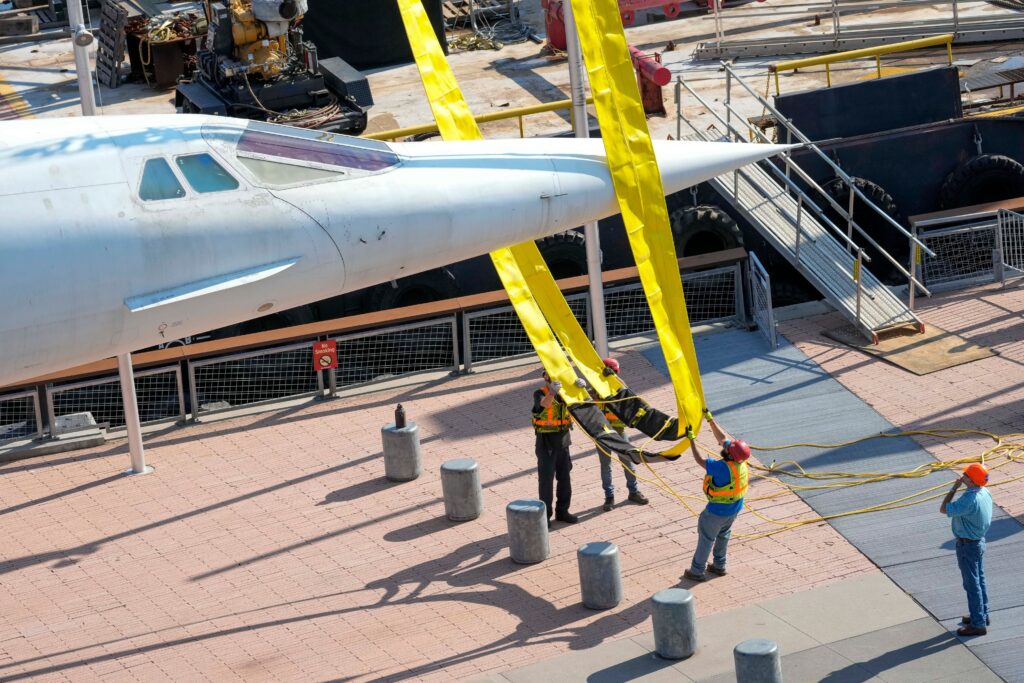
Imagine flying commercial between the West and East coasts in under three hours. It won’t happen anytime soon, but the Trump administration took a step this week to clear the runway for innovative companies to experiment with significantly speeding up air travel.
Transportation Secretary Sean P. Duffy announced Tuesday that he’s moving to rewrite decades-old regulations that prohibit supersonic civilian flights over the United States.
Since the 1970s, the Federal Aviation Administration has banned nonmilitary aircraft from flying faster than the speed of sound over U.S. territory, since doing so results in sonic booms that disrupt communities and can cause property damage. As a result, supersonic jets such as the Concorde — which haven’t flown commercially since 2003 — have been able to operate only over the Atlantic Ocean, outside U.S. airspace.
Now, developers believe that advances in engineering and other strategies, such as flying at very high altitudes, can mitigate noise. NASA recently tested a research aircraft that managed to fly at supersonic speeds with a mild “thump,” as opposed to the rattling blast of a sonic boom.
The new rule proposed by the FAA would replace its speed limitation with one based on noise. That opens the door to “boomless” supersonic operations, so long as companies can prove their jets would have limited impact on communities they fly over.
The industry has a long way to go before any of this becomes reality. The FAA would still need to issue operational requirements for supersonic aircraft, as well as noise standards associated with landing and takeoff.
There’s also no guarantee that airlines will be able to build a business model around supersonic flights. The Concorde — which flew for almost three decades, cutting the travel time between New York and London to about 3½ hours — burned through so much fuel that it struggled to make a profit. A horrific crash in France in 2000 sealed its fate.
Today’s start-ups will need to overcome the same hurdles. Being able to fly over land opens the possibility of more lucrative routes, but has technology come far enough to make it economical for the number of passengers necessary to sustain supersonic flights?
That’s a question for the market, not the government, to answer. Even if the answer turns out to be no, it makes more sense for regulators to focus on limiting noise than speed.
The post The FAA clears the runway to revive supersonic travel appeared first on Washington Post.