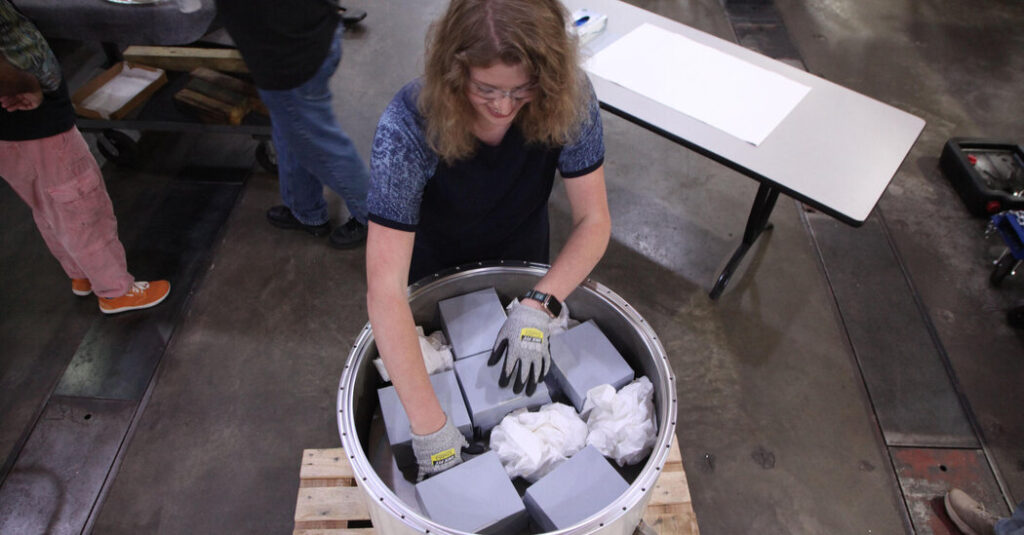
As the country’s 250th birthday approaches, Americans have been busy stocking up on fireworks, visiting Revolutionary War sites — and preparing to bury treasure. Or at least the federal government has.
On July 4, at Independence National Historical Park in Philadelphia, the federal government will bury a time capsule containing objects and records from all 50 states and six territories.
The historical treasures will be stored in a 900-pound cylinder covered with a 1,100-pound bell jar and stashed at least eight feet underground. It will hopefully survive a quarter of a millennium until 2276, when the capsule is scheduled to be dug up again.
The National Institute of Standards and Technology oversaw the creation of the capsule, employing materials science, geometry, physics and other disciplines to ensure the objects inside look as good as new when they’re dug up. Michael Berilla, who led the project as director of the institute’s fabrication technology office, spoke with The New York Times about what went into engineering such a specialized capsule.
This conversation has been edited for brevity and clarity.
This capsule has to represent all American states and territories, so let’s start with its contents. What’s sealed inside?
Maine submitted a message etched on an actual whalebone. The Northern Mariana Islands submitted shells and necklaces. Arizona is the copper state, so they submitted a copper ingot. Ohio is the home of the Wright brothers, so they submitted a piece of fabric from the original Wright flight.
Many states submitted commemorative coins. Almost every state and territory submitted letters — all on archival grade paper with archival ink — from governors, important people from the state, or just from everyday citizens.
The “don’t add that” list included anything that would decompose or interact with the items around it in a negative fashion.
A full list of the over 200 objects inside the capsule can be found here.
How long did it take to collect all of the items?
We actually sent the letter in March asking for people to submit things, but we didn’t finish collecting things up until the day I had to close the humidity cabinet on June 1. The Supreme Court justices signed a pocket constitution, and it took a long time to get all of their signatures.
Given the wide variety of materials, what interior conditions — like temperature and humidity — did capsule engineers have to create to keep everything from degrading?
I love how you use that word, “create,” because that’s what we are doing: creating our own little biome inside. The items and letters were stored for at least 48 hours in a controlled environment — I’ll call it the humidity cabinet. It was set to 35 percent humidity and 23 degrees Celsius. We made it so that when you close the lid, that is the air that will exist for the next 250 years. We know that it is humid enough for items not to naturally dry out and fall apart, and it is not so humid that they will all turn to mush.
Will the temperature remain consistent?
It should. This is a three-quarter inch walled stainless steel tube. It is sealed, so that air is trapped inside. When the time capsule goes to Philadelphia, it will be buried at least eight feet underground, so that’s below the frost line. The temperature down there will stay consistent for the rest of 250 years — I’d say the rest of time, but someone’s digging it up.
You mentioned really thick walls, but what else protects items from the elements?
We chose a cylinder because a round object has no edges, and the edges are usually the first thing that degrade either by rusting or just by breaking, because the seam is the weakest point.
We seal the vessel with what’s called an indium wire. That’s a soft metal that will weld to itself. And when compressed, it will fill all the cracks and microscopic voids to create a perfectly airtight system.
The lid is fastened with 43 bolts, and then over the top of the time capsule is something called a bell jar. It will capture air inside of it, and that air will form a bubble. If water tries to get into the bell jar, the pressure will increase and that air bubble will force the water back out.
Tell me a little more about the sealing process, which took place a couple weeks ago.
On the day of, we started at about 9:30 a.m. and everyone was pretty hyped up. You want to move the items as quickly as possible into the time capsule, and seal it up so that the environment stays controlled.
Once everything was loaded, we craned in the lid, laid down the indium wire and then brought the lid down.
Now that it’s sealed, what’s next?
The next part of the process for me is a huge sigh of relief. We hand it off at this point.
The next group of collaborators will need to transport it, receive it, get it in place and have construction workers digging holes. Then, this will all come together in a really cool celebration on July 4, when they’ll put this capsule in the ground.
This has been a monthslong endeavor for you, but for the people who will only see the capsule as it’s being buried, what do you hope they take away from the experience?
I really view time capsules as a way to share identity, to show what was important and valued. You can only pick a few objects, so you have to think: What really represents you?
I’m hoping for a collective feeling of unity. I think it’s a really powerful message to come together and accomplish something as crazy as making a capsule that will live for 250 years.
Looking further ahead, I had the unique honor of actually writing a letter on behalf of the people who made the capsule. It’ll be the first letter that they get to open.
The letter, shared with The New York Times, begins, “To you who are reading these words in the year 2276: Greetings from the living, breathing hearts and hands of 2026.”
The post How to Make a Time Capsule That Will Last 250 Years appeared first on New York Times.