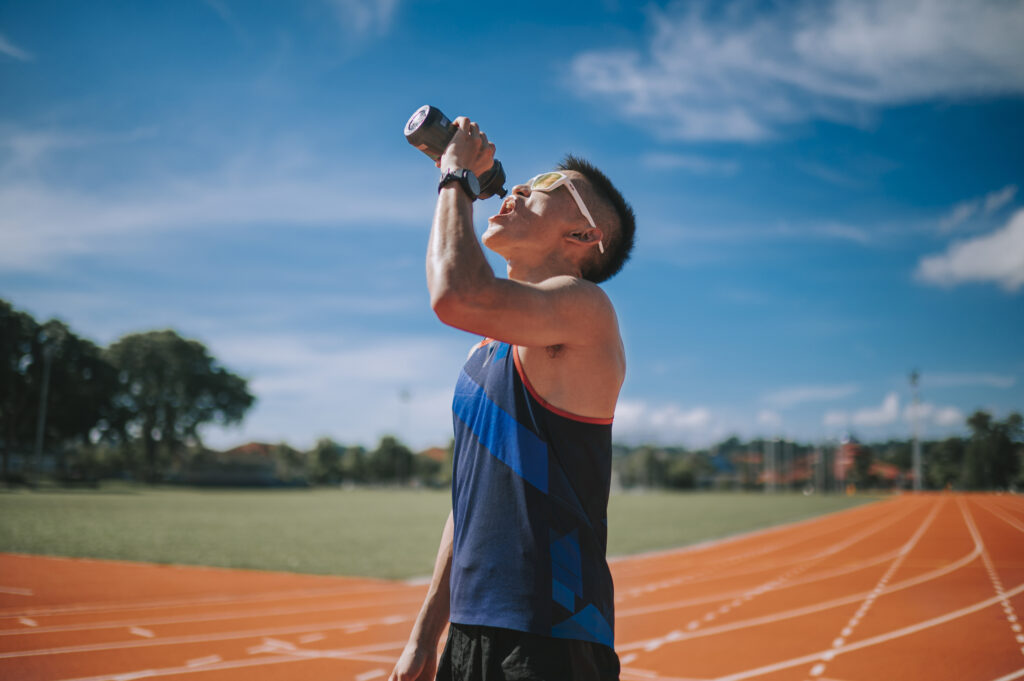
During the cold, dark days of winter, outdoor exercisers can’t help but look toward the summer with gleeful anticipation. But when the heat actually rolls in, a reality check arrives with it: Exercising outside in the warm months can be challenging.
It’s not just your perception. Exercising in hot temperatures stresses your body more than comfortable environments.
It all has to do with blood flow. Whenever you’re walking, running or cycling, your body shuttles blood to your muscles, so they can get the work done. But when it’s hot out, your skin also requires extra blood flow to help you sweat and thus cool off.
“So your body has to work almost twice as hard to do both of those things simultaneously,” said Riana Pryor, director of the Hydration, Exercise, and Thermoregulation (HEAT) Laboratory at the University of Buffalo. As a result, the same workout that feels easy in the cool days of spring may become incredibly difficult during hot summer sessions.
Steamy workouts may never feel effortless, but there are some things you can do to make them more bearable — and protect your body from heat illness — while you’re getting them done.
Gradually get your body used to higher temperatures
You don’t want to jump right into your regular workout the first day it’s really hot. Instead, focus on acclimating your body to the heat slowly, said Rebecca Stearns, chief operating officer at the University of Connecticut’s Korey Stringer Institute, which researches heat illness among athletes.
This can look like gradually increasing duration or intensity, and working in more breaks, as your body gets used to the warmer temperatures. For example, instead of going for a 30-minute run right away, start with a 15-minute session that includes walk intervals, and work up from there.
Repeated, brief exposures to warm environments spark important body-wide adaptations, including increasing your blood plasma volume, boosting your sweat rate, and lowering your core temperature and heart rate during exercise, Stearns said. Once you’re adjusted, “it’ll feel less hard to exercise in that environment,” she added.
For professional athletes, whose sessions generally last at least an hour during acclimation, the process takes about 10 to 14 days. It’ll take a little longer if your sessions are shorter, Stearns said.
There’s even research to suggest that six consecutive days of soaking in a hot bath for 40 minutes after exercising could help your body acclimate and improve performance in heat.
Hydrate before, during and after
“If you’re starting exercise dehydrated, your core temperature is going to rise faster than if you start in a fully hydrated state,” Pryor said. Not only can this make you uncomfortably warm, but it can make your normal effort feel even harder.
How much you should drink depends on several factors such as individual sweat rate, body size, activity level and environment. But a consensus statement published in the British Journal of Sports Medicine gives a general guideline for pre-exercise hydration: Rather than chugging water right before your session, aim to take in 6 milliliters of fluids per kilogram of body weight two to three hours before exercising in the heat (roughly 14 ounces for a 150-pound person). Make sure you’re also drinking consistently throughout the rest of the day, Pryor said.
During exercise, the goal is to take in enough fluids to prevent more than a 2 percent decrease from your starting body weight, per the American College of Sports Medicine. Generally, consuming 7 to 10 ounces every 10 to 20 minutes during exercise does the trick.
Afterward, you should aim to replace 100 to 120 percent of the fluid you sweat out. You can do this by drinking 16 to 19 ounces for every 1 pound you lost.
If you would rather not deal with the scale, you can also use other guidelines to gauge your hydration level. Simply feeling thirsty can be a cue to drink up, as can urine that is any darker than a light yellow. If both of those are true, “it’s pretty likely that you’re dehydrated,” Stearns said.
Dress for the conditions
The goal of sweating is to allow moisture to evaporate, which cools you off, so you want to wear clothing that helps the process along, Pryor said.
The tight, stretchy garments you see at the gym probably aren’t going to cut it: Opt for loose, lightweight material made of sweat-wicking fabrics — usually synthetic polyester blends or merino wool.
“If you notice sweat dripping — a lot of times, it’s down your back — it means you don’t have airflow to the area, so you can’t cool yourself down,” Pryor said. “If you notice that, it might be time for a looser shirt or a different-material shirt that’s a little bit lighter, so that air can flow through it.”
Precool your body
Reducing your core body temperature ahead of time can help you feel cooler in the heat. “If you’re in a cold shower for five or 10 minutes, that probably would help you for the first 10 or 20 minutes of your run,” Pyror said.
Hanging out in a heavily air-conditioned room beforehand or precooling with ice vests are also options, Stearns said. So is DIY-ing something similar: Keep towels in a cooler with ice and water, and rotate them over large portions of your body, such as your legs, arms or neck, for five to 10 minutes, Stearns said.
You can also drink a cold slushy (a combo of crushed ice and water) before your outdoor session. When Pryor and her team had firefighters try this before working in the heat, it modestly reduced their core body temperature during the first 30 minutes, according to a study published in Prehospital Emergency Care. Whip up your own electrolyte-packed version by blending together your favorite sports drink with ice, Stearns said.
Be flexible with your workout — and dial back if you feel unwell
If you have a set workout planned with specific timing or pacing, you may need to cut it short or adjust it to be a little slower to account for the weather.
Stearns, a runner who is not a fan of the heat, switches up her schedule as needed: If she’s planning a long run Saturday, but the forecast looks hot and humid, she’ll switch it to Friday or Sunday instead. And she’ll nudge it earlier, too — the hottest times of day tend to be between 10 a.m. and 5 p.m.
Swapping routes also can help: A trail shaded by trees tends to feel cooler than a neighborhood route, where the sun reflects off the concrete sidewalks and asphalt streets. And choosing a walking or running route that’s a loop instead of an out-and-back can be helpful if the heat catches up with you, and you need to bail.
“Really listen to your body and recognize that if you’re feeling worse than usual, then it’s probably time to slow down or take a little bit more water or a little bit of rest,” Pryor said.
It’s also important to keep an eye out for signs of heat illnesses. These can range from minor — such as heat edema, which can cause your hands to swell — to dangerous, such as heatstroke, which happens when your body’s temperature control fails and can be life-threatening. Signs such as nausea, fatigue, dizziness, clumsiness or irritability are warning signs of heat stress or exhaustion, precursors to heatstroke, Pryor said.
These symptoms can signal that “it’s time to stop the workout for the day, and then maybe try again the next day or a day later,” she said.
The post How to stay safe when exercising in the heat appeared first on Washington Post.