A Chinese lab recently unveiled another astonishingly powerful and astonishingly cheap artificial intelligence model. GLM-5.2, produced by Z.ai, is almost as good as Anthropic’s latest model but runs at less than a tenth of its price.
The A.I. race between the U.S. and China has been front of mind at the highest levels of government in both countries.
But creating the most potent model is not the only — and maybe not even the best — way to measure A.I. success. Today I write about an area that’s had less attention, but where China might well have an edge: managing the human and political fallout from the A.I. revolution.
Robotaxis and A.I. Marxism
If there is one thing China’s Communist Party fears, it’s a restive proletariat.
In Wuhan, the world’s largest open-air laboratory for driverless cars, taxi drivers first complained about the growing fleet of robotaxis two years ago. Petitions were filed. Social media posts were hashtagged. The local outcry was noisy.
It focused minds in the party, which reacted swiftly to censor the protests online. But it also set off a bigger rethink of something that worries many in the West, too. How to avoid mass displacement of humans by A.I. in the labor market — and the political backlash that comes with it?
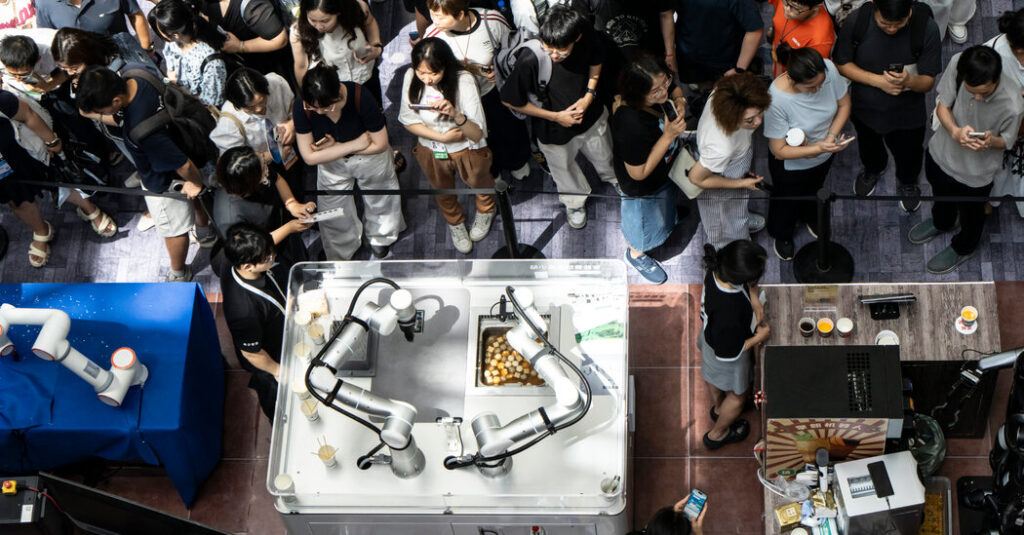
China has more experience than most countries with automating jobs. More than two million robots work in its factories. Driverless delivery vans roam many of its cities. Service robots attend to guests in hotels and restaurants. Parking-lot robots swap out dying E.V. batteries. Drones deliver lunch.
So far the fallout has been mostly among blue-collar workers. But A.I. is primarily threatening college graduates. And for an authoritarian regime that fears political instability, that’s a group that has historically caused trouble.
Which is why China’s goal to become the world’s A.I. superpower is now officially twinned with another one: keeping humans at the core of the A.I. economy. And over the past year, the government has started acting more decisively to make that happen.
‘Liberating labor,’ one court case at a time
When the Communist Party wants to show it really means something, it puts it in a five-year plan. And on Page 72 of its current five-year plan, China commits to “comprehensively address” the impact of A.I. on employment.
I spoke to Kyle Chan at the Brookings Institution, who studies China’s A.I. policy. He told me that China wants A.I. to augment humans — that is, make them more productive across old and new industries — not replace them. And in the process of transitioning to this A.I. economy, it says, it wants to cushion the impact to avoid social fallout.
My colleague Catie Edmondson recently wrote about what this looks like. The Ministry of Human Resources and Social Security is promising “targeted employment support for key industries.” One member of the National People’s Congress is calling for an “A.I.-unemployment insurance program” as a safety net for displaced workers. Party officials have pushed for vocational training to help workers adapt to an A.I.-centric job market.
Chinese scholars have even been developing a field they call A.I. Marxism — trying to apply a Marxist lens to questions like “Who or what creates value after the A.I. revolution?” (The machine? The human who invented it? The human who operates it?)
Perhaps most strikingly, the government is leaning heavily on companies to avoid layoffs. And those who don’t fall in line might find themselves in court.
There have already been several high-profile rulings siding with workers who were dismissed. In April, a court ruled that a tech company had illegally laid off a worker after replacing him with A.I. software. The ruling delivered an implicit warning to other employers.
“The development of artificial intelligence technology should be applied to liberating labor, promoting employment and improving people’s livelihood,” the Hangzhou Intermediate People’s Court wrote. “Labor law allows employers to undertake technological changes and upgrade their operations, but it should also take into account the protection of workers’ legitimate rights and interests.”
Just how that will work in practice, and how far the government is actually prepared to go with companies that don’t comply, remains to be seen. But what these rulings underscore is how much China is thinking about the problem.
Two different A.I. visions
The U.S. is letting tech companies take the lead on A.I., and Silicon Valley is focused primarily on one thing: achieving superintelligent machines capable of displacing humans. It’s an approach the Trump administration seems to be broadly on board with, or at least isn’t willing to stop.
China’s approach is different. China is imagining what it wants its economy and society to look like and how A.I. can help achieve that, Chan, the Brookings expert, says. It wants a self-reliant economy, and so it’s embedding A.I. in every industry — from flashy new businesses like robotics to uncool old industries like steel or cement — to turbocharge productivity so it can never be strategically vulnerable again.
It also wants stability and so, even as it does so, it’s thinking about how to keep humans employed.
China’s vision for A.I. is state-driven, aimed at achieving government goals. America’s is company-led — companies like Open A.I. are pursuing superintelligence because it fits with their own interests, not because of a broader U.S. strategy, for now.
The lesson from China isn’t that countries should follow its specific approach to A.I. and jobs, Chan says — Chinese-style control over the tech industry isn’t feasible in most Western countries, for example. But China shows that policymakers have agency over this technology. They can influence its direction, rather than just letting the (A.I.) chips fall where they may.
Human choices still matter. That’s one reason we’re already seeing two very different visions for the future of A.I., playing out in real time.
OTHER NEWS
-
As traffic in the Strait of Hormuz begins to pick up again, Iran and Oman are moving forward with plans to collect payment for transiting ships.
-
Russia said it had shot down 419 drones from a Ukrainian attack that targeted areas including Moscow and Crimea.
-
The Supreme Court struck down President Trump’s executive order limiting birthright citizenship.
-
Keiko Fujimori was elected president of Peru, decades after the collapse of her father’s authoritarian government.
-
A bomb exploded in Monaco, injuring three people and prompting a cross-border hunt for the perpetrator.
-
Guo Wengui, a Chinese businessman and ally of the American far right, was sentenced in New York to 30 years in prison for defrauding investors.
-
More than one million undocumented migrants in Spain have applied to legalize their status under a new program, Prime Minister Pedro Sánchez said.
TOP OF THE WORLD
The most clicked link in your newsletter yesterday was about a study that involved tickling baby apes.
WORLD CUP
Norway won a World Cup knockout game for the first time, defeating Ivory Coast 2-1 with a late goal by Erling Haaland. France, the 2018 World Cup winner and 2022 runner-up, is facing Sweden.
The “Viking row”: The signature cheer of Norway’s fans, featuring imaginary oars and a “Ro!” chant, has taken over the World Cup. Not everyone is thrilled.
Penalties: For the losing side, shootouts can feel extremely cruel (sorry, Germany and the Netherlands!), but is there a better way to settle tied games? Writers from The Athletic weighed in.
WORD OF THE DAY
Matahara
Workplace discrimination against pregnant women and young mothers is so common in Japan that it has its own word: matahara, or “maternity harassment.” A national debate about the issue has been reignited after Shoko Kawata of Yawata became the first mayor in the country’s history to plan on taking maternity leave. Some men are furious.
MORNING READ
Bending Spoons, an Italian firm that has amassed a stable of aging internet companies, is going public this week at a potential value of $19 billion. Its strategy of buying old names like AOL, Evernote and Vimeo stands out in an industry obsessed with the new.
The Bending Spoons playbook is often to cut staff, raise prices and send in its army of young engineers to improve the products and kick-start growth. The approach has angered some of the companies’ employees and customers. Read more.
AROUND THE WORLD
A zombie pilgrimage to Pennsylvania
Each year, fans of the movie “Dawn of the Dead” flock to the mall in Monroeville, Pa., that George A. Romero filled with zombies during filming in the late 1970s for a weekend of panel discussions and autograph sessions. This year’s gathering had an elegiac feel: Walmart has bought the building and plans to demolish it.
“It’s hard to fathom, because it’s so iconic to so many people,” one attendee said in disbelief. Read more.
RECOMMENDATIONS
Watch: A scene from a “Lord of the Flies” adaptation is among our critic’s favorite onscreen moments of the year.
Understand: Why can’t you eat as much as you used to as you age?
Read: A biography asks why the French novelist George Sand is remembered more for her suits and love affairs than her work.
Tend: An English landscape designer shares his secrets for creating a naturalistic garden.
RECIPE
Pancit is the catchall term for Filipino noodle dishes; the name comes from the Hokkien phrase “pian i sit,” meaning “food cooked fast.” In this one-pan version inspired by Chinese stir-fries, chewy wheat noodles are coated in a savory, citrusy sauce.
WHERE IS THIS?
Where is this iceberg?
TIME TO PLAY
Here are today’s Spelling Bee, Mini Crossword, Wordle and Sudoku. Find all our games here.
That’s it for today. See you tomorrow! — Katrin
We welcome your feedback. Send us your suggestions at [email protected].
The post China’s Plan to Save Jobs From A.I. appeared first on New York Times.