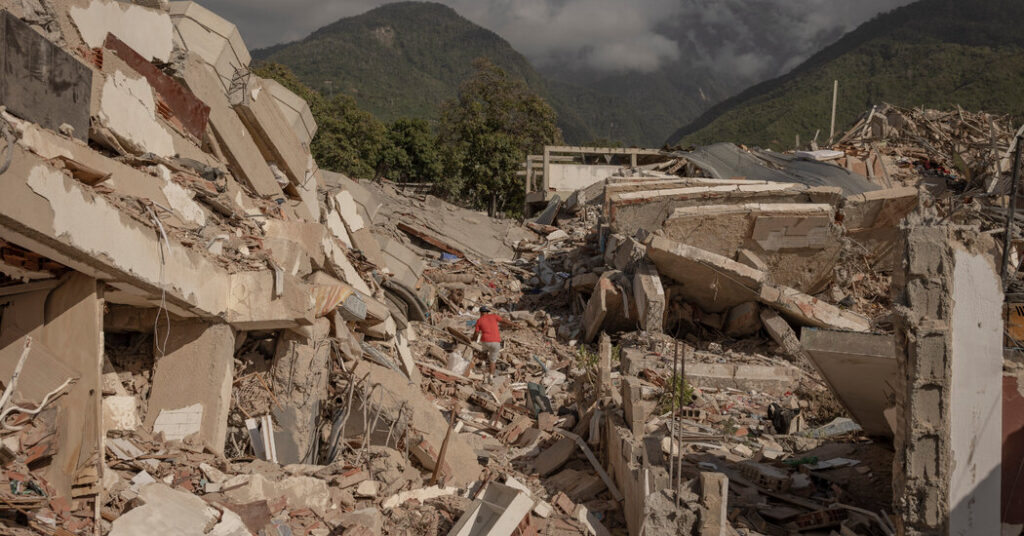
As the window of opportunity shrank in the search for earthquake survivors trapped under rubble in Venezuela, relief efforts on Tuesday began to focus on the longer-term ripple effects of disaster that are often less reported.
One of the most pressing consequences is the destruction of what little infrastructure for clean water existed in affected areas, raising the risk of contamination and the spread of illnesses like cholera and typhoid fever.
“The water distribution system collapsed as a result of the earthquake,” said Susana Arroyo, a spokeswoman for the International Federation of Red Cross and Red Crescent Societies in Caracas, Venezuela’s capital.
Ms. Arroyo confirmed in a WhatsApp message on Tuesday that in parts of La Guaira, one of the states hit hardest, bottled water remained the only option for bathing, brushing teeth, washing hands, cooking and everything else.
“The same applies to sanitation,” she said. “The sewage system was destroyed, and access to toilets is limited — and in some areas, nonexistent.”
The feared long-term consequences of last week’s tremors piled onto longstanding problems. Many in La Guaira state lacked access to running water before the earthquakes, relying on mobile water tankers for basic needs, Ms. Arroyo said.
Over the past 10 years, water supplies have run dangerously low in Venezuela. Hospitals have also been failing and lack basic resources. By the end of 2025, the United Nations and independent civil society organizations estimated that more than 7.9 million people in the country — more than a quarter of the population — faced critical food, water and health care shortages.
During the earthquakes and in the immediate aftermath, officials have counted over 1,900 deaths, a figure that rises daily, though the true toll is difficult to pin down.
The knock-on effects could lead to countless more deaths because life-sustaining infrastructure has been demolished.
Many people remain homeless because their residences were flattened. Others fear their former homes could crumble on top of them at any moment, so they have not returned. The earthquakes destroyed roads, power lines and sewage systems, and they cut off access to life-sustaining medications for people with chronic conditions.
Carlos Arias Vincente, who oversees medical operations in South America for the aid nonprofit organization Doctors Without Borders, said his teams had not yet seen organized water distribution or safe waste disposal in affected areas.
Without proper safety measures, Dr. Vincente said, displacement camps and aid shelters could become hot spots for diseases like malaria, diphtheria and cholera, which he observed during past earthquake responses in Syria and Haiti.
Aid workers stressed the need to establish safe places quickly for people to wash themselves, prepare food and dispose of waste.
Dr. Byron Scott, chief medical officer at the emergency aid nonprofit Direct Relief, said his organization was preparing to send kits containing antibiotics, water purification tablets and personal protective equipment to help mitigate the possible spread of waterborne illnesses.
Without urgent efforts to detect infections and establish access to clean water, Dr. Scott said, outbreaks could “progress pretty quickly.”
The Spanish Red Cross plans to establish a clinic in La Guaira in the coming weeks to watch for outbreaks and provide mental health services for survivors. Ms. Arroyo expects the clinic to operate “nonstop” for the next four months or more.
“The end of the search-and-rescue phase,” she said, “is not the end of the disaster. It’s just the beginning.”
The post Aid Workers Fear Disease Outbreaks in Venezuela After Quakes appeared first on New York Times.