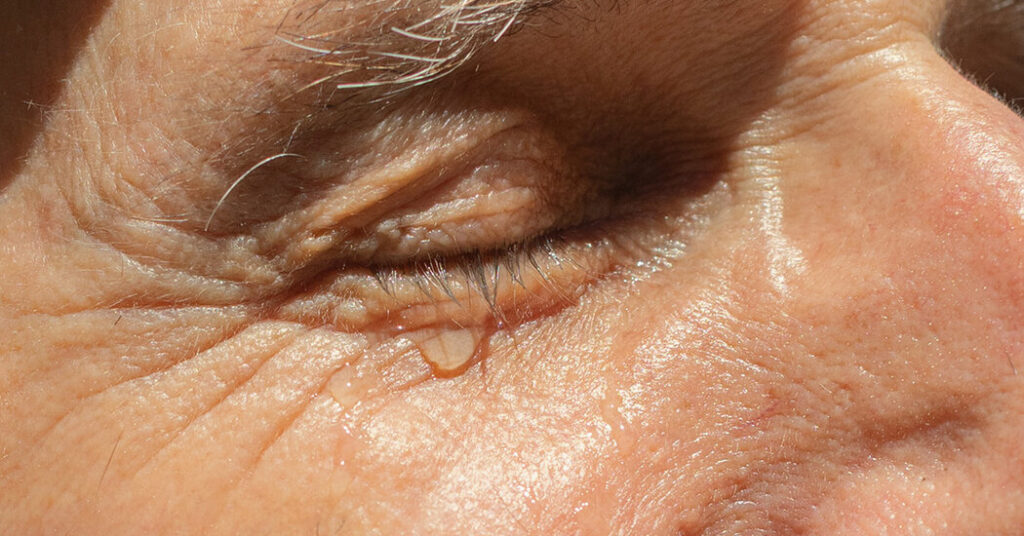
Old people cry a lot. I will see a sweet child in the street, watch a news story about a heroic rescue or catch sight of a peony or of a full moon, and my eyes will be awash with tears. Whatever it is that I am feeling seems expressible only this way. People weep for joy or sorrow. I do neither, consciously.
Something comes over me, as it did the other day when I was sitting alone in an elegant room at the New York Society Library, waiting for an event at which I was to speak. It was one of those breathlessly hot days in mid-May, and the heat outside seemed to compound the still silence inside. For no apparent reason, I began to sing a song from “Carousel” called “If I Loved You.” I don’t mean that I muttered the song softly or mouthed the words or whispered. I mean that I sang clearly, nearly belting it out, as if I were onstage in the middle of the play: “If I loved you, / Words wouldn’t come in an easy way / Round in circles I’d go / Longin’ to tell you / But afraid and shy, / I’d let my golden chances pass me by.”
And sure enough, I started tearing up, as I tend to do often these days.
My singing at the Society Library lasted less than a minute. My event was about to begin, and I left the room thinking of what I was going to say. All the tentative beauty of the Rodgers and Hammerstein song had vanished along with my tears. But for a moment there, I was living in the world of the lyrics, a world of thwarted possibility and regret — not my own but rather that of everyone, the world I have arrived at after 85 years of living. And I was saying or singing to that world how I’d love you if I loved you.
Why do I tear up so often? I think it has to do with the past, how much past has built up inside me all these years. I first saw “Carousel” when I was 10 and was frightened by Billy Bigelow’s violent death. I saw it again when my granddaughter Jessica appeared in a school version of the play and I heard “Soliloquy,” which includes the recurring phrase “my little girl,” not long after our daughter Amy died. Yet these days I may tear up not for the play specifically but rather for all the years the play has rested with me, and whatever I’m feeling is both gone and remembered.
The past is a strange thing, both present and missing. In John Donne’s “Song: Go and Catch a Falling Star,” he creates a list of impossible things en route to his scoundrel’s lament that there’s no such thing as a woman who is faithful. “Tell me where all past years are,” he writes. It’s like the common phrase “Where did the time go?” to indicate that a stretch of time has passed too quickly to enjoy it fully. Here, Donne means the phrase literally. Where does time go? It is impossible to know.
And how suddenly the present becomes the past. Lifelong friends, here yesterday, gone today.
So many things lost in a life, my life, yours. So much left to articulate yearning. The proposition of “If I Loved You” is that, in fact, I do love you but I cannot say it. I don’t have the words or the nerve. In Jane Austen’s “Emma,” the stoic Mr. Knightley says to the meddling heroine, “If I loved you less, I might be able to talk about it more.”
Is that why I tear up? Because I’m so overwhelmed with life as I approach the end of it that I’m at a loss for words and all I can do is cry?
Overwhelmed. That seems to be the basis of weeping. Lord Byron contemplates losing his love, then regaining it. “How shall I greet thee? / With silence and tears.” In fact, tears are a form of silence. Voltaire called them “the silent language of grief.” They are for everything we cannot say, a tear for every word. A tear rolls down our face, glistens, then dries and disappears. Or we wipe it away, as if we are ashamed of it, as if we are getting rid of it. We never do, any more than we get rid of the pain that the endorphins were sent to cure.
In older age, the inexpressible may occur more frequently because one is approaching the ultimate inexpressibility of dying. We cannot know death until it is too late to report back on it. And we know the impossibility of knowing until all knowing has vanished into the past, the remembered, forgotten past.
Whatever happened to your life long ago, whatever carousel you were on, reminds you of yourself, who also happened long ago. So you’re tearing up for all that is gone, all that monumental past, vast and variegated. These days, I have so much past behind and within me, it’s as if it bubbles over.
In my appearance that day, I said that one of the beauties of old age lies in appreciating what one has as opposed to ever wanting something new. This is true. But all that one has can gang up on you, too, and hit you when you least expect it. Such as the time I found myself all alone in an elegant room at the New York Society Library and sang my heart out.
Roger Rosenblatt is the author of “More Rules for Aging,” “Making Toast,” “Kayak Morning,” “Cold Moon,” the satirical novel “Lapham Rising” and other books.
The Times is committed to publishing a diversity of letters to the editor. We’d like to hear what you think about this or any of our articles. Here are some tips. And here’s our email: [email protected].
Follow the New York Times Opinion section on Facebook, Instagram, TikTok, Bluesky, WhatsApp and Threads.
The post Why Old People Cry appeared first on New York Times.