Shirley Jennett, a retired nurse, loves her spacious ranch-style house in Denver, with its big backyard and gazebo.
“I want to stay here,” she vowed. “And die here.”
She might pull that off. In relatively good health, Ms. Jennett still drives to lunch with friends, does her own housekeeping and grocery shopping, and plows through a book a day, usually a mystery. But her children worry about her living alone at 89, especially after she has had a couple of falls.
Enter her new housemate, Susan Beese. Despite working four days a week in retail, Ms. Beese could no longer afford her nearby one-bedroom apartment as the rent topped $1,500 a month. She moved out, first staying with friends and then in what she delicately called “a senior women’s facility.”
Now Ms. Beese, who is 79, pays Ms. Jennett $800 monthly for a bright two-bedroom space, with a bath and a kitchen, on the lower level of her house. As part of the agreement the housemates worked out, she helps plant and water Ms. Jennett’s garden, takes out the trash and cooks occasional meals.
“It’s been a lifesaver,” Ms. Beese said. Ms. Jennett even welcomed her dog.
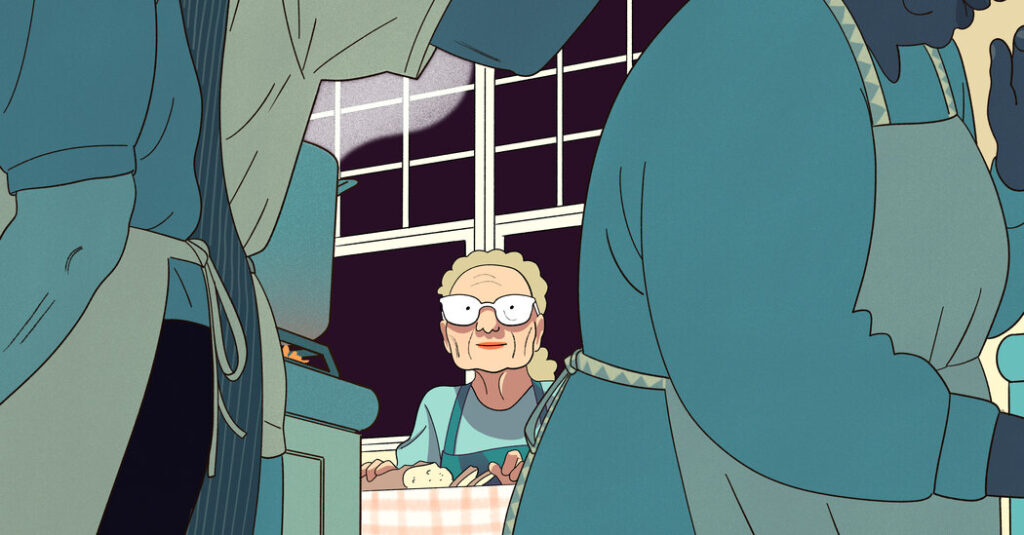
Meet the real-life Golden Girls. In the much-loved 1980s sitcom, still in perpetual reruns, the four wisecracking women who share a house in Miami met through an ad on a supermarket bulletin board.
In Denver, the housing matchmaker was Sunshine Home Share Colorado, a local nonprofit that Alison Joucovsky, a senior services administrator, founded in 2016 when the problem became urgent. “My phone was ringing off the hook,” she said, recalling anxious pleas from older residents spending most of their Social Security checks on rising rent or facing years-long waiting lists for subsidized senior housing.
Home sharing “is a really efficient way to create affordable housing and to support older people who want to age in place,” Ms. Joucovsky said. Carefully vetting both “home providers,” who may be rattling around in family houses now too big and too empty, and “home sharers” seeking reasonable rents, Sunshine facilitated 31 shares last year, a record for the nonprofit.
“The cost of developing and building new housing is astronomical, and so is the length of time it takes,” said Laura Fanucchi, president of the National Shared Housing Resource Center and an administrator with HIP Housing, a home-share organization in San Mateo County, Calif. “Why not make use of existing housing stock?”
About 55 organizations around the country offer these services — and demand is growing, driven by housing shortages, rising rents and sales prices that affect both the old and the young. Legislators in several states are working to promote home sharing as an option. (Personal care is not part of these arrangements.)
The need is acute. About a third of households headed by someone 65 or older were “cost-burdened” in 2024, according to an analysis by the Harvard Joint Center for Housing Studies. That means they spent more than 30 percent of their income on housing.
Although nearly 80 percent of those people were homeowners, the center found, an increasing proportion are still paying off mortgages or home equity loans, and most contend with higher taxes, utility and maintenance costs and insurance premiums.
“A lot of the people calling me to complain about property taxes and inflation are senior citizens on fixed incomes whose children have left, and maybe their spouse has died,” said State Representative Abby Major, Republican of Pennsylvania and a co-sponsor of a bill that would facilitate home sharing. “They’re a single older adult living in a four-bedroom house.”
Yet most don’t want to relocate. Even if they do, many older adults will find that downsizing has also become prohibitively expensive, as home prices rise and very low interest rates become a memory.
Younger people are similarly cost burdened, including 37 percent of those aged 25 to 34, and 31 percent of those 35 to 44, the Joint Center has reported. Home sharing can benefit both older homeowners who need income and people of any age in search of lower-cost housing.
To help increase their reach, some home-share programs now supplement or replace the traditionally labor-intensive matching process with online platforms. (For-profit companies like Nesterly or Roommates.com also facilitate shared housing.)
“It’s like online dating, except that people who have rooms can meet people who need rooms,” said Candice Smith, executive director of HomeShare Oregon. “And it’s a lot more secure.” HomeShare’s online platform has drawn close to 7,000 providers and seekers over five years.
Further support has come from the city of Portland, which this year announced a pilot program to pay $1,000 to homeowners who make a spare room available (or $1,500 for two rooms) through qualified home-share programs.
In addition, legislators in several states have introduced or passed bills that prohibit municipalities from unduly restricting homeowners who want to rent spare rooms to nonfamily members. Sponsors in Pennsylvania and Connecticut actually call them Golden Girls bills, and they’ve drawn bipartisan support.
“So many young people have basically given up on buying a home,” said State Representative Manny Rutinel, Democrat of Colorado. He helped pass a 2024 law prohibiting cities and counties from limiting the number of unrelated people who could live together in a single dwelling.
In Pennsylvania, State Representative Tarik Khan steered a similar bill through the House in June; it awaits a Senate vote. “It doesn’t make sense that your cousin can move in but someone unrelated to you can’t,” said Mr. Khan, a Democrat.
The Pennsylvania bill caps the number of nonfamily occupants in a home at five; Connecticut’s limit would be three. That bill passed the Senate in April, and then died without a vote in the House. But the bill sponsors plan to reintroduce it next session.
Home sharing can’t solve the housing crisis, its fans acknowledge. But it could make a dent, potentially unlocking thousands of spare bedrooms across the country without requiring new construction that would change the character of neighborhoods.
Admittedly, matching homeowners with those who want to rent a room becomes a delicate process. Home-share staff members typically interview the individual parties, run background checks, verify incomes, coordinate initial phone calls and meetings and mediate if problems later arise.
They also help applicants sift through the myriad lifestyle preferences that can torpedo a match. “Living together isn’t easy,” Ms. Fanucchi said. Will the home provider accept smokers, pets, visitors? Does the sharer work from home? Or need to park a car? Who sets the thermostat?
Sometimes the agreement includes a “service exchange,” in which the newcomer does a few hours of chores like snow shoveling, shopping or some meal preparation in return for reduced rent.
Jenlyn and Larry Boyer, for instance, have lived in their ranch house in suburban Broomfield, Colo., for 31 years and never want to leave. But Ms. Boyer, who is 80, has “gotten unsteady” and uses a walker. Her husband, 70, suffers chronic fibromyalgia pain and needs a wheelchair.
Because they now pay for tasks that they used to undertake themselves, and because inflation has undermined their finances, “I had an epiphany,” Ms. Boyer said. “We need more help and we need more money.”
Six months ago, through Sunshine Home Share, they met a 46-year-old graduate student whose monthly rent had doubled to an unmanageable $2,000.
The student moved into their furnished downstairs bedroom/family room with a bathroom, a small refrigerator and a microwave. In exchange for about 10 hours of dishwashing a month, she pays a reduced rent of $600.
The additional income has helped the Boyers cover expenses like van repairs and wheelchair batteries. But they also enjoy chatting with their new housemate.
“She turns out to be just a gem,” Ms. Boyer said. “We laugh together a lot.”
The New Old Age is produced through a partnership with KFF Health News.
The post Older Adults Turn to ‘Golden Girls’ Housing appeared first on New York Times.