Lionel Messi’s finger needed to be straightened. His leg muscles still had to be sculpted, then clothed in the Argentine national team’s shorts. And a net was needed to cover Messi’s mouth to prevent doves from nestling inside, said Aldo Beroisa, an artist, as he stared at his colossal, unfinished sculpture of Argentina’s soccer idol.
As Messi, the captain of the Argentina team, chases the lofty goal of leading his team to a second consecutive World Cup title, Mr. Beirosa has taken on another monumental challenge: building a gigantic statue of the soccer icon in the middle of the Patagonian desert.
“We are going to make it,” said Mr. Beroisa, his ankles swollen from a recent fall he took as he rushed between Messi’s feet to finish the work ahead of this year’s tournament. “He deserves it.”
For over a year, Mr. Beroisa — a former railway worker and a local artist whose portfolio includes multiple statues of dinosaurs and of Jesus — has been cutting and welding old oil pipes in the desert dust to shape them into Messi’s steel skeleton.
He has defied the relentless Patagonian winds that pulverized Messi’s beard, Earth’s gravity that once snapped the player’s arm, and nearly broke his own neck to give his country’s soccer legend a larger-than-life tribute.
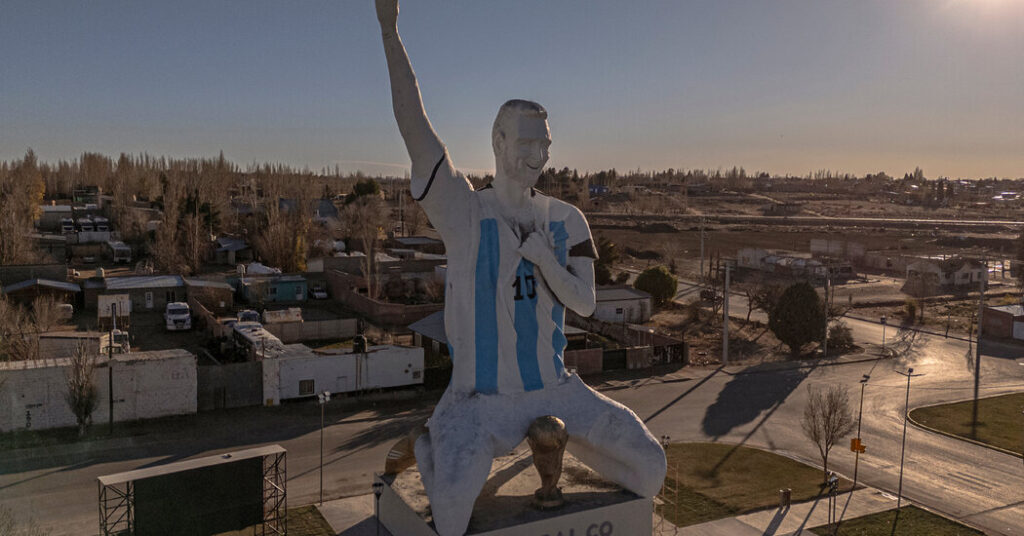
Now 85 feet tall, weighing 70 tons and coated in shimmering white paint, the statue towers over the remote oil town of Cutral Có, prompting children to gape and bikers to snap selfies.
Unlike many things in soccer these days, there was no Gulf financing or billionaire funding behind the monument — the statue cost the city about $130,000. But the work pulsed with the gritty and unyielding devotion to the game that defines Argentine fandom.
Just as scrappy Argentine fans will jury-rig makeshift antennas to their walls to catch a soccer match, orcram 10 people into a hotel room to afford a trip to the World Cup, Mr. Beroisa hunkered down in a plot of arid land to erect an artisanal homage to his country’s love of Messi.
Mr. Beroisa said he took his indomitable spirit from his town.
Cutral Có, a town of about 40,000 people, was built nearly a century ago around the jobs that the state energy company, YPF, offered at nearby plants. When the government privatized YPF in 1992, thousands of families lost their livelihoods amid mass layoffs.
Local residents say the government authorities told them that they might as well leave. The town was too remote, marooned in an inhospitable desert with no reason left to survive. Mr. Beroisa was laid off from the state railway company, which had also been privatized.
Instead of yielding, residents staged protests, resisted and stayed. Mr. Beroisa, a railway technician by training but a disciple of the Italian Renaissance at heart, picked up a chisel. He started with mannequins for clothing stores and Nativity figurines. Then came a life-size dinosaur for the local museum. Then came public commissions.
Though his wife’s fear of flying grounded his dream of seeing the Sistine Chapel, Mr. Beroisa studied photographs of Michelangelo’s Pietà for the folds in the tunic of a 50-foot statue of Christ standing on a sun-bleached highway used mostly by oil trucks.
When a local sports official suggested over a year ago building a life-size statue of Messi, Mr. Beroisa pitched making it bigger to match the star’s global magnitude. The city of Kolkata, India, already had a 70-foot statue of Messi. Mr. Beroisa proposed making his own 15 feet taller.
The mayor, Ramón Rioseco, agreed.
“This is going to be our Sistine Chapel,” he said.
Mr. Rioseco said he knew that creating the sculpture was not going to be an easy task. Few would notice fumbling the features of a religious figure from another millennium, but one could not botch the face of Argentina’s living god.
“You can manage to convey what Christ looked like, or in the Last Supper — what the apostles looked like is open to interpretation,” Mr. Rioseco said. “But with this one, you can’t make a mistake,” he added. “Messi is Messi.”
Mr. Beroisa said he was fully aware of the expectations.
It took him three months to sculpt Messi’s face. He said he went three days without sleeping because he was unhappy with how the mouth looked. When he was done, he added, his wife told him there was something wrong with the player’s eyes. “Break the eyes,” Mr. Beroisa said he had told his helper.
Argentines know Messi’s face well. They’ve painted it on murals, printed it on posters, tattooed it on their skin and even sculpted it into Milanesas, the classic Argentine breaded meat cutlet.
“All the public opinion’s eyes are going to be on the face,” Mr. Beroisa added. “If I don’t get the face right, everything I built falls apart.”
Finally, when the behemoth head was finished and hauled to the construction site, Mr. Beroisa said he wept.
It took him another two weeks to piece the rest of the body parts together. As a dozen workers toiling on the project stretched their shifts into the night, neighbors brought out warm tortas fritas — a traditional Argentine fried dough — and one even showed up with four roasted chickens.
Now, the giant Messi was kneeling on unfinished legs along the side of a road outside Cutral Có, gazing at the vast Argentine expanses with an amused smile.
This month, the statue of Messi in Kolkata had to be taken down because of safety concerns after it was spotted “swaying in the wind,” according to news reports.
Mr. Beroisa was nervous about the same thing happening to his opus, so he removed the World Cup trophy from Messi’s hand, placing it instead between the player’s knees. Critics online said that the player’s pose looked less like a celebration and more like a mid-twerk dance, but few visitors in Cutral Có seemed to notice, or care.
“It takes so much effort and hard work for us to have something like this here in Argentina,” said Federico Poblete, a paleontologist from the area who had traveled to see the statue.
“It’s the only one of its kind in the world, and it’s really awesome.”
The post The Race to Sculpt Argentina’s Living God appeared first on New York Times.