Across the more than half a century he spent as a Virginia prosecutor, Paul B. Ebert dealt with the full panoply of human failings: drunken driving, penny-ante burglaries, robberies, rape and horrific homicides.
Yet, even after thousands of cases — more than a dozen of them involving the death penalty — Mr. Ebert was aware of the trials he was best known for in Prince William County, his home base, and the world beyond.
“They call me the ‘sniper and the snipper’ prosecutor,” Mr. Ebert once told a voter while campaigning for reelection, his soft drawl as unmistakable as the blue Ford pickup he drove to work.
The “sniper” was John Allen Muhammad, who, along with an accomplice, Lee Boyd Malvo, terrorized the Washington region in 2002, killing 10 people over three weeks. Mr. Ebert, at the behest of then-Attorney General John Ashcroft, prosecuted Muhammad, who was convicted and executed.
The “snipper” was Lorena Bobbitt, who drew international headlines after using a 12-inch knife from her kitchen to cut off the penis of her husband, John Wayne Bobbitt, who she said had sexually assaulted her. Mr. Ebert prosecuted both husband and wife; neither were convicted.
“I’ve worked hard all my life only to become known as the penis prosecutor,” Mr. Ebert once joked, his signature brevity conveying the mix of absurdity and frustration that sometimes accompanied his work.
Of course, there was much more to the life and career of Mr. Ebert, who died June 23 at the age of 88, after suffering from Parkinson’s disease, his son, Pete, said.
In 1967, at 30 years old, Mr. Ebert became the youngest person ever elected commonwealth attorney in Virginia. When he retired 52 years later, after 13 consecutive terms, he was the state’s longest-serving chief prosecutor.
In between, Mr. Ebert pursued more death-penalty cases than any Virginia prosecutor — 15, by his count — and remained a proponent of capital punishment even as popular sentiment turned against it.
Mr. Ebert was convinced that the death penalty, which was abolished in Virginia a couple of years after his retirement, was a way for the justice system to help relatives of homicide victims recover from their loss. “It gives them solace,” Mr. Ebert said in 2018. “They know the person who took away their loved one is getting their life taken.”
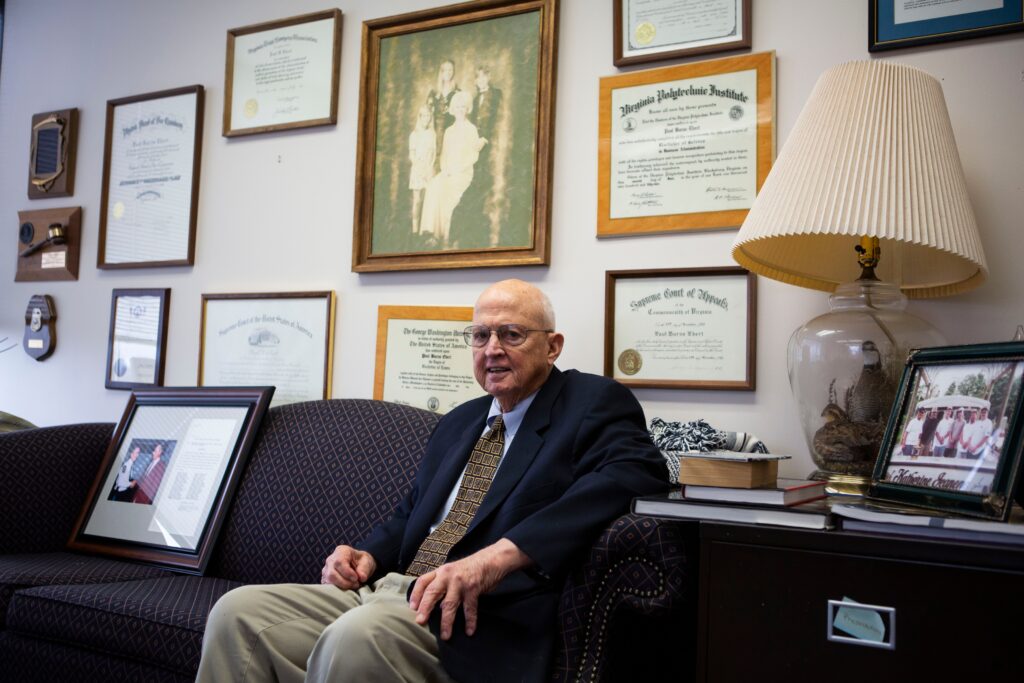
If his attitude struck some as severe, Mr. Ebert’s rumpled, unassuming appearance suggested an unpretentious sort. His pickup truck, which he was known to drive to crime scenes, was loaded with fishing rods, evidence of his passion for a sport he pursued on expeditions to Alaska, Brazil and Sweden.
His office decor included hunting magazines, wildlife photos and carved duck figurines. At an annual holiday party he hosted, Mr. Ebert liked to serve helpings of bear and wild boar that he had killed. “Let’s just say he has remained more country than the average resident,” a fellow prosecutor, Robert Horan Jr., who died several years ago, once said of Mr. Ebert. “He can fool you in that sense. He looks and acts like an old-time country lawyer, but his mind is working every second.”
Mr. Ebert’s former office in Prince William, now headed by Commonwealth Attorney Amy Ashworth, released a statement after his death that said he “always stressed the importance of fairness, while never forgetting the need to protect public safety.”
Lorena Bobbitt, who now identifies herself by her maiden name Gallo, expressed sadness over Mr. Ebert’s death, pointing out the coincidence that he died on “the same day that the incident happened 33 years ago.”
“Mr. Ebert always treated me fairly, and I always had the utmost respect and admiration for him and the work that he did,” she wrote in an email to The Washington Post.
Her former husband said Mr. Ebert “failed to prosecute my wife Lorena. He had evidence in my case that could have convicted her.”
“He failed me,” said John Wayne Bobbitt, when reached by phone. “He never got my side of the story. He never understood what really happened.”
More from A Notable Life
Blessed by Pope Francis, a boy with cerebral palsy became a symbol of grace
Protesting McDonald’s with bowls of pasta, he launched a global food movement
Forced to dance for Mengele at Auschwitz, she was called to help others heal
For late rodeo clown Rick Young, angry bulls were just part of the show
Law instead of dentistry
Mr. Ebert’s passion for law developed when he was a young man, but only after he considered dentistry, his father’s occupation, an interest that faded, he once said, when he realized he “didn’t want to look in somebody’s mouth for the rest of my life.”
He was born Sept. 23, 1937, in Roanoke, the oldest of three siblings. Two years later, his parents relocated to Northern Virginia, then a rural outpost removed from the bustle of the nation’s capital.
After graduating from what was then known as George Mason High School, where he was a lineman on the football team, Mr. Ebert earned a business administration degree at Virginia Tech. At the urging of a cousin, he decided to get a law degree, attending night classes at George Washington University while working construction and janitorial jobs during the day to support his family.
By then, Mr. Ebert had married his wife, Priscilla, who died in 1983 from a heart attack. He never remarried. Their three children, Peter, Jeanene and Katherine, and three grandchildren, survive him.
After law school, Mr. Ebert worked for a private firm before joining the Prince William prosecutor’s office to gain trial experience. When his boss, Selwyn Smith, decided not to seek reelection, Mr. Ebert, backed by the local Democratic Party, ran for and won the seat.
Although he never lost an election, Mr. Ebert found himself the target of occasional criticism in legal circles. In 2011, a federal judge overturned a murder conviction Mr. Ebert obtained against Justin Wolfe, a drug dealer accused of orchestrating the killing of his supplier.
The judge ruled that Mr. Ebert and another prosecutor had withheld key evidence, an omission that was “not only unconstitutional in regards to due process, but abhorrent to the judicial process.” Wolfe eventually pleaded guilty and was sentenced to 41 years in prison.
In 2014, Mr. Ebert’s office was criticized after seeking to photograph a 17-year-old boy’s genitalia to prove prosecutors’ case that the youth had sent pornographic video to his 15-year-old girlfriend. After the outcry, Mr. Ebert’s office dropped its quest for the photo. A judge sentenced the teen to probation.
The Bobbitt case thrust Mr. Ebert into the spotlight as never before, a position he accepted with a measure of humor as he batted away interview requests from the likes of Oprah Winfrey and “Nightline.”
“I always said they kind of deserved one another,” Mr. Ebert once said of the Bobbitts.
Peter Ebert said his father’s career “was a lot more than an act between two crazy people. He had a million crazy cases. He was much more than that incident.”
Mr. Ebert returned to the spotlight during the sniper trial in 2003. He attended Muhammad’s execution by injection in 2009, telling a reporter afterward that the sniper “died very peacefully, much more than most of his victims.”
He worked well past retirement age, deciding in 2019 not to seek a 14th term only because of failing health. By then, he knew as only a prosecutor could that his home county was not the backwater he had embraced a half-century before.
“I always knew someone on the jury,” Mr. Ebert said. “Now, I seldom know someone on the jury.”
This article is part of A Notable Life, an obituary feature telling the stories of remarkable people every Saturday.
The post Paul Ebert prosecuted thousands of cases. He was best known for two. appeared first on Washington Post.