Michael Maccioli said he could feel something special happening when he visited Chicago last weekend.
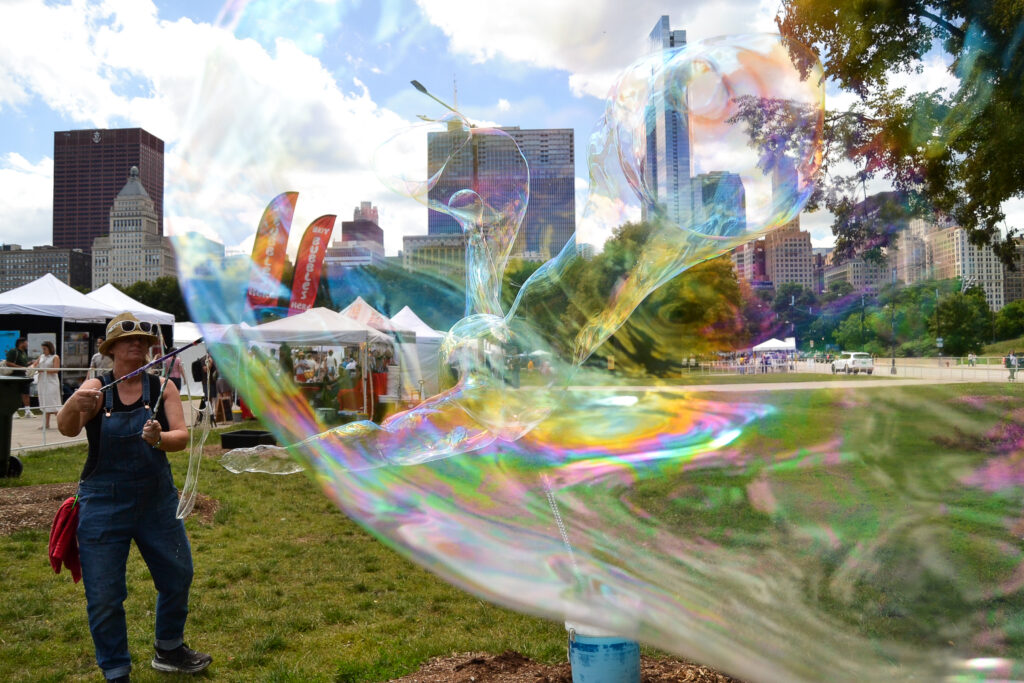
It was the height of the city’s summer festival scene, and neighborhoods were filled with events. There was the Festival of Chariots along the lakeshore, where Hindus dressed in colorful clothing for a parade. A short distance away, the Lakeshore Arts and Music Festival attracted thousands. And in the Northalsted neighborhood, streets were packed for one of the nation’s largest Pride celebrations.
Maccioli, 68, who was visiting from Dallas, settled on the Gold Coast Art Fair in Grant Park, where he could browse wares from more than 150 vendors.
“You need to partake in what the city has to offer to fully enjoy it,” said Maccioli, a retired marketing consultant. “You just need to get out. Put in the effort, get off the couch, turn off the news, listen to some music, and be much happier overall.”
That energy can be seen in cities across the country as people search for ways to connect with one another this summer. The enthusiasm has been especially pronounced in the 11 U.S. cities hosting World Cup matches, where fans are flooding stadiums, festivals and bars to cheer on their teams. But even those without World Cup games — from big cities like Milwaukee to smaller ones such as Abilene, Texas — are reporting a renewed glow around seasonal festivals and events.
The trends suggest that the nation’s cities continue to bounce back from the pandemic and its aftermath by drawing people out of their homes to downtown business districts. Local officials say the surge in interest reaffirms the push in recent decades to invest in public spaces, including waterfront parks, entertainment venues and bicycle lanes.
Over the past three months, Pittsburgh reported record attendance for the NFL draft. In Cleveland, so many people showed up to an Asian cultural festival last month that police had to shut it down early. And in New York, where many residents say the city is experiencing its most robust summer in decades, about 2 million people overwhelmed Lower Manhattan last week to celebrate the Knicks’ NBA championship.
“This new urbanism is paying dividends,” Manhattan Borough President Brad Hoylman-Sigal (D) said. “It’s too early to say we are completely back from covid, but the trend is very positive, and you can feel it out on the streets — a palpable sense of optimism.”
Analysts warn that many cities still face considerable economic hurdles that include weakened demand for commercial real estate space and stagnant condominium markets. Some cities have also grappled with unruly “teen takeovers” that at times lead to violence and have prompted strict curfews.
But crime overall has dropped sharply since the pandemic in cities nationwide. Urban areas may also be benefiting this summer from high gas prices, which are limiting out-of-town vacations. And relatively nice weather may be enticing people out of their homes after an icy, snowy winter in many East Coast cities, analysts say.
Experts and local officials said all of that points to a banner year for city revitalization, building on decades-long efforts to bring more people into urban centers to live, work and socialize.
Social media feeds are filled with people enjoying themselves in cities, from couples sipping wine at free concerts near Chicago’s lakefront to Washington residents dancing at a Juneteenth celebration.
In Cleveland, officials say they have seen more than a half-million visits downtown so far in June, a 24 percent increase compared with last year. Mayor Justin Bibb (D) said the lakefront city has been sponsoring pop-up parties, kickball and soccer games, and art installations that are drawing visitors.
“I think folks want to get back to analog connecting,” Bibb said. “They are tried of being on their phones. They want to be outside. They want to be on the water. … People are craving community again.”
Some of the more viral posts have come from international visitors in World Cup host cities. Fans have marveled at American food and iconic sites, including Philadelphia’s Rocky statue and New York’s Times Square. Scotland’s traveling pep squad, known as the Tartan Army, recently drank Boston dry, and fans celebrating this week’s Brazil vs. Scotland match packed Miami’s South Beach.
“We are having a blast,” said David McRitchie, 69, a Scottish resident who was in New York last week for the World Cup and also attended a Yankees game wearing a kilt. “U.S. cities are fantastic.”
Local residents are helping to energize the host cities, too. During the first 11 days of the tournament, about 250,000 people visited Philadelphia’s Fan Festival, including 54,000 who crammed into Lemon Hill Park on Friday. Atlanta reported that nearly 275,000 people have attended its fan festival in Centennial Olympic Park.
“With the World Cup, we are being reminded how great cities are and how cities are better than anything else at doing what we value the most, which is bringing people together,” said Jeff Speck, a city planner who wrote “Walkable City: How Downtown Can Save America, One Step at a Time.”
Speck added that the enthusiasm this summer reaffirms that “covid was a blip” that did little to slow a trend that began around the turn of the century: more people wanting to reside and socialize in the nation’s downtowns.
“The challenge we have in cities is not getting people back into them,” Speck said. “It’s making them affordable for all the people who want to live in them.”
Hoylman-Sigal said people also want to congregate to distract themselves from divisive political polarization.
In Chicago, Aaliyah Tally, 20, said she traveled from an outer suburb to the Pride festival with her girlfriend to be around others who share her political beliefs.
“You see so much red when elections come,” Tally said. “Chicago is so blue it takes over everything.”
But William Pate, president and CEO of the Atlanta Convention and Visitors Bureau, credited downtown investments, including a $5 billion transformation of Centennial Yards near Atlanta’s sports stadiums that has become a key site for World Cup fans to gather before matches.
“There is a certain electricity that has taken over the city,” Pate said.
Officials in Boston are also confident that the World Cup buzz there will continue throughout the summer.
In addition to a series of matches that lasts until July 9, the city will be hosting a massive celebration honoring the nation’s 250th birthday. In mid-July, officials expect more than 4 million people to visit more than 50 tall ships and military vessels that will be docked in Boston Harbor.
Kate Dineen, president and CEO of A Better City, which promotes Boston and encourages redevelopment of its public spaces, praised state and city leaders for investing in public transportation, streetscapes and parks to better accommodate crowds. She noted that Boston also amended its drinking laws for the summer, extending bar closing times to 3 a.m., while also creating outdoor zones where people can walk with open containers of alcohol.
“We are showing young people that Boston can be a fun space, and you don’t need to move,” Dineen said.
Even some skeptics of funding for sports arenas concede that the atmosphere in cities this summer has been a hit. Chris Dempsey, an urban planner who led a fight against Boston’s bid for the 2024 Olympic Games, said “the fun has been very real” because of the World Cup.
But Dempsey attributes that atmosphere to investments in public spaces that people can “use every single day.”
“A lot of the revelry and celebration that has happened in Boston have happened in truly public spaces that are not even close to the stadium,” Dempsey said, noting that the stadium where World Cup matches are played is about 30 miles outside of Boston. “The buzz and the energy has been right downtown.”
Big summer crowds have caught some cities by surprise. When an estimated 50,000 people showed up at the Cleveland Asian Festival last month, police were forced to shut it down more than three hours early because of concerns about overcrowding.
Organizers told local media outlets that the enthusiasm was unprecedented.
In Pittsburgh, officials reported sizable crowds at an arts festival this month in a new park wedged between the city’s skyscrapers and its Allegheny River bridges.
“It was a fantastic showing,” said Derek Scalzott of the Pittsburgh Cultural Trust, who noted that the event attracted more than 100,000 visitors over seven days.
As Maccioli walked around Chicago’s art fair with his dog, Pumpkin, last weekend, he said he already plans to return to the Windy City next summer.
“I’ve been all over the world,” Maccioli said. “For 90 days of the year, summertime in Chicago is it.”
Craig reported from New York. Johnson reported from Chicago.
The post In U.S. cities big and small, summer crowds signal an urban comeback appeared first on Washington Post.