Times Insider explains who we are and what we do, and delivers behind-the-scenes insights into how our journalism comes together. A version of this article first appeared in El Times.
I have been speaking Spanish for over 40 years, and practically every day I learn a new word, an unfamiliar meaning or a new slang term.
I grew up on the border between Mexico and Texas, where a gallon container is called a yoga — after the English jug, the name given to milk containers on the U.S. side of the Rio Grande.
As a graduate student, I spent a few months among Puerto Ricans and Dominicans in New York, perreando at sweaty parties and soaking up the lyrics of what we’d now call classic reggaeton.
For nearly a decade, I worked as a journalist in South America. I married a Peruvian colleague, and even though we have lived in Mexico City for many years, the Spanish spoken in our home mixes vocabulary from our backgrounds: cuddling is apapacharse, a very Mexican word with Nahuatl roots, but scolding is the Peruvian resondrar. Chiles are called ajíes, as they are in Peru, but if we find them too spicy, we say nos enchilamos, the expression in Mexico.
On our team, which translates dozens of New York Times articles into Spanish each day, there’s an editor from Mexico City with roots in the north, an Ecuadorean journalist who has lived in Managua and Brasília, a Peruvian writer who studied in Barcelona and a couple of uprooted Venezuelans. Plus another handful of colleagues with personal and professional vocabularies that shape and enrich the work we do.
Last week we added one more word to our shared vocabulary, courtesy of José María León Cabrera, a contributor based in Ecuador: changarse, which means something like a hug of the legs or lying down with your legs intertwined.
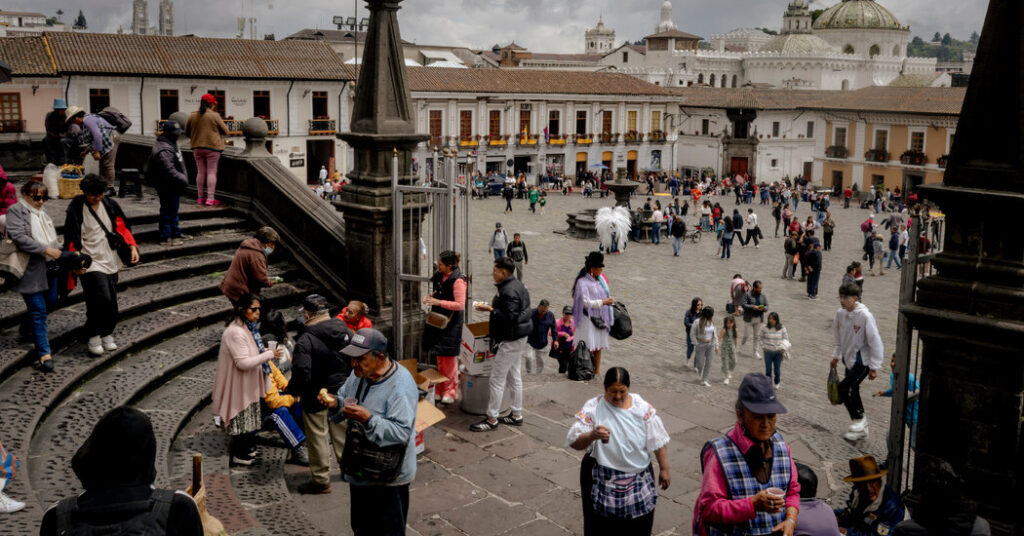
Almost nine years ago, José María, who is from Guayaquil, on Ecuador’s coast, moved to Quito, in the Andean region of his country.
In the highlands, he began to hear the Spanish he’d known all his life mixed with Kichwa, the Indigenous language spoken by the Incas who inhabited the slopes of the Pichincha volcano — and roughly half a million Ecuadoreans today. The hybrid way of speaking strikes newcomers who think they know Spanish perfectly as peculiar. But it feels natural to its native speakers. José María explored this blend in an article that was published (in English and Spanish) last week.
“I began collecting snippets of conversations I overheard by chance — at parties, dinners or in offices — fascinated by this particular form of Spanish,” José María told me in a text message after his article came out. We were discussing his work on the messaging platform WhatsApp, which is hugely popular in Latin America.
He said he didn’t think the language he heard could be a story until 2024, while on a reporting trip with Julie Turkewitz and Federico Ríos, New York Times journalists based in Colombia. The group spent some time together riding in a van around Quito, and his colleagues remarked on some of the Kichwa-inflected words José María used.
At that moment, the team was focused on the blackouts affecting Ecuador and the country’s security crisis. But he remembered thinking: “I have to turn this into a story,” he said.
“It’s my responsibility to report on the violence and the crime crisis,” he added. “But also it is my duty to try and convey that this country is much more than just the crime and the problems.”
For his article, José María faced the challenge of reporting in both languages and writing for The Times’s diverse international audiences.
“I had to approach it with curiosity and the joy of ignorance, like a kid would,” he said. He relied on experts, he added, to explain “a thing that we have taken for granted. And it’s actually filled with meaning, historical context. It’s filled with linguistic value.”
He also started paying more attention to the way people around him spoke, from the mayor of Quito to banking executives to workers on the street: They all used fusion words. The terms were also in the music of the singer Ñusta Picuasi and on menus all over town.
José María shared a sample of his notes and some of his favorite words: “I love wawa (baby), and I love shunsho (silly),” a word not included in the article because there were already so many examples. “They say, ‘Don’t be a shunsho — come on!’” he wrote on WhatsApp.
“And everyone’s favorite: chuchaqui, which means hungover,” he added. Through his reporting, José María said, he learned that “experts believe it comes from chuchake, which in Kichwa was a disease of shame. That’s exactly how a hangover makes you feel.”
The post In Ecuador, a Blend of Two Languages Was Music to a Reporter’s Ears appeared first on New York Times.