Matthew Warchus’s stirring 2014 movie “Pride,” about an unlikely alliance between gay and lesbian rights activists from London and Welsh mineworkers during the miners’ strike of 1984-85, didn’t quite achieve the same international success as earlier British kitchen-sink comedies like “The Full Monty” and “Brassed Off.” But it contained many of the same winning ingredients: a powerful story inspired by true events, told with a blend of homey social realism and irreverent humor, and a hopeful message of togetherness. It resonated deeply with a generation of Brits for whom the strike remains a watershed.
Warchus is now back with a musical stage adaptation of “Pride,” running at the National Theater in London through Sept. 12 and starring Jhon Lumsden as the activist group’s founder, Mark Ashton. Mark rallies his pals to raise funds for the embattled miners, who are engaged in a grueling standoff with Margaret Thatcher’s government after downing tools in protest over proposed colliery closures.
Unlike the movie, which told the story with a restrained sentimentality, this musical version goes all-in on emotion and camp. The tone is set in an early exchange when, shortly after their arrival in Wales, one of the gay activists suggests that the group should play it safe and dial back on flamboyance. He gets short shrift from Jonathan (Samuel Barnett), who has no intention of censoring himself: “I will not, even for one single second, tone it down!” he says.
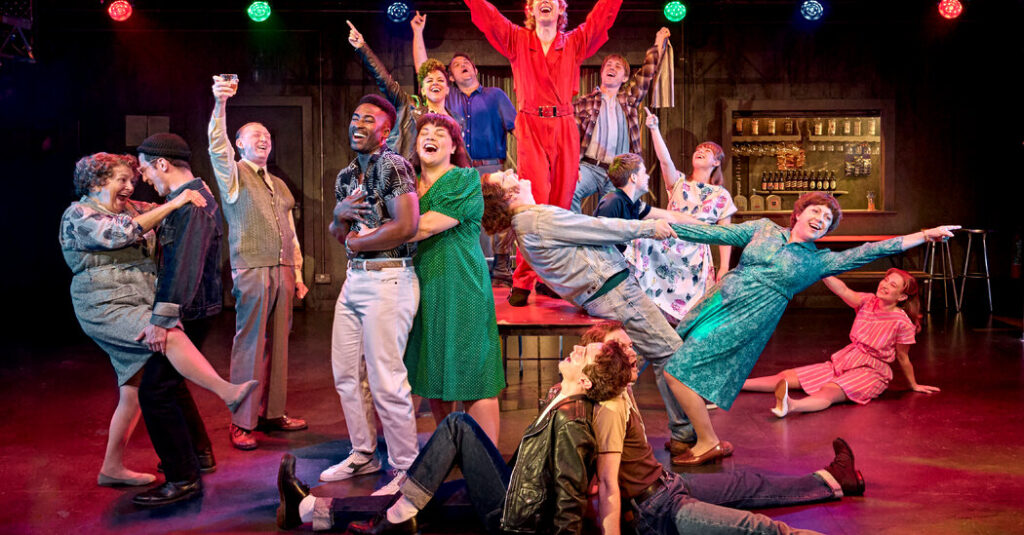
And so it proves. The emphasis here is on joy, so the initial awkwardness between the activists and the socially conservative mineworkers quickly gives way to exuberant abandon as the newcomers win hearts and minds via the dance floor at a social club in rural Wales.
Since the menfolk in this town don’t dance, the women are the first to warm to “the gays.” Their hospitality is reciprocated, and we enjoy the incongruous spectacle of four older Welsh women — led by the magnificent Gillian Elisa as Gwen — frolicking in Soho gay bars and singing a bawdy song that references anilingus and amyl nitrate.
The characters occasionally double as narrators, setting out the historical context. Despite their differences, the mineworkers and the gay activists had a common enemy in Thatcher, whose government stigmatized homosexuality and portrayed the striking miners as fifth columnists working for the Soviet Union.
Although the miners eventually lost the strike, the unlikely alliance persisted: The play ends on the day of the 1985 London Gay Pride march, when Welsh mineworkers traveled to the city in buses to express gratitude by leading the parade.
“Pride”’s bittersweet melodrama and its tender evocation of community and solidarity lend themselves well to a musical theater treatment. In the number “Gay Induction,” the group advises a 20-year-old character, Bromley (Lewis Cornay), on how to avoid police harassment; later, he comes out to his conservative parents with the amusingly blunt “I’m Into Guys.”
Jonathan, who is H.I.V. positive, croons in droll cabaret style, complete with a tap-dance, about the specter of death — “so you’re one cubic meter / from meeting St. Peter” — before shifting to a more somber timbre in a candlelit vigil for people who died of AIDS. (Book and lyrics are by Stephen Beresford, music by Christopher Nightingale, Josh Cohen and DJ Walde.)
The show lacks a truly knockout original tune. The most memorable song is a gorgeous rendition of the labor movement anthem “Bread and Roses,” led by Kirsty Malpass. It’s the dialogue, much of it borrowed from the movie, that sustains the piece: witty badinage, spicy double entendres and occasional gallows humor. The Welsh ladies got the biggest laughs on opening night on Thursday — there’s just something about people saying rude things in heavy Welsh accents that guarantees mirth for a British audience.
Is there a hint of condescension in their portrayal as endearingly straightforward, salt-of-the-earth folk? Perhaps. And does the emphasis on celebration obscure the harder edges of the political struggle? Undoubtedly. But these are artistic choices made on the horses-for-courses principle that the relative tonal subtlety of the movie simply would not fly with a musical theater audience.
One scene in particular sums up the difference in register between the film and the musical. A homophobic assailant throws a brick strapped to a lit firework through the window of Gay’s the Word, the London bookshop which serves as the campaign group’s headquarters.
In the movie it’s a scary, intense moment, and the bookshop owner (played by Andrew Scott) grabs a fire extinguisher to put out the flames. Onstage, it’s played for laughs. The men flail helplessly, too flustered to take action, and it falls to the gang’s only female member, the lesbian tough cookie Steph (Courtney Stapleton), to calmly save the day.
The scene riffs on a pernicious prejudice, but it is funny, and any loss of moral authority is offset by an unquantifiable gain. It’s a fair trade-off. Because there’s power in charismatic self-deprecation: agency, comfort, catharsis — and, yes, pride.
The post A Pride Tale Retold, Zhuzhed Up With Extra Camp appeared first on New York Times.