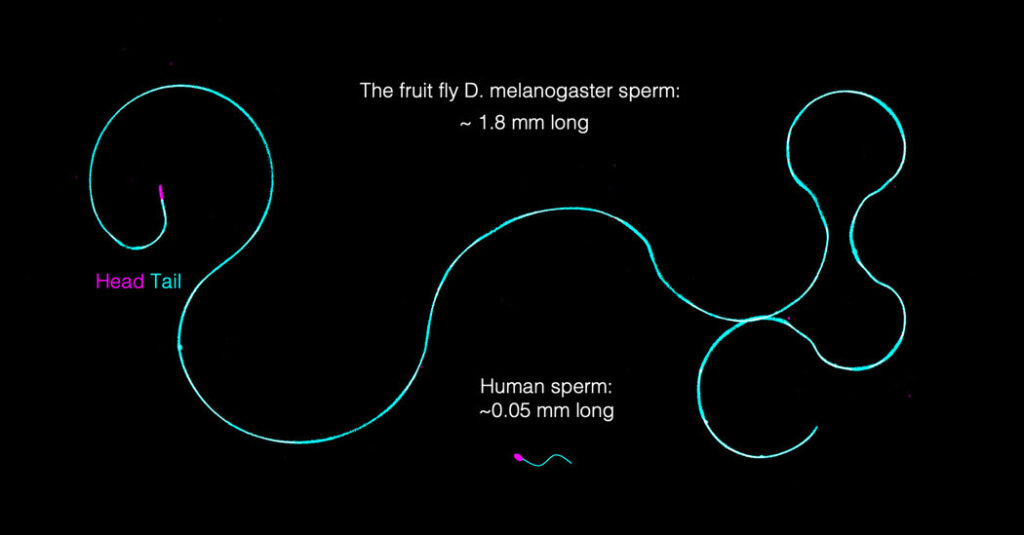
Some of the largest sperm come from the smallest animals.
Take the tiny fruit flies that hover over overripe bananas. The male flies hold the world record for longest sperm, at a whopping two inches. That’s roughly twenty times their body size (and about 1,000 times the length of human sperm, which are 0.05 millimeters).
The physics of this presents a real packing nightmare. It’s like jamming thousands of strands of fishing line into a shoe box. The risk is that the male sex cells will get completely tangled up and unable to get to an egg. Yet, somehow, this doesn’t happen, and scientists have long wondered why.
A new study in Nature Physics offers an answer. Researchers at the Flatiron Institute in New York took a look at a readily available cousin: Drosophila melanogaster, the laboratory fruit fly that scientists use to study a wide range of biological processes, from genetics to cancer. Its sperm are about two millimeters long, nearly as long as the fly itself.
When Michael Shelley, an applied mathematician, and his team viewed the sperm under a microscope, they found that they were not clumped into a messy ball. Instead, they were neatly stacked in parallel rows, like spaghetti strands that stay together as they swirl in a pot of water. The sperm were lined up side by side, bending inside the confines of the sperm storage organ. The whole mass seemed to move together in a smooth, slow wave, while the sperm themselves were moving.
To understand how a sperm’s individual movements corresponded to the whole, the scientists conducted several more experiments using high-resolution visualizing techniques, including dyeing the sperm different glowing colors and tracking them in real time.
Based on the results, the team concluded that fruit fly sperm don’t become tangled because they’re constantly moving, sliding past one another in opposing lanes to keep the whole mass fluid and organized. “It’s like a 1,000-lane highway where all the cars are moving in opposite directions,” said Dr. Shelley, the paper’s senior author.
Dr. Shelley explains that such behavior is very different from that of human sperm, which swim in a pool of liquid by beating their tails to propel themselves forward. Fruit fly sperm are packed together so tightly that there is barely any fluid to push against. Instead, the sperm send rippling waves down their tails, like a snake. As the wave of one sperm meets that of its neighbor, which is traveling in the opposite direction, the two push off against each other. This motion keeps the whole mass moving and prevents tangles.
When the sperm were isolated one by one, they didn’t seem to move at all. Though their tails were still beating, their bodies just wriggled in place. “It’s not just one heroic swimmer getting to the egg; it’s a collective behavior,” said the study’s first author, the biologist Jasmin Imran Alsous.
This finding gives a different look at a long-held picture of how sperm get around, said John Fitzpatrick, an evolutionary biologist at Stockholm University who studies sperm evolution across the animal kingdom. “We have this view of sperm flapping their tails and swimming like someone in a pool, but that’s not what’s happening here at all,” said Dr. Fitzpatrick, who was not involved in the research. “They have to be pushing against something to propel themselves forward, and the thing they’re pushing against could be sperm or the female reproductive tract. That’s a really cool finding,” he added.
Dr. Fitzpatrick said that this research provides one of the first real-time visualizations of how tiny animals with large sperm manage to keep their sperm untangled and functioning. Fruit flies are not the only example: The minute featherwing beetle is another, producing sperm that are roughly double its body size. (The sperm have to coil into tight helical springs to fit inside the insect’s tiny body.) Another is seed shrimp, tiny crustaceans that produce sperm that reach lengths up to seven times their body length.
In each example, the animal has to overcome the same physical problem: how to pack and deploy a sex cell larger than itself. This study offers a seminal discovery in how the fruit fly does it.
The post Fruit Fly Sperm Are Giant. How Do They Stay Untangled? appeared first on New York Times.