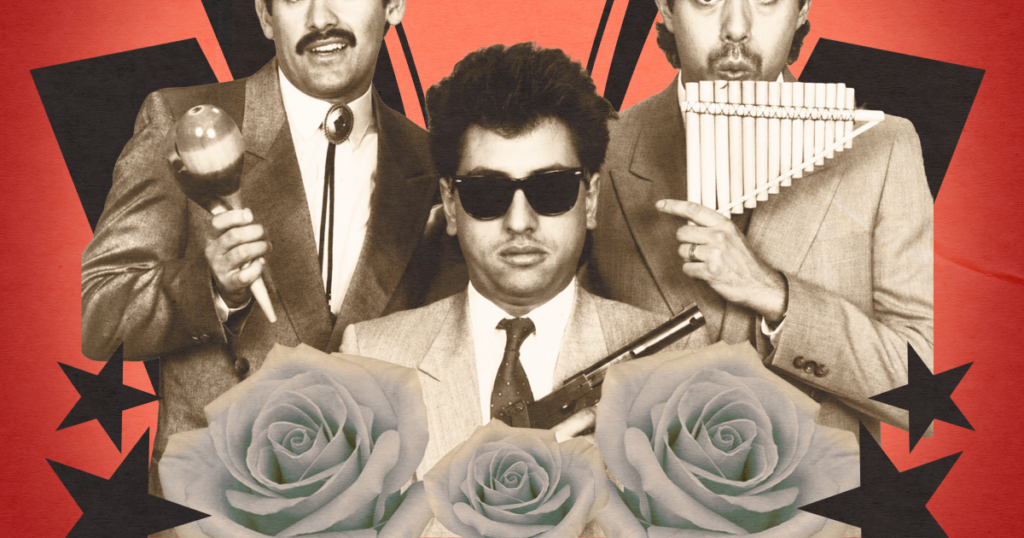
Richard Montoya of Culture Clash doesn’t mince words when it comes to politics, current events or the state of mainstream Hollywood. But he does sugarcoat his technological limitations as a 67-year-old comic in the dreaded age of video calls with a punchy Chicano twist.
“I’m a low-tech Aztec,” he writes via email when requesting a Zoom link to our Monday interview.
Culture Clash — which includes members Montoya, Ric Salinas and Herbert Sigüenza — arrived on the scene as a guerrilla sketch theater group from the San Francisco Mission District in 1984. By that time, the Chicano movement had reached its peak, thanks to the United Farm Workers labor movement, as well as student activist organizations like Movimiento Estudiantil Chicano de Aztlán (MEChA), which advocated for Chicano unity, political empowerment and educational access.
Luis Valdez, founder of El Teatro Campesino — who began putting on social justice-oriented plays for the striking Delano farmworkers in 1965 — backed the slapstick satire troupe, considering the trio “the cutting edge of fresh, new Latino comic genius.”
Culture Clash stood out in a time when Chicanos became more vocal and visible — and its members challenged an entertainment industry that has historically lacked Latino representation. Between 1993 and 1996, Culture Clash hosted its own self-titled TV show on the syndicated Fox network. The show, which was filmed at the Mayan Theater in downtown Los Angeles, is widely considered the first Latino sketch comedy to air on American television.
Throughout the last four decades, Culture Clash has parodied nearly every prominent Latino figure in history, including Che Guevara, Frida Kahlo, Ritchie Valens, Rita Moreno, Edward James Olmos and others. Its members have mocked hard-shell cholos and gangsters, often by placing them in funny scenarios. For instance, take this clip, in which the trio take on cholo characters and reimagine what it would be like to surf on the Southern California shore.
But they’ve also taken on more serious topics in their classic “Chavez Ravine” play, which looks into one of the darkest chapters in L.A. history: the forceful removal and displacement of families, mostly Mexican, in the 1950s under eminent domain. Recently Montoya attended a live reading adapted by Somos El Teatro, led by Xolo Maridueña, Mariana da Silva and Angel Villalobos at Elysian Park.
“It gives us so much life that people are finding the issues of swindlers, whether it’s gentrification, the taking over of settlements,” says Montoya. “The generational trauma of losing your home in L.A. has never gone away.”
But not every Culture Clash joke or skit has been safe from criticism. Montoya still remembers how a conservative pundit chastised the group for using light humor to discuss the 1992 riots, when LAPD officers were acquitted for using excessive force in the arrest and beating of Rodney King.
“By looking at it and treating it as dynamite, exploding it and then by bringing some levity and a whole lot of seriousness to the Rodney King matter allows us a moment, a fraction of time to look at the issues a little bit differently,” says Montoya. “That laugh allows us a moment to examine it differently.”
On June 27, Culture Clash will return to Grand Performances, a free summer concert series at California Plaza in downtown L.A., with comedic sketches colored by political and social satire. The show, titled “American Payasos! Culture Clash’s End Times Cabaret” will be co-presented with De Los.
While their 40-year-plus legacy might merit a show reminiscent of old goofball skits — like their early 1989 show “The Mission” that poked fun at the problematic Spanish Franciscan missionary Junipero Serra — this will not be an “oldies but goodies show,” as Montoya put it. “We are highly pissed off about a lot of stuff right now.”
“ We’re thinking a lot about the Mexican American patriarchy, Cesar Chavez, Dolores Huerta and it’s time to address some of these things,” says Montoya. “ We want to look at the service workers of Los Angeles, the people that sell cotton candy in MacArthur Park, the people that sell ice cream in Echo Park and the people working the World Cup.”
For the veteran comic, son of the late Chicano poet Jose Montoya, it is also impossible to ignore the immigration enforcement raids that have rattled Los Angeles communities in recent years.
“This is a very strange moment for satirists,” says Montoya. “We have a responsibility to use those tools to say what’s going on in our city and country and provide these moments where we can do a little bit closer examination because the people in power aren’t telling us what’s going on.”
In the last five years, Montoya has fiddled around with digital media, creating sporadic videos featuring old clips of the troupe, as well as videos of Latino media, to connect with technologically diverse audiences of all ages. (One example is a video calling on people to get out the vote, that features clips of Speedy Gonzales and honors political figures like Huerta.)
Although Montoya believes Culture Clash is nearing the end of its career, there’s a question lingering inside his mind: What does a graceful exit look like for a group like Culture Clash, which has never been fully integrated into mainstream Hollywood and still left such a profound legacy in the world of Latino entertainment?
The answer to that might still be unknown, but like any Culture Clash project, it will likely be wickedly satirical and punchy. Says Montoya: “We’re ready to go out with a huge, loud bang that can say something against the power structure.”
Culture Clash will take center stage on June 27 at Grand Performances, in partnership with De Los. Also performing is the retro cumbia-quebradita musician É Arenas (bassist of Chicano Batman), the cumbia-fusion, luchador-masked cumbia group La Nueva Ola de Cumbia, as well as DJ Dali.
The post Culture Clash knows the end is near. It wants to go out with a bang appeared first on Los Angeles Times.