Agon Maliqi is a political scientist from Kosovo and a senior fellow at the Atlantic Council. He lives in Tirana, Albania.
Albania’s embattled socialist prime minister, Edi Rama — who is facing a protest movement over his rule, which received global attention mostly because it involves Trump family business dealings — is arguably the most aesthetically driven and image-conscious leader in the world.
Whether it is by wearing casual sneakers at NATO summits or turning conference panels into stages for viral stand-up comedy bits, the 61-year-old Rama knew how to draw media attention before influencers were a thing — and to draw power from being an effective, albeit bullying, communicator.
It therefore seems perfectly fitting that the biggest challenge to Rama’s 13-year rule has come from savvy and confident Gen Z protesters who, using memes hyperproduced by artificial intelligence as their aesthetic weapons, have effectively subverted the prime minister’s ample talents — by relegating him into “OK boomer” territory.
An artist and a painter by training, Rama rose to power in the early 2000s as mayor of Albania’s capital, Tirana, by nurturing the image of an eccentric “anti-politician,” yelling at lazy bureaucrats in front of media cameras and rehabilitating the city’s run-down communist facades with colorful drawings. He promoted a philosophy that art in public spaces can fuel community transformation.
As prime minister, Rama has devoted much of his attention to a transformation of not just formerly drab Tirana but also Albania’s Mediterranean coastline. Gleaming skyscrapers, luxury resorts and modernized and revitalized public spaces have turned one of Europe’s poorest countries into a tourist hot spot, while also attracting the attention of the world’s most prominent architects and artists.
Albania’s own youths have been less impressed by the painter-turned-politician. But their disdain was apparent more in emigration statistics than street protests. Until now. Much like how the Arab Spring was triggered by a viral video of a self-immolating Tunisian street vendor, a single incident brought young Albanians’ long-accumulating frustrations to a boil.
When local residents and environmentalists in the coastal village of Zvernec — the site of a planned new tourist resort linked to Jared Kushner, a Qatar-based fund and local oligarchs — protested the fencing of a public beach around a protected natural site, two private security officers dragged one of the local residents through the sand as local police looked on. The public outcry was immediate.
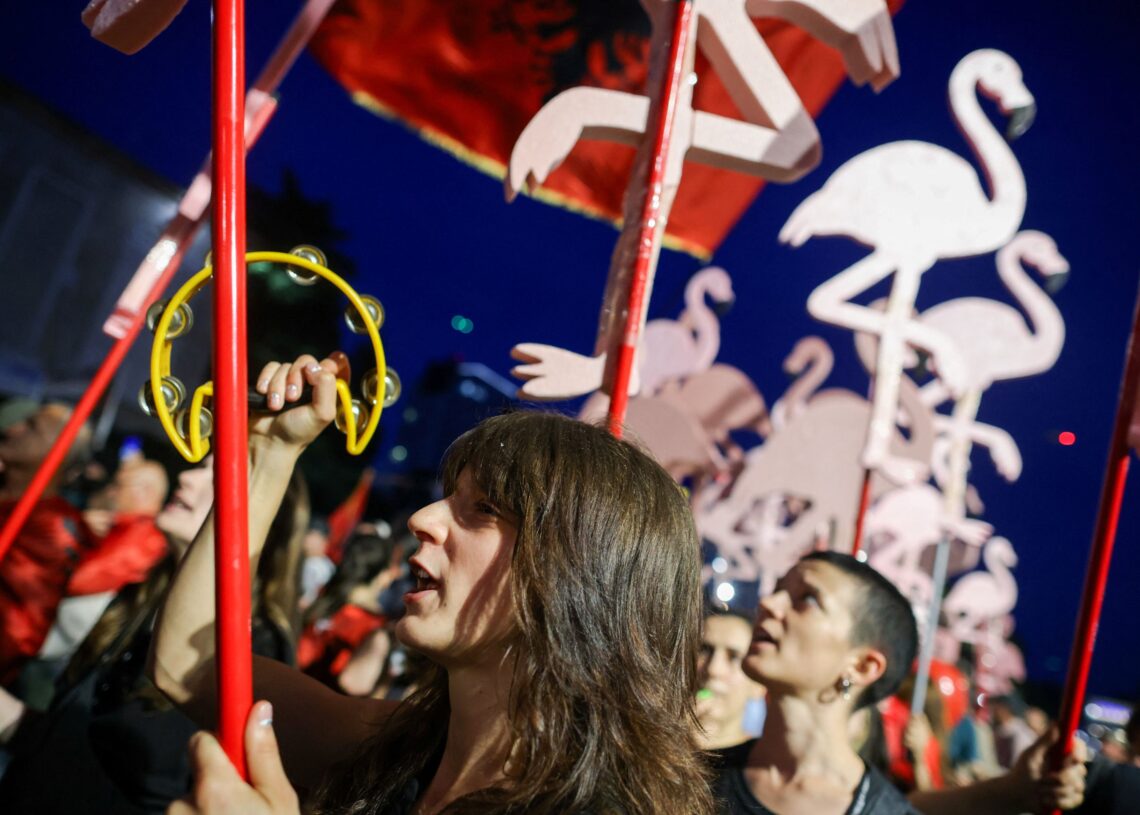
What began as an isolated protest in a distant village quickly moved to the capital, growing so fast that the mostly self-censoring mainstream media could no longer hold back coverage. It has been almost four weeks and the demonstrations now happen daily, with the flamingo — indigenous to Albania and endangered by the resort construction — as its unifying symbol. The protests are both angry — calling for the overthrow of the entire political and media establishment — and festive. Like with many other Gen Z uprisings, political solidarity has spread through humor and memes. A previously quiescent generation of Albanians are feeling a newfound sense of dignity and political agency.
Western media coverage has narrowly framed the demonstrations as being directed at the Kushner project — an easier hook for their readers at home. Authoritarian social media bot farms have also been deployed, framing the rebellion as somehow being against U.S. and Israeli colonialism.
But the true grievances are entirely related to domestic governance. Tens of thousands of Albanians of all ideological stripes — liberals, nationalists, environmentalists, Marxists, fashion influencers and even fringe conspiracy theorists — are rallying every evening because they feel disenfranchised and abandoned by a self-serving elite, including the formal opposition in parliament, the Democratic Party, that has been stripping public assets through opaque sweetheart deals with special interests for years. Kushner’s resort being green-lit was just the latest and most prominent example.
Rama has tried to make the case that luxury tourism projects like Kushner’s are the future of the economy. The demonstrators are having none of it. Albania is still a poor country, and a development model based heavily on construction and tourism has only enriched the well-connected, while pricing out regular voters from the simple pleasures of a summer getaway to the coast. Worse, the tourism sector is using low-paid migrant workers to keep costs down, even as Albanians themselves emigrate westward looking for work.
Widespread corruption in Rama’s government has also become too much for citizens to bear. Rama’s recent refusal to lift parliamentary immunity for his former deputy prime minister, who is facing an indictment, is creating a major roadblock in Albania’s progress in E.U. accession talks. It’s also seen as a broader threat to popular rule of law reforms, demanded by the European Union and the United States, which Rama had until recently embraced as his own.
The record of Gen Z protests worldwide has been decidedly mixed, and Albania has no elections until 2029. But these particular demonstrations have done one important thing: They have dented the charismatic prime minister’s reputation as someone who is always able to talk his way out of a situation. His attempts to mock protest participants as out-of-touch influencers and to co-opt their symbol by wryly wearing a flamingo T-shirt have, at best, fallen flat.
A rising generation is figuring out how to mobilize public discontent into electoral politics. And for the first time in his long career, Rama seems unable to have the last word. That may cost him yet.
The post For Albania’s Gen Z, Jared Kushner’s resort was the last straw appeared first on Washington Post.