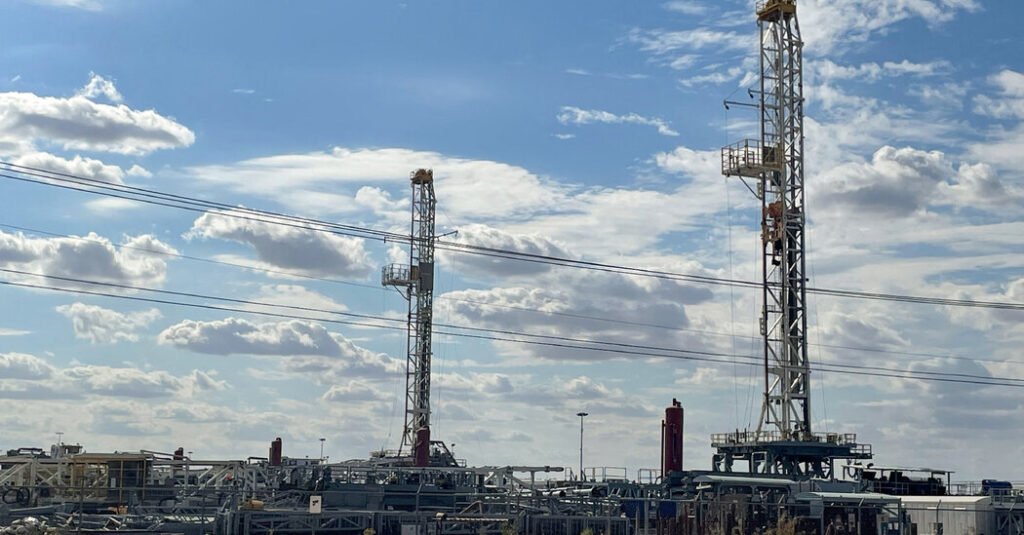
The war with Iran has pulled the American oil industry out of a slump, raising corporate profits and spurring some companies to drill more wells.
U.S. oil production is now forecast to grow modestly next year, topping 14 million barrels a day for the first time, according to the Energy Information Administration. The federal agency previously expected output to contract.
But the war, paused for now by a preliminary deal, is unlikely to provide enough of a lift for the United States to take significant business from Persian Gulf countries that have been hobbled by the conflict, oil executives and investors said.
There are many reasons for that. The U.S. oil industry, the world’s largest, is dominated by giant companies whose shareholders want steady profits, not the boom-to-bust cycles the business has long been known for. Many executives are also worried about running out of places to drill new wells profitably. And last year’s very low oil prices led companies to shed employees and equipment, making it harder for them to quickly ramp up now.
“I am skeptical that the U.S. really has the means or the wherewithal to actually gain share,” J. David Anderson, a Barclays analyst, said. “It’s a combination of: Can they grow? Do investors want them to grow?”
Natural gas, which is used to generate electricity and heat homes, is another matter. U.S. gas exports are growing rapidly, while another large producer, Qatar, is facing years of costly repairs to facilities damaged in the war. Buyers are also likely to remain wary of relying too heavily on energy from the Persian Gulf now that Iran has demonstrated how easy it is to strangle shipping there.
That said, forecasting the trajectory of energy crises has never been easy. One of the biggest questions is whether high prices and shortages will permanently dampen demand for oil and natural gas. The data may be especially noisy in the next few years as countries rebuild or establish new fuel stockpiles.
The International Energy Agency said this month that it expected global oil demand to be about 1 percent higher in 2027 compared with 2025, a growth rate it said was “well below long-term average rates.”
The “million-dollar question” is whether the demand that withered over the past few months will recover fully, said Kaes Van’t Hof, chief executive of Diamondback Energy, an oil company based in Midland, Texas.
“How much of it is just a petrochemical plant turning off versus someone not driving, or not driving a gas car,” he said in an interview.
The West Texas oil producer is among the few large American oil companies that are drilling more because of higher wartime prices. Bigger rivals like Exxon Mobil and Chevron have not changed their plans.
All told, companies have put about a dozen new drilling rigs to work in the United States since the war started, according to the energy firm Baker Hughes. Many of them are smaller operations that typically respond faster to price swings but produce little oil.
That new activity has not yet translated to more U.S. output, which has hardly budged from prewar levels of 13.7 million barrels a day, or about 16 percent of what the world produces, according to the Energy Information Administration. Persian Gulf countries, on the other hand, collectively extracted roughly 32 percent of the world’s oil before the war. (Those figures reflect only crude oil, not related fuels like propane and ethane.)
How quickly those countries get production flowing again after ship traffic into and out of the gulf through the Strait of Hormuz picks up will determine the size of the gap left for the rest of the world to fill. Saudi Arabia and the United Arab Emirates are expected to recover relatively quickly, while Iraq, whose fields and equipment generally are in poorer condition, may have a harder time.
“Our ability to gain market share is probably more dependent on the rest of the world’s ability to recover from this” Sam Sledge, chief executive of ProPetro, a West Texas service provider that specializes in hydraulic fracturing, said in an interview.
Mr. Sledge added that because oil prices were low for a while before the war, U.S. companies would not be able to quickly ramp up production. “There’s just not enough equipment or people,” he said.
And companies generally are basing decisions on the price of oil six months or more from now because that is when new wells would start producing. The benchmark price of U.S. oil for delivery in December was recently about $72 a barrel, only slightly higher than the price of oil before the war.
“This is exactly why U.S. shale producers that could ramp up chose not to,” said Wil VanLoh, founder and chief executive of Quantum Capital Group, an energy investment firm in Houston.
Many other countries are poised to benefit, however. Within the Gulf, the Emirates left the Organization of the Petroleum Exporting Countries, a powerful cartel, partly to be free to produce more oil. Several South American countries, such as Guyana, are also ramping up quickly.
The post U.S. Oil Is Skipping the Chance to Grab Market Share From the Gulf appeared first on New York Times.