Jessica Buscher pressed her face against the sharp, wet rock and realized she might never see her three children or wife again. The knowledge that her family could get a call that her body had been found along the Colorado River, or perhaps never found, sank so heavy inside her that it was hard to breathe.
The muddy water, surging with trees and boulders, kept getting closer to where she and her sister were perched on a ledge that jutted slightly out of the otherwise sheer Grand Canyon wall. If she went in that water, she knew she would be dead.
Buscher, a 40-year-old preschool teacher from Sherwood, Oregon, was on a long-planned trip at the iconic national park with her younger sister and their friend, when a flash flood swept through, killing at least two people. They were among dozens who were rescued throughout the weekend, as walls of water and debris rushed through canyons and down steep terrain.
Buscher, who loves the outdoors and camps frequently, hadn’t done a big adventure since having kids. But game for anything, and wanting to spend time with her younger sister, she agreed to take on the Grand Canyon’s Rim to Rim, a strenuous 24-mile excursion that usually starts on the park’s North Rim. The route drops 6,000 feet over 14.3 miles to the Colorado River and heart of the canyon, then snakes back up the Bright Angel Trail to the South Rim, a nearly 10-mile climb with 4,500 feet of elevation gain.
But about halfway in, a torrent of water rushed toward them, coming up over the trail that was supposed to lead them away from it. The sisters’ friend had disappeared around the corner; the last thing they heard her yell was “You need to hold on to something!”
They thought they’d prepared for the reality of a flash flood, but they never imagined that they’d be trapped in the deepest, narrowest part of the canyon, enclosed in what the National Park Service calls “one of the most notorious sections.”
This route is a bucket-list item for many people, including Melanie McGuirk, Buscher’s 33-year-old sister. The siblings didn’t grow up together and have never lived in the same state, so every year they plan something big.
The sisters and McGuirk’s good friend Katie Brink secured hard-to-get permits and researched the weather and conditions. They knew it was Arizona’s monsoon season and that the region was prone to flash floods. They knew about the Dragon Bravo fire that torched the canyon the year before and how burn scars can exacerbate flooding.
Experts noted that this weekend’s event is far from the worst or largest flooding event that has struck the national park — as longtime Grand Canyon hiker and historian Tom Martin said, “flash floods are what make Grand Canyon the Grand Canyon.” Monsoons often hit this time of year. But these storms struck at a point, the Bright Angel Canyon, where recent fire burn scars made the terrain more vulnerable and chalk full of debris.
Even as the specifics of how the Dragon Bravo scar affected Saturday’s areas remain uncertain, Jack Schmidt, director of the Center for Colorado River Studies at Utah State University, said burn scars “can exacerbate a situation.”
Martin worries the North Kaibab trail should have been kept closed to the public.
“This should never have been open,” he said. “Now they got two deaths on their hands.”
Buscher said the group talked about the risks a lot, she said.
“We were not going in blind by any means,” Buscher said, joking that the group “had done much more mental research and preparation than physical.”
On Friday evening, Buscher, McGuirk and Brink checked into the North Rim Campground and chatted at length with a ranger.
They discussed “how fast we thought we’d be going, what areas we would be in at what times and the weather forecasted all along the route,” Buscher said.
The ranger told them “they might have some rain showers, a 10 percent chance of thunderstorms, but otherwise it looks great,” Buscher said. The ranger didn’t otherwise seem concerned.
And now, Buscher said, “seeing all these comments like ‘It’s monsoon season, what did you expect?’ … There is no amount of preparation or forethought that would have shown this.”
‘We were just waiting to die’
Donning 45-pound packs, Buscher, McGuirk and Brink started their ambitious hike in the pitch black, descending the North Kaibab Trail around 4:30 a.m. Saturday.
Thunder boomed and lightning, at times, illuminated the red expanse around them. When the sun finally rose, they were “awestruck,” Buscher said, at the mind-blowing views of endless curving rock formations.
As the day wore on and the miles ticked by, the women say they now understand some of the signs of what was coming, though at the time they wouldn’t have understood them.
The Bright Angel Creek, for one, didn’t look like the photos they’d studied. It was thick and fast-moving, like the “chocolate river” in Willy Wonka, which Buscher made a mental note to tell her son about. The water “looked faster and higher than it should have when we started,” she recalled.
Then there was the hail. The three women got caught in three separate storms Saturday, forcing them to hunker beneath their packs as the trail quickly turned to muddy slush. But those are common in the summer around these parts of Arizona. And no one else seemed to be too worried.
They met a woman, Wieke de Boer, who was running the infamous “Rim 2 Rim 2 Rim,” over three days, a 42-ish mile trek that takes you across the canyon and back. De Boer, a seasoned ultrarunner, has been adventuring in the canyon since she was 4. She had made honest assessments on “what would need to happen for me to turn around,” since she was running solo.
About two-and-a-half miles from the North Rim, the runner determined the conditions were bad enough to turn back. One downpour forced her to curl into a ball under a tree. Water began to spread down the trail and she could hear the Bright Angel creek below.
“I felt quite scared,” she said. “It just kept getting louder and louder.”
When Buscher’s crew met de Boer at the Manzanita Rest Area, around 10 a.m. that day, her small, wiry body was “covered in mud.” They talked about the rain and hail. By then, though, the weather was back to calm and beautiful, and they snacked and continued on.
A few hours later, around 1:50 p.m., the trio realized they were walking through the Dragon Bravo burn area. And again, Buscher said “I didn’t even connect the fire scar with what would happen if a lot of rain hit and water came through that.” They ran into a ranger who asked them if they’d gotten caught in the flash flood. They thought he had meant the hailstorm.
Buscher would later realize they had not been talking about the same thing.
It turns out a flash flood had hit a part of the canyon earlier — either ahead or behind them — but it had been small enough for the ranger to casually mention. He told them they were lucky to have cool weather and commended them for their trek: “a little rain scares a lot of people off.”
He was on his way to Cottonwood Campground, which they’d passed, because someone had pushed an emergency button, Buscher said. “Nothing seemed like a big deal,” she said.
At 2:14 p.m., that changed. And it changed fast.
One of the “craziest looking clouds” they’d ever seen appeared, with a tornado-shaped funnel beneath it.
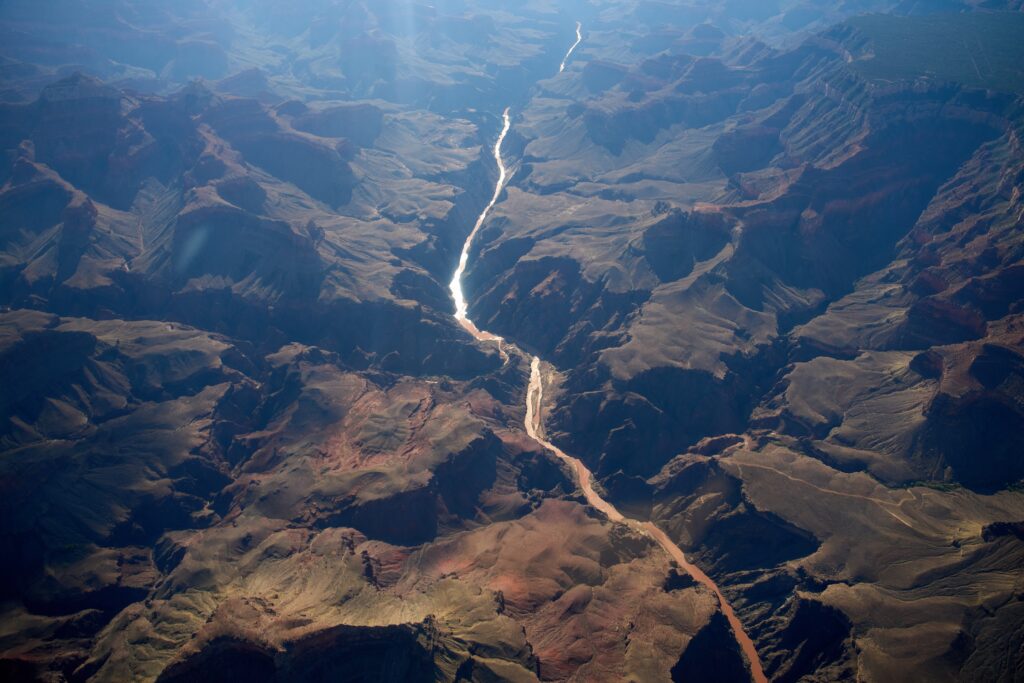
At this point, they were in the depths of the canyon, entering what is known as The Box, a narrow four-mile section of trail carved into the rock face along Bright Angel Creek. There is no high ground, no escape routes.
Suddenly, it seemed, they were under the cloud, and a wall of wind and rain turned the air white around them. Water felt like it was coming at them from every direction. They could no longer see in front or behind them and had no idea whether they should keep going or turn around.
They started to hear boulders crashing from above.
“We can’t stay here,” Buscher told the other two. “If the river starts to rise there is nowhere for us to go.”
They decided to keep going. Around them, the once-dry canyon walls transformed into vertical rivers. And “not trickles,” Buscher described, “rivers pouring down every surface and all you can think is that is going right to my feet, right into this creek and we have nowhere else to go.”
As they turned a corner, Buscher spotted a damaged section of trail now washed into a surging river. It was their only way forward, but her sister did not want to cross it. As they were arguing, a tiny yellow and gray bird appeared.
For the last 12 miles, nearly 10 hours crossing the canyon, the women had not seen any birds, Buscher said. They’d talked about how strange it was, the absence of them.
Then there was this bird, which stopped on a rock and stared at them, repeatedly flying back to this rocky sludge and back toward them.
“I know this sounds crazy, but my younger brother passed away a few years ago,” Buscher explained, her voice raw. “I knew that was Blake. That was my brother. I knew we had to keep going.”
Around this time, park rangers had started the process of evacuating hikers around the camp grounds, de Boer, the runner, said. She described how officials took her and others to Silver Bridge, about two miles south of where Buscher’s crew was, “and that’s when the wall of water started to come down,” De Boer said.
Back in The Box, the three women were trying to run. They pushed through “a waterfall” that pelted them with rocks. Next to them, Buscher said the “brown, rumbling, nasty water” kept getting closer.
They hit a black bridge and debated stopping there to avoid the dangerous falling boulders. They decided against it.
“That bridge is gone now,” she said.
A quarter-mile later the water had submerged the trail in front of them. Brink decided to backtrack to find a group of three men who’d been behind them to see if they had a plan. She turned the corner and screamed for them to grab onto anything they could, and did not come back.
After clinging to a tiny rock ledge “by fingers and toes” for about five minutes, Buscher knew they had to get higher up.
They eyed a taller ledge about 10 feet away and tried to scramble up. Held back by her heavy pack, McGuirk struggled and water rose up Buscher’s calves. Buscher screamed at her sister to ditch her pack, quickly unbuckling hers and dropping it into the rushing water.
McGuirk wrestled to get her Garmin watch off the shoulder strap without slipping into the river, frantically pushing the watch’s emergency button.
The siblings grabbed a burnt tree that was sticking out of the otherwise crumbling rock and anchored themselves on the ledge.
“This is all my fault,” McGuirk sobbed. “I am going to have to tell Katie’s family she is dead.”
About 10 minutes later, the water receded slightly and they spotted a figure walking up the path. It was Brink. After she climbed up to join them, the three sat for about about ninety minutes “and took turns having mental breakdowns,” Buscher said. At one point a helicopter flew by.
“We were just waiting to die,” Buscher said. “We were hoping and praying it didn’t rain again because if it did, this ledge would collapse and we would be gone.”
Their phones had been without service for most of the hike, but they realized that while the Garmin alert signal had worked, their location was now out of range. McGuirk decided to climb back down to try and communicate with Garmin’s emergency services. It worked, and she stayed on the tiny ledge for about two hours as officials assured them to hold tight.
Four hours later, at 6:48 p.m., they spotted another helicopter, this one was making a beeline straight to them. They later learned that it took hours to get them because rescuers had been evacuating groups of people from Phantom Ranch, a few miles away.
They could make out “a guy dangling from a rope and we knew it was for us,” Buscher said.
As the chopper got closer, the rescuer told them he could only take two. Buscher told her sister and Brink to go first. And as he tossed her a helmet and harness, Buscher said he motioned that “he would be right back for me.”
Ten minutes later, he was.
‘If we were 10 feet further down’
Even with precedent or warnings, one expert who specializes in trauma and international aid response said there is a common expectation when it comes to extreme weather and disasters that “it won’t get to us, that we will be okay.”
People’s brains are not made to conceptualize this kind of threat and devastation, said Cynthia Eriksson, a psychologist and dean at the Fuller School of Psychology & Marriage and Family Therapy.
“If we were constantly functioning out of a perception of the worst-case scenario happening we would be frozen in our lives.”
That is why it is so common to hear, as Buscher repeatedly said, “I never could have imagined this.”
After the rescue helicopter came, emergency responders eventually took them to the top of the South Rim, to a cafeteria filled with Red Cross volunteers who handed them hygiene kits, clothes and warm food. There was a smattering of other rescued hikers, “but none of them looked like us,” Buscher said. “They were clean and dry and had all their stuff.”
A Park Service investigator gently asked them about who else they’d encountered on the trail, as there were many people still unaccounted for.
All Buscher could think of was the group of three men behind them.
So far, responders have recovered the bodies of two men. A third is still missing. While officials have not yet identified them, friends and family members have put out statements, describing John Giusti, a dedicated chiropractor, father of three girls and “real-life superhero;” Brent Rosenkranz, a 42-year-old husband, father of three and passionate martial artist from Texas; and Timothy Smith, as good friends from Texas and lovers of the outdoors. In a Facebook video, Smith’s wife, Carrie sat next to her three children and asked those to continue to pray “as the search and rescue teams look for our ‘Daddy.’ We are praying that he is found today.”
Based on the timing and location, the women have a gut feeling the three could be the men who were hiking behind them — the ones they’d seen in the distance throughout the day, splashing and cooling off at the creek and heard laughing and marveling at the stunning Ribbon Falls.
“If we were 10 feet further down the trail in either direction I don’t think we would be here,” Buscher said. “I don’t think you would be hearing our story.”
The post Deep in the Grand Canyon, the rain left them nowhere to go appeared first on Washington Post.