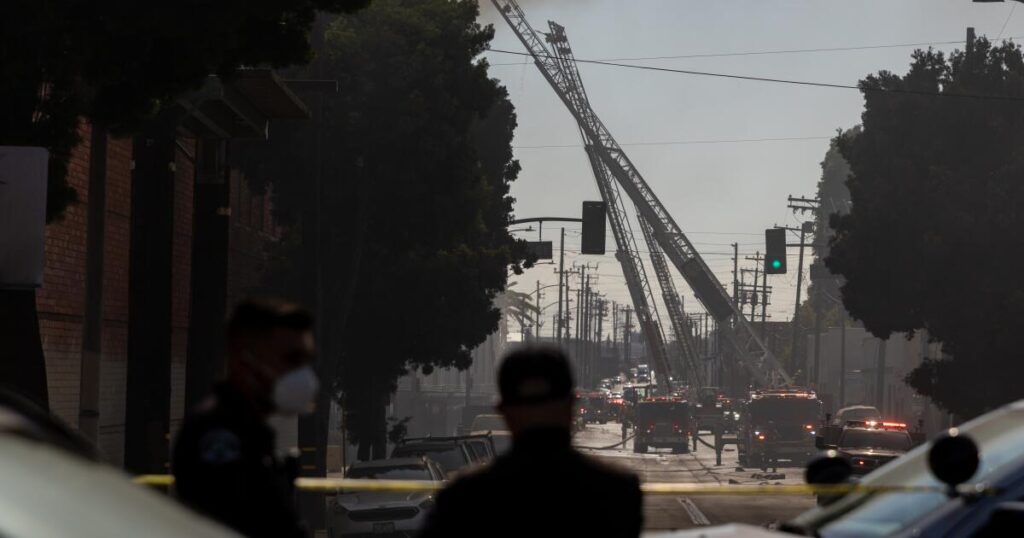
More bad air is expected around the Boyle Heights cold storage facility that has been burning since Wednesday.
Residents for miles away have been hit by the smoke.
Here is what to know and stay safe.
The latest advisories for Boyle Heights fire
The South Coast Air Quality Management District has extended a Particle Pollution Advisory until 12:30 p.m. on Sunday.
“On Sunday morning, a change in wind direction may push smoke towards Southeast LA county. If the fire is still producing a significant amount of smoke on Sunday afternoon, it will continue to impact Central and East Los Angeles,” the AQMD said.
What should you do?
- Officials cautioned people with lung issues or smoke sensitivity to avoid outdoor activities, but said crews have mitigated hazardous materials at the site. However, they remain concerned about biohazards potentially posed by spoiled food, including bread, poultry, pork and beef. The 500,000-square-foot warehouse stores 85 million pounds of frozen food.
- L.A. County Health Officer Muntu Davis said the main public health concern was smoke and fine particles that can irritate the ears, nose, throat and lungs, as well as exacerbate heart and lung conditions. Sensitive individuals were encouraged to wear well-fitting N95 and P100 masks, and to register for emergency notifications at alertla.org.
- Will Barrett, assistant vice president for nationwide clean air policy with the American Lung Assn., told The Times that it can be hard to pinpoint exactly what is in the smoke while crews are still working to contain the evolving health risk, but that the most important thing is to avoid exposure. “Much like recent industrial and wildfire incidents, the makeup of the smoke can include toxic chemicals, fine particles and other serious risks to lung health depending on fire conditions and what is burned,” he said.
Tips for dealing with smoke
The Los Angeles County Department of Health has issued some basic tips if you are dealing with smoke from the fire:
- If you smell smoke or see smoke or ash at ground level, avoid vigorous physical activity and remain indoors with doors and windows closed.
- Run an air purifier if available.
- Avoid using a whole-house fan or swamp cooler, as they can bring polluted air indoors.
- If you see or smell smoke, or notice particles and ash in the air, stay indoors to limit exposure, especially if you have heart or lung conditions, are elderly, or have children.
- Wear an N95 or P100 mask if you must go outside in smoky conditions for long periods of time in areas with heavy smoke or where ash is present.
- If it’s too hot to keep windows and doors closed, go to a public place like a library or shopping center to stay cool and protect yourself from harmful air.
- Avoid using fireplaces, candles, or vacuums. Clean dusty surfaces with a damp cloth and don’t smoke.
- If you experience symptoms like severe coughing, shortness of breath, wheezing, chest pain, palpitations, nausea, or unusual fatigue, contact your doctor or go to urgent care. For life-threatening symptoms, call 911.
What an expert says
Michael Kleinman, a toxicologist and professor at UC Irvine’s Wen School of Population and Public Health, said the zone from the smoke is very dependent on how fast the wind is blowing and in what direction. But “if you start to feel irritation, or your eyes are stinging or watering, or your nose is beginning to run or feel irritated, that’s a little more serious.”
The potential biohazard posed by millions of pounds of spoiling food is a concern, Kleinman said.
“It’ll certainly be smelly and noxious, and bacteria and things are going to be growing in it,” he said. “Obviously not getting in contact with it is an issue, but if the stuff starts to burn, it adds this biological material the plumes, and you’re going off into territory that really is very untested.”
Resources
- The city opened a smoke respite shelter at Pecan Recreation Center at 145 S. Pecan St., while the county opened one in City Terrace Park at 1126 N. Hazard Ave.
- The state will deploy technical experts and make ready 5.5 million respirator masks for distribution, along with commercial-grade air purifiers, bottled water and enhanced air-quality monitors.
Laurence Darmiento and Shelby Grad contributed to this report.
The post How to deal with the smoke, health effects of Boyle Heights cold storage fire appeared first on Los Angeles Times.