In a time when an iPhone can be preordered, customized, and on its way to your doorstep all through a touch-screen tap, it’s almost quaint to remember that people used to camp out for smartphone releases. That was once the regular routine of Andrew Erickson, a longtime tech YouTuber, who recalled to me with a mixture of nostalgia and awe the time he braved the rain at 4:30 a.m. to join a line for the newest iPhone. The line snaked through the mall, nearly reaching the parking lot.
[Read: The $10,000 MacBook Pro is here]
Next month, when Apple is expected to launch the iPhone 18 Pro, Erickson has no plans to even buy the phone, let alone fight crowds for it. Instead, along with a growing number of Americans, Erickson is buying used. He’s fed up with incremental improvements in gadgets, he told me, and is more interested in getting an old version of the iPhone 17 Pro when it hits the secondhand market at a discount. Already, almost half of his current devices were acquired secondhand, and as electronics prices soar amid an AI-fueled chip shortage, he expects that portion to grow. “The argument’s just getting weaker and weaker to buy brand-new,” he said.
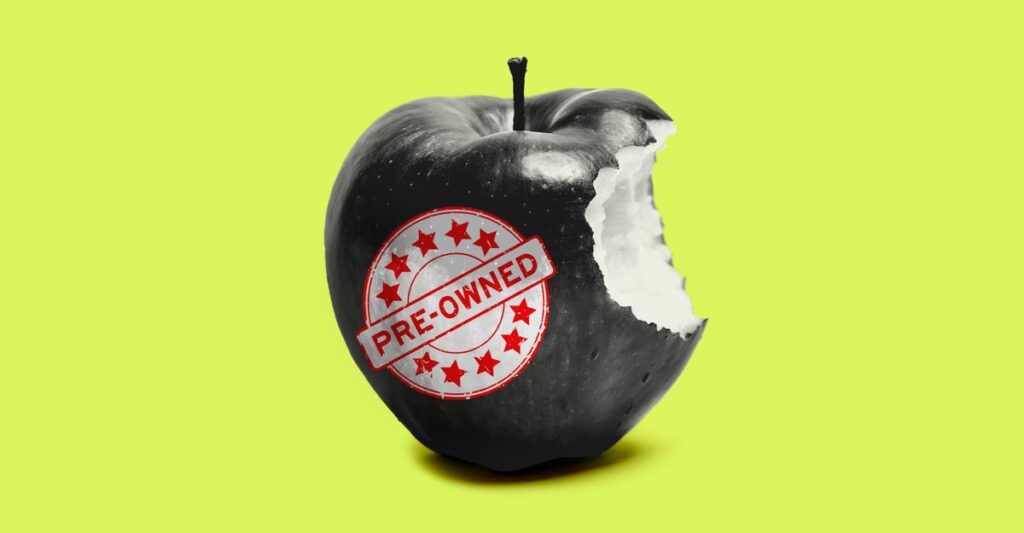
Based on the numbers, old tech products are indeed being looked at in a new light. Globally, the size of the industry could reach $153.4 billion this year, up from $104.1 billion four years ago. The used-smartphone market alone is expected to grow by more than 12 percent in 2026, according to the International Data Corporation, which forecasts that the market for new smartphones will experience a record drop this year. Growth in secondhand electronics and refurbished gadgets that have been restored to full working condition now outpaces that of new products on eBay, the e-commerce giant reports.
Among a number of shoppers I spoke with, there was a sense that new models are indistinguishable from the old ones, and the hype of securing the latest and greatest has given way to an upgrade cycle driven by practicality. More than ever before, people are eager to buy used.
“We’ve never been here,” Lauren Benton, the U.S. general manager of the refurbished-electronics marketplace Back Market, told me. She said demand ticked up immediately after Apple unveiled price hikes this summer. Back Market’s order values for refurbished MacBooks in the U.S. increased by 37 percent throughout the week following the price increase, while order values for iPads rose 25 percent. Demand for the company’s non-Apple laptops, too, has soared by 74 percent compared with last year. Outside of students and parents, a large portion of the marketplace’s buyers are “people that understand that the newer tech isn’t giving us all that much more,” Benton said.
Regular upgrade cycles were a hallmark of tech gadgets in the 2010s, a trend led by Apple, which has introduced at least one new iPhone model every year since its initial launch. Americans bought into the frenzy: In 2014, the first year Consumer Intelligence Research Partners tracked such figures, about 44 percent of iPhone holders said they replaced their device every one to two years. In those days, lines at Apple stores stretched so long that they were used by analysts to gauge annual demand.
In 2026, the lines that former Apple fanatics once waited in have all but disappeared. Online preorders are partly to blame, but so is dissipating excitement for releases that promise incremental upgrades. People now hold on to their smartphone for three years or longer, fatigued from “buying, effectively, the same device over and over and over again,” Wamsi Mohan, a Bank of America analyst who covers Apple, told me. Those buying new are doing so largely because their phone was broken or stolen, rather than to get their hands on new features. A recent report found that 76 percent of buyers refuse to upgrade until new capabilities feel “worth the cost.”
And those costs are climbing, driven by data centers eating up the world’s inventory of RAM. Samsung’s Galaxy Tab S11, Sony’s PlayStation 5, and Microsoft’s XBox Series S console were all marked up $100 this year. Apple conceded to “unavoidable” hikes in June, increasing the cost of its MacBooks and iPads by roughly 15 to 25 percent. Even the most ardent tech loyalists have changed their buying habits: A recent poll of thousands of readers of 9to5Mac, a website popular among Apple fans, revealed that 38 percent of them intended to upgrade less frequently because of higher prices.
In tandem, people are warming up to refurbished devices. Google queries for secondhand laptop have jumped by upwards of 5,000 percent over the past year. In an April CNET survey, nearly half of U.S. adults said they’d considered buying refurbished tech within the past year and cited cost-effectiveness and expensive new models as driving factors. Angie Cardona-Nelson, who recycles used electronics on eBay, told me that when she started her business in 2008, selling refurbished devices was tough going—she’d sit on products for months, attempting to drum up business with sales or discounts. “There was no confidence to buy a used item,” she said. Since January 2025, her laptop sales have more than doubled, and new listings are being bought up in a week or two.
The way people are buying secondhand devices has also shifted: Instead of opting for products that are roughly three generations behind, buyers are purchasing last year’s models—an indication that the refurbished industry is now attracting those who were “truly considering new,” according to Back Market’s Benton.
Erik Helgesen, the president of PayMore, a retail chain focused on used electronics, told me that the company had already seen a major uptick in sales preceding Apple’s price hike. But after, it was “just a hockey stick,” he said. Now PayMore can hardly keep some products in stock. Helgesen expects the company to open more stores in the coming year to meet demand.
This new readiness to opt out of the endless treadmill of releases seems to be a sign that people are starting to look for something more practical from their devices: deals. Whether this more utilitarian—and arguably healthier—approach to gadget consumption means that we’ll actually free ourselves from expensive tech, though, remains to be seen. A three-year-old MacBook may be a steal today, but as Nabila Popal, a senior director at the International Data Corporation, reminded me, prices reflect demand: If people keep buying up the used gadgets, those prices are bound to shoot up, too.
The post There’s No Reason to Buy a New Phone Anymore appeared first on The Atlantic.