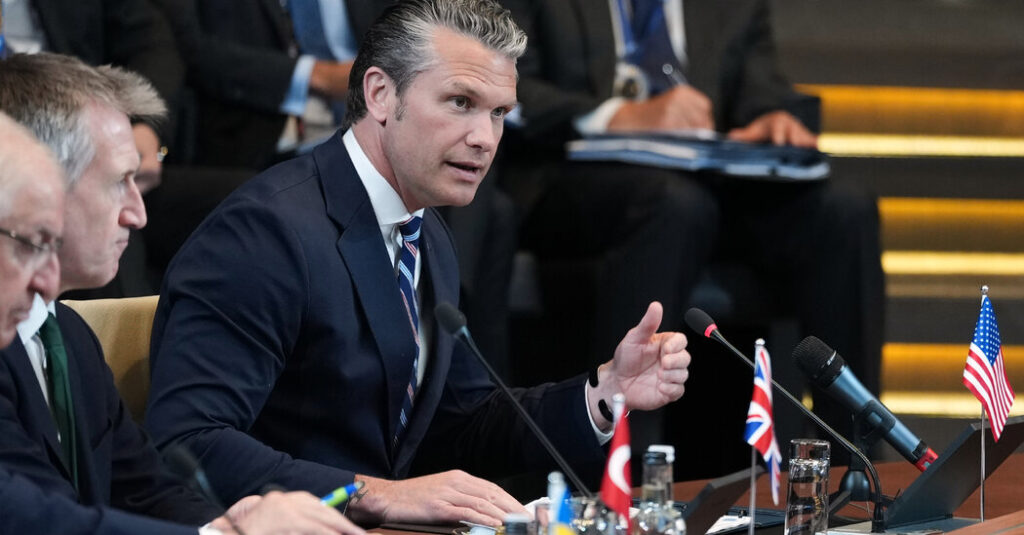
Defense Secretary Pete Hegseth berated NATO allies as “shameful” for their reluctance to assist in American strikes against Iran, suggesting on Thursday that the Pentagon would reduce the number of troops it keeps in Europe as a result.
He repeated President Trump’s previous description of the military alliance as a “paper tiger” and warned that U.S. support to NATO would not be “a one-way street.” Mr. Hegseth’s 12-minute lecture cast a chill over a meeting that had been designed to set a collaborative agenda for a summit of NATO leaders next month.
He scolded allies whom he described as having failed to step up their defense spending, as the alliance agreed to do last summer, under pressure from Mr. Trump. But Mr. Hegseth reserved his harshest remarks for countries that had resisted letting American jets or ships use bases in Europe on their way to attack Iran during the war that the United States and Israel initiated Feb. 28.
“Too many of our allies said no, or tried to drown us in arcane legal debates, or criticized us publicly for doing what they aren’t prepared or able to do themselves,” Mr. Hegseth told the other 31 NATO defense ministers gathered at the alliance’s headquarters in Brussels.
“It was shameful,” added Mr. Hegseth, who did not name the countries he was criticizing. “These allies, they put America’s sons and daughters — our sons and daughters — at risk by denying them the predictable access basing and overflight that never should have been in question at all.”
Mr. Trump has long questioned the North Atlantic Treaty Organization’s value, threatening at times to either leave the alliance that the United States helped create after World War II, or saying he would not defend its other members.
At the outset of the war with Iran, European leaders grappled with whether to support U.S.-Israeli attacks that many viewed as potentially illegal. France and Italy refused to allow American bombers to take off from bases in their countries, while Britain offered limited access to its bases in Cyprus and allowed only warplanes flying “defensive” missions to land in Britain. Spain blocked U.S. military jets involved in the Iran mission from using its airspace.
Mr. Hegseth then announced a six-month review of the U.S. troop presence in Europe “to ensure our forces are postured for America’s global needs.” He said that the review would seek to ensure that American access to bases and airspace was clearly understood, while putting the onus on NATO to ensure that Europe took primary responsibility for its own defense, instead of relying on the United States.
The United States is already planning to significantly reduce the aircraft and warships that it makes available for NATO operations in Europe. That could limit NATO’s ability to monitor Russian submarine traffic, for example, or launch long-range Tomahawk missiles deep into Russian territory.
Additionally, Mr. Hegseth said the United States would reduce what it pays in annual NATO dues if other members did not increase their annual defense spending as Mr. Trump has demanded. The United States pays about 15 percent of annual NATO administrative costs, amounting to about $790 million, about the same as Germany.
Mr. Trump demanded last year that all NATO members spend at least 5 percent of their national economic output on their militaries and defense-related projects, up from a 2 percent benchmark set in 2014. Three countries — Albania, the Czech Republic and Slovenia — still fell short of 2 percent as of last year, the latest official numbers available.
“We are going to keep a close eye on allies who are not doing that,” Mr. Hegseth said Thursday.
His speech was unusual compared with the customarily anodyne remarks delivered at the start of meetings of the NATO ministers, who gather only a few times a year. The alliance’s secretary general, Mark Rutte, took the microphone after Mr. Hegseth and tried quickly to pivot to business as usual, saying they had “much to discuss.”
The post Hegseth Berates NATO Allies for ‘Shameful’ Response to U.S. War in Iran appeared first on New York Times.