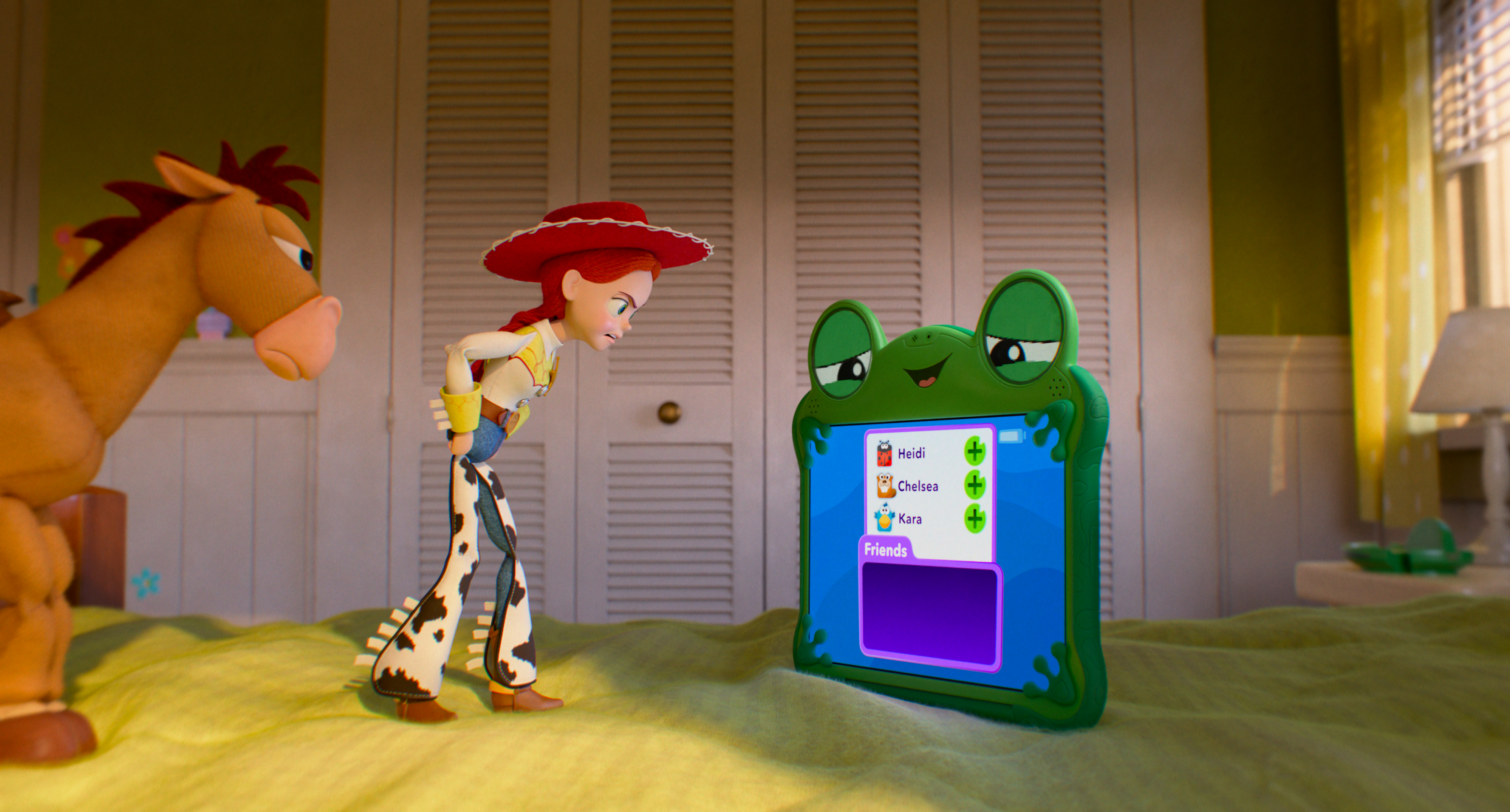
The antagonist of Toy Story 5 isn’t a kid who loves ripping dolls apart or a bitter, abandoned toy. It’s a tablet, a familiar foe to the modern parent.
The movie asks whether young Bonnie should spend less time playing games, watching content, and messaging her friends on a tablet called Lilypad and more time interacting with those same friends—or, perhaps, better, more genuine ones—outside. Lilypad also poses an existential threat to Bonnie’s less mind-numbingly addictive toys, including Woody, Buzz, and Jessie, the last of whom takes center stage in this new movie.
Greta Lee gleefully accepted a role in the film because of her love of the franchise, which debuted when she herself was a child. But she panicked when she learned she would be playing the controversial Lilypad, and saw the first rendering of her character. A parent herself, she was all too familiar with the debate over how much tech kids should be exposed to, and knew that when Pixar (which is owned by Disney and whose films stream on Disney+) weighed in, the conversation among parents would not “be chill.” Lee herself has tried to stave off the inevitable invasion of smartphones into her kids lives by, recently, buying a landline for her two boys, a purchase gaining popularity among parents anxious to limit screen time and nostalgic for an analog past.
Ultimately, Lee thinks director Andrew Stanton and co-director McKenna Harris handled the subject with nuance. The actor, who will also appear this summer opposite Willem Dafoe in the drama Late Fame and Wagner Moura in the Netflix sci-fi thriller The Last House, spoke with TIME about the film and how she navigates tech with her own kids.
TIME: What made you want to play the tablet Lilypad?
Greta Lee: I got a message from [director] Andrew Stanton, and Toy Story is one of those cultural phenomena I’ve loved for so long. I immediately said yes. Then they sent the mock-up of the character image, and I began to panic a little bit.
Why?
Lily being a device made me realize they were going to go there in terms of the conversation around tech. I am a parent, and I am having those conversations. There was no way it was going to be chill. It was the first time I understood the responsibility and the risk.
How did you feel about that as a parent?
I’m no parenting expert. I have been on my own journey of constantly trying to recenter my family’s priorities. I recognize the parents in this movie. Nobody buys an educational tablet thinking, well, my child is never going to speak to me again. Sometimes it even feels like a social responsibility: I need to arm my kid to live in a tech-first world, especially for girls with STEM. It gets all wrapped up in this messy web. I’m so glad the movie does not back away from that.
Do you have a policy at home?
It’s shifting. We’ve had to walk back iMessaging cousins and friends to organize a lemonade stand because we realized how quickly it creeps into screens all the time. The latest thing is we got a landline phone.
How has that been?
It has been such a game changer. It’s like a dam. There’s no way they’re going to live in a world without cell phones, but we’re delaying it. I recommend people put a landline in a public space. The thing we griped about as kids, having your mom intercept your call, has been instrumental: You get a sense of, who is your kid talking to? What’s their community? Our boys were 9 and 7, and it was hilarious: We had to teach them to say, “Hello?” when they picked up a phone. Otherwise it was just a lot of standing there in silence or saying, “Are you still there?” But now they talk to their friends all afternoon.
As you limit screen time for your kids, are you conscious of your own phone usage?
With my first, I can’t believe the phone barrier I had between us. I wanted to document everything. One of my favorite parts of the movie is when the toys go on the roof and see nobody’s playing outside. It looks dystopian because every person is inside with a screen in front of them.
Obviously Disney, which is behind this Pixar movie, has a streaming service. How did you reconcile a streaming company weighing in on tablet use?
I’ve heard Andrew Stanton say there’s no contest between tech and toys. It’s already over. For me, it’s so actor-y, but I’m just trying to humanize a tablet. Lilypad is superfocused on making Bonnie friends [through messaging and games on the tablet]. And that’s exactly what [the doll] Jessie wants too [through imaginative play]. So instead of the binary question of whether streaming, tech, and AI are good or bad—I mean, they’re bad, but as parents we know the conversation doesn’t end there—it was more about being deliberate about, how do you foster real friendship? It’s not necessarily through messaging or games.
They need to get outside. I read you keep chickens?
We have. But we live in a place in Los Angeles where there are lots of predators, so our current chicken count is zero. We’re not in full donkey or pig territory, but we’re cuspy.
You’re famous for your red-carpet looks. Do you worry about kids’ sticky hands on your clothes?
At home, I’m in jorts. I maybe shouldn’t admit this, but my kids have also tried everything I’ve worn. I have a whole camera roll of them wearing all these sculptural pieces or this leather armor I wore. It really is a gag.
The post Greta Lee Plays a Tablet in Toy Story 5. In Real Life, She Bought Her Kids a Landline appeared first on TIME.