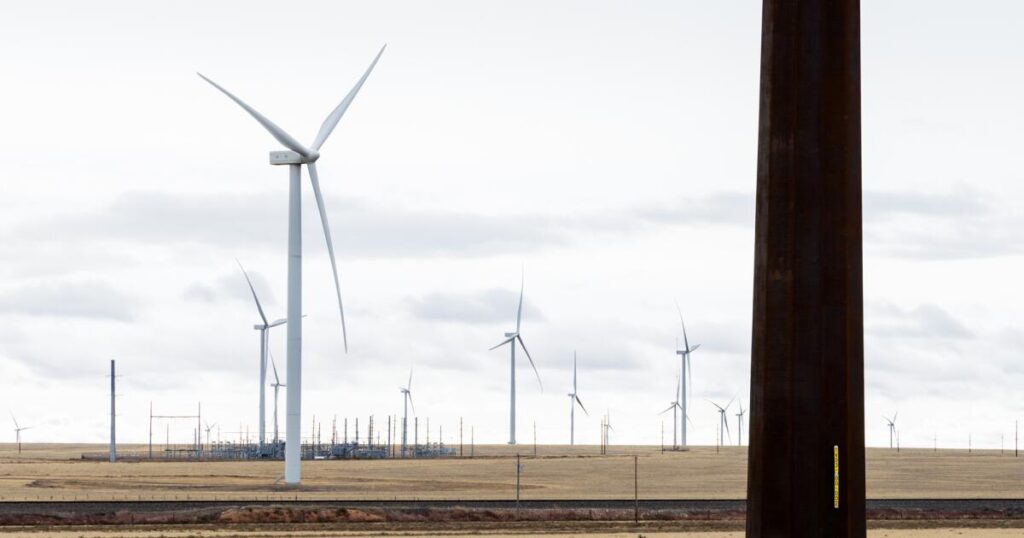
One of the largest clean energy projects in United States history is now online, delivering electricity from a massive wind farm in New Mexico to Arizona and California — and signaling a new era for sending clean electricity across the West.
Nearly two decades in the making, the estimated $11 billion SunZia project from Pattern Energy is composed of 916 turbines that can produce up to 3.5 gigawatts of capacity — a scale that would have been difficult to imagine even a decade ago. It’s enough to power about 1 million homes and more than three times the amount of clean electricity as each of the next two largest U.S. wind farms, Alta Wind in Kern County and Great Prairie in northern Texas, according to the U.S. Energy Information Administration.
Critically, the project also includes a 550-mile high-voltage direct-current transmission line that delivers wind power from New Mexico to the Palo Verde substation in Arizona, where it then feeds into Southern California. In all, some two-thirds of the power sent across the line will be delivered here.
Experts say the project has already begun making a difference on the state’s grid: Since SunZia began testing in April, the state’s Independent System Operator, CAISO, has reported record-breaking amounts of wind power on the California grid at least five times, according to Dennis Wamsted, an energy analyst at the Institute for Energy Economics and Financial Analysis.
Wind output on May 15 hit a record 8,294 megawatts — almost 1,600 megawatts higher than the record before SunZia power began flowing into the state, he said.
“This is a milestone, there’s no doubt about it,” Wamsted said. “They’re tapping into a great wind resource in New Mexico, and that wind resource is now going to be used across the Southwest. It’s good for consumers everywhere, and it’s really good for folks who are in favor of a transition away from fossil fuels.”
The New Mexico region was selected in part for its strong and consistent winds, which are comparable to California’s offshore wind resources off the coast of Morro Bay.
Much of it will come when the wind picks up at night, complementing California’s abundant daytime solar power, and batteries, which discharge for a few hours around sunset.
But it’s not only a benefit for California. The project reflects a renewed effort to move large amounts of remote wind or solar to high-demand population centers across multiple states.
“Large-scale transmission is essential to meeting the West’s growing energy needs and strengthening reliability across the grid,” said Elliot Mainzer, CAISO’s president and chief executive, in a statement. “Projects of this scale help deliver energy reliably to areas of rising demand, improve the movement of power across states and support a more resilient, flexible and affordable electric system.”
It also comes at a critical moment. While many countries, including China, are investing heavily in renewable energy including wind, solar and battery energy storage, the U.S. has pulled back on these under the Trump administration, which has prioritized fossil fuels such as oil, gas and coal in its mission to “unleash American energy.”
The president has especially targeted offshore wind, striking a series of multi-million-dollar deals with energy developers to walk away from offshore wind leases in federal waters and instead invest in domestic fossil fuel and geothermal projects. Two of those abandoned leases have been off the coast of California’s Morro Bay.
But data show land-based wind, such as the SunZia project, is already cost competitive with other major new-build power sources in the U.S. Despite Trump’s approach, red states have continued to expand their wind power, such as Texas, which now leads the nation in the development of wind and solar power and battery storage.
Iowa, Oklahoma, Kansas and Illinois have invested heavily in wind, while Wyoming is developing a 3,550 megawatt wind farm, the Chokecherry and Sierra Madre Wind Energy Project, that will export wind power to Western states including California.
“The administration cannot stop the transition,” said Wamsted. “The market [is] moving toward renewable energy.”
The SunZia project faced a long road to completion with ownership changes, slow permitting processes and major redesigns since it was first conceived in 2006. Pattern Energy acquired the project in 2022.
“SunZia proves that we can still build the consequential infrastructure this country needs,” said Hunter Armistead, chief executive of Pattern Energy, in a statement, noting that “many thought this was too big and too complex to finish.”
There was opposition, including from environmental groups concerned about habitat fragmentation, effects on bird migration and other disturbances from construction of the transmission line, which crosses the San Pedro River Valley, an important migratory flyway and desert riparian corridor in Arizona.
Perhaps the most significant opposition came from groups concerned about cultural and architectural sites along the transmission path. The Center for Biological Diversity, the Tohono O’Odham Nation, the San Carlos Apache Tribe, and the nonprofit Archaeology Southwest challenged the project in court, contending that the developers did not comply with historic preservation rules and that the project will cause irreversible damage to sensitive areas.
“Instead of taking the landscape-level impact into consideration in planning and designing the power line, they basically did a slalom course through the places where there were occurrences of environmental sensitivities and cultural sites,” said John Welch, vice president of preservation and collaboration at Archaeology Southwest and a professor at Simon Fraser University. “And this is especially true for the San Pedro Valley, which for decades now has been well known as a place of exceptional cultural significance.”
Welch said a motion for summary judgment is still pending in the U.S. District Court in Arizona, which the groups hope will require the developer to undo parts of the project or otherwise address their concerns.
But others see it as a huge victory for the region and the U.S., including Sen. Martin Heinrich of New Mexico, the top Democrat on the Senate’s Energy and Natural Resources Committee, who was instrumental in ushering SunZia to completion over the course of nearly 20 years.
Reached by phone Thursday, Heinrich said he believes SunZia is a model for big infrastructure projects in the U.S. It also demonstrates that transmission, not generation, is a constraint that can be addressed.
“We’re at a point now where it’s fairly straightforward to site and develop new generation — be it wind, solar, batteries, etc. — but getting the electrons where they need to go is the limiting factor in many of these cases,” Heinrich said. “Demand is on the rise for the first time since air conditioning became commonplace, so transmission is important to be able to solve for that.”
The project also underscores the need for permitting reform to help expedite the planning and approval process for similar projects moving forward, the senator said.
“My hope is that we can take this project, lift it up as an example, and apply some of those lessons more broadly,” he said. “SunZia solves for a particular set of challenges, but we need to be able to do multiple SunZias.”
The post After nearly two decades, this massive New Mexico wind project is now powering California appeared first on Los Angeles Times.