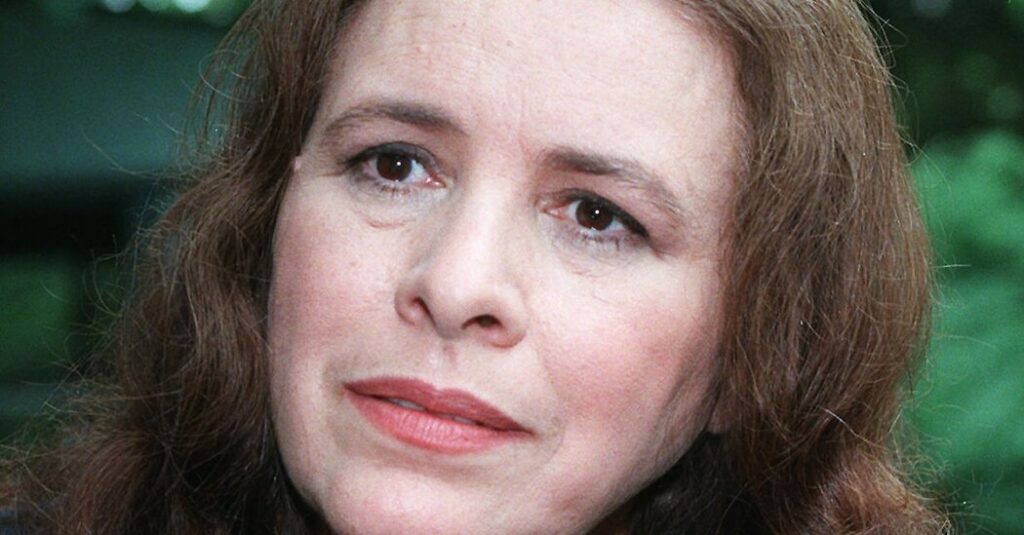
Jean Houston, a spellbinding figure in the human potential movement of the 1960s who used guided imagery to inspire unmoored suburbanites, burned-out executives and even Hillary Rodham Clinton, helping Mrs. Clinton conduct imaginary conversations at the White House with Eleanor Roosevelt, died on May 16 at her home in Ashland, Ore. She was 89.
Her death was confirmed by her friend and business partner, Constance Buffalo.
The daughter of a gag writer for Bob Hope, George Burns and Henny Youngman, Ms. Houston rejected any association with the word “guru,” viewing it as an intellectual demotion. She called herself an “evocateur of the possible” and a “midwife of souls.”
“In my definition, guru is spelled ‘Gee, You Are You,’” she said on the Oprah Winfrey television show “Super Soul Sunday.” “I seem to be a process. I seem to be a verb of becoming, and held by the lure of becoming that keeps us going on.”
As the founder of numerous organizations, including the Human Capacities Corporation, Mystery School, Social Artistry School and the Possible Society, Ms. Houston led workshops at empowerment retreats, in corporate boardrooms, at her geodesic-domed house in Oregon and in far-flung countries with the United Nations.
“She had a remarkable capacity to be present to others,” Robertson Work, a U.N. policy adviser who accompanied her on trips around the world, said in an interview. “You felt like you were being seen. You could discover: ‘What is my greatness? What is my potential?’”
Ms. Houston synthesized mythology, the psychology of Carl Jung and Joseph Campbell, and the experiential ethos of Esalen, the California retreat that shaped the human potential movement.
During her multiday workshops, participants engaged in imaginary conversations with historical figures like Mahatma Gandhi and Pablo Picasso, acted out the stages of evolution while pretending to be a fish or a monkey, and translated their dreams into elaborate dances.
“The idea was that it’s possible to cultivate a higher power within yourself,” Marion Goldman, a professor emeritus of sociology and religious studies at the University of Oregon and the author of “The American Soul Rush: Esalen and the Rise of Spiritual Privilege” (2012), said in an interview. “By making the self a better place, you make the world a better place.”
In addition to her workshops, Ms. Houston published more than two dozen books, including “The Possible Human: A Course in Enhancing Your Physical, Mental and Creative Abilities” (1982), which sold more than 400,000 copies.
“The imaginal realms of inner space proliferate and spill over into the external world in a phenomenal growth of new science, art, music, literature, politics, and above all in a new vision of mankind and world that is the glory of humanism,” she wrote in the book’s introduction.
There were dissenters.
Writing in Skeptical Inquirer magazine, Martin Gardner, a critic of pseudoscience, called Ms. Houston’s workshops “bewildering” and judged her “flowery New Age jargon” to be “so vague and murky that it is often difficult to understand.” (Adding insult to injury, the article’s headline labeled her a guru.)
Still, her pull was gravitational — even at the White House. In 1994, Ms. Houston was among a group of motivational speakers whom President Bill Clinton and the first lady invited to Camp David for a series of pick-me-up conversations after their universal health care initiative failed and Republicans took control of Congress.
She and Mrs. Clinton hit it off.
“Jean wraps herself in brightly colored capes and caftans and dominates the room with her larger-than-life presence and crackling wit,” Mrs. Clinton wrote in her memoir “Living History” (2003). “She is a walking encyclopedia, reciting poems, passages from great works of literature, historical facts and scientific data all in the same breath.”
Ms. Houston helped Mrs. Clinton prepare for a visit to India, Nepal and Bangladesh in 1995. That year, the first lady invited her to the White House to brainstorm ideas for “It Takes a Village,” Mrs. Clinton’s book about the well-being of children.
Mrs. Clinton was physically and mentally exhausted. Perhaps, Ms. Houston suggested, she should speak with her hero, Mrs. Roosevelt. The idea was for Mrs. Clinton to talk as herself and then answer back as Mrs. Roosevelt — the sort of role-playing exercise that Ms. Houston had conducted thousands of times.
At some point, she described the sessions with Mrs. Clinton to the Washington Post reporter Bob Woodward, who recounted the details in his 1996 book, “The Choice.” After an excerpt appeared in The Post, tabloids and Republican opponents of the Clintons accused the first lady of holding seances at the White House.
Mrs. Clinton released a lengthy statement in her defense. “This was an interesting intellectual exercise to help spark my own thoughts,” she said. “It was a brainstorming session for my book — not a spiritual event.”
In an appearance on the “Today” show, Ms. Houston told Katie Couric that she was simply helping the first lady focus her mind by imagining “what she would say to Eleanor Roosevelt should she have the occasion to do so.”
Ms. Houston felt that she had been unfairly maligned.
“I’m not a psychic,” she said. “I’m not a guru.”
Jean Houston was born on May 10, 1937, in Brooklyn. Her mother, Mary (Todaro) Houston, was an actress, interior designer and stock analyst. Her father, Jack Houston, was a comedy writer.
Growing up, she found inspiration in a dummy. When she was 8, she accompanied her father to deliver a script to the ventriloquist Edgar Bergen. Upon arriving, they found Mr. Bergen talking to his plastic-and-wood buddy, Charlie McCarthy.
“Charlie, what is the meaning of life?” Mr. Bergen asked the dummy, as Ms. Houston recalled in her memoir, “A Mythic Life” (1996). “What is the nature of love? Is there any truth to be found?”
The dummy mumbled some answers.
“At that moment,” Ms. Houston wrote, “my skin turned to gooseflesh, an electric hand seemed to touch mine, and a fractal wave of my future activities crashed on the shore of my 8-year-old self. For I suddenly knew that we all contain ‘so much more’ than we think we do.”
Her epiphanies proliferated. On a school trip, she met Helen Keller and marveled at how happy she seemed despite being blind and deaf. She joined an international pen pal club and corresponded about the scriptures of Sikhs, Hindus and Buddhists. She had long conversations with an old man in Central Park; later, she discovered that she had been talking to the philosopher Pierre Teilhard de Chardin.
“When you befriend your own brain,” she said, “a great deal becomes possible.”
At Barnard, she studied religion and theater, acting in Off Broadway plays at night. She attended a doctoral program in religion offered by Columbia University and the Union Theological Seminary, but did not receive a degree.
During graduate school, while conducting studies on LSD use, she met Robert E.L. Masters Jr., a writer. They married in 1965 and spent their honeymoon writing “The Varieties of Psychedelic Experience,” which was reviewed on the cover of The New York Times Book Review.
Also in 1965, the couple founded the Foundation for Mind Research, the first of many organizations that Ms. Houston started to promote and study human potential.
“We are living at the beginnings of the golden age of brain, mind and body research,” she told The Washington Post in 1978. “We may well be standing, with regard to these, where Einstein stood in the year 1904 with his discovery of the special theory of relativity.”
Mr. Masters died in 2008. Ms. Houston has no immediate survivors.
Among her fondest memories was her childhood meeting with Ms. Keller, who was then in her late 60s — a story she recounted often.
Ms. Keller put her hand on Jean’s face to read her lips.
“Why are you so happy?” Jean asked.
“My child,” Ms. Keller responded, “it is because I live my life each day as if it were my last. And life in all its moments is so full of glory.”
The post Jean Houston, ‘Midwife of Souls’ Who Advised Hillary Clinton, Dies at 89 appeared first on New York Times.