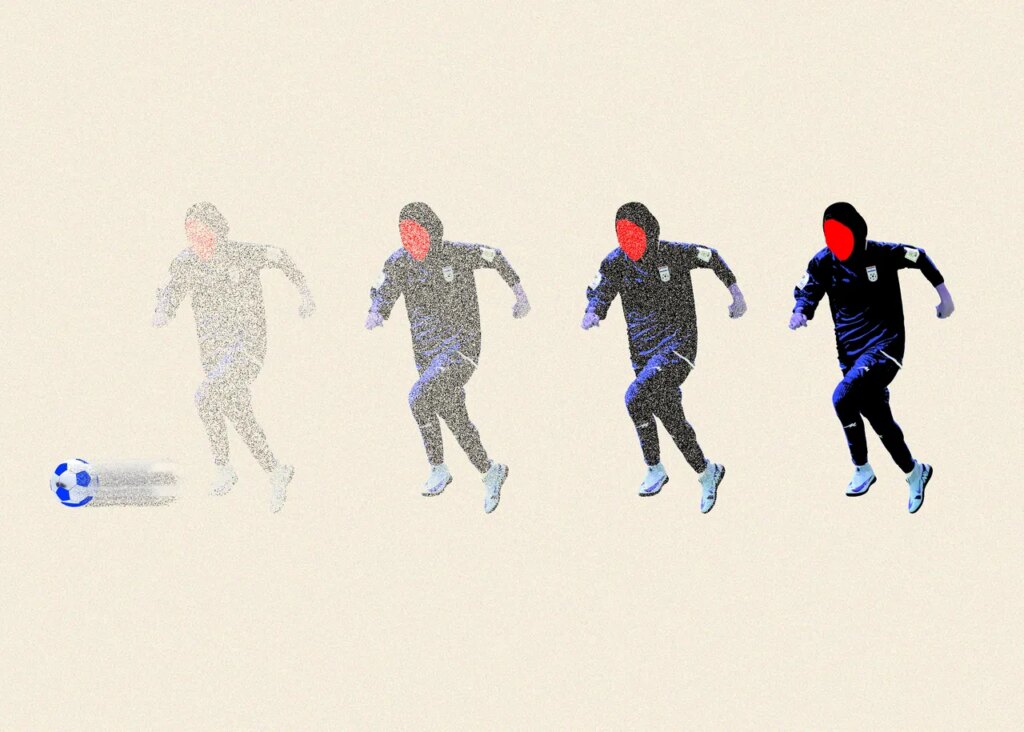
Iran’s national soccer team has made its 2026 World Cup debut amid a tumultuous backdrop: an abrupt and tentative ceasefire after months of war, an extraordinary set-up in Mexico after the US prevented the team from residing in-country between matches, and political uncertainty that has now expanded to the international stage.
But for many Iranians, professional sports have always sat at an intersection between athleticism, identity, and politics. From sporting defections and political activism to moments of immense national sporting pride, the trajectory of Iranian sports underscores what’s at stake this World Cup. The Iranian team, on Tuesday morning, drew 2-2 in their debut against New Zealand and will next face Belgium and Egypt, traveling to and from Mexico in between.
“I think it’s not fair,” says Iranian athlete Hadi Tiranvalipour about Iran’s team flying from Mexico to the US ahead of each match, although he’s not paying much attention to the World Cup this year.
Tiranvalipour, like several prominent Iranian athletes, knows the dichotomy of pursuing his sporting dreams amid the backdrop of the nation he once represented. In fact, he left everything behind in 2022: his family, friends, an entire life in Iran, crossing into Turkey, before seeking asylum in Italy. The taekwondo athlete and TV presenter had spent eight years on the Iranian national team and even became its captain, winning countless national and international accolades while representing his country.
Here’s WIRED’s complete guide to the 2026 FIFA World Cup.
But after speaking out about the rights of the Iranian people, especially women and girls, on TV, everything changed. What followed, Tiranvalipour says, was a swift backlash: “After the program, they closed everything for me, and they closed my career in sports, they closed my education.”
“I decided to leave all the medals and all the memories I created in my life,” he tells WIRED Middle East about leaving Iran, though that was far from the end of his sporting journey.
Sports have always been a major part of Iranian society and often a point of convergence between identity and politics.
But the experience of being an athlete in Iran, and what the role represents in the international arena, isn’t always straightforward. There have been moments of deep pride—when Iranian footballers gave white roses to their US opponents ahead of the 1998 World Cup, for instance. But there have also been a number of high-profile defections and sporting tensions, such as Iran’s only female Olympic medallist, Kimia Alizadeh, leaving the country in 2020.
As for Tiranvalipour, he had little choice but to pursue his dreams elsewhere, in what he describes as a “difficult” refugee journey amid periods of great uncertainty. “I didn’t have any other solution, because I wanted to keep going about my targets,” he says. “Unfortunately, in Iran, sport is so complicated.” Two years after he left, Tiranvalipour would achieve his dreams, representing the Refugee Olympic Team with Italy’s backing while competing in taekwondo at the 2024 Paris Olympics.
The significance of sports in Iran can be traced back centuries. One research paper notes that wrestling often appeared in Iran’s national epic poem, the “Shāhnāme,” embodying a heroic characterization associated with modern-day Iranian athletes. Figures such as world champion wrestler Gholam Reza Takhti have added to the influential legacy that athletes hold in Iranian popular culture.
But after the 1979 Islamic Revolution, Iran’s sporting landscape shifted dramatically due to state control, with women’s teams disbanded, female spectators banned from watching male sports, and stadiums placed under Revolutionary Guard control. In 1993, the Supreme Leader reportedly ruled that professional athletes were required to bring pride and honor to the nation, outlining the role athletes were expected to play beyond individualistic achievements, bringing national glory to Iran.
Iranian athletes have faced immense scrutiny throughout the years of the Islamic Republic’s governance, but the tightening of rules had consequences. Accounts of athletes defecting and seeking asylum date back to at least 1982, with the undercurrent of international events often framing such high-profile moments. This landscape shifted once again following the landmark 1997 win of Iranian president Mohammad Khatami, a reformist candidate more open to sports diplomacy. Reports even acknowledge that for a brief period, the women’s rights movements gained momentum during his presidency.
Beyond moments of political rupture, however, more subtle and nonetheless impactful movements emerged within Iran. One such example was the rise of women’s soccer, which Katayoun Khosrowyar helped bring to life. Khosrowyar, an Iranian American, moved to Iran in 2005 when she was 17. At the time, women’s soccer was still in its nascent stages and female spectators were largely prohibited from entering soccer stadiums. But with mounting internal and global pressure like the White Scarves movement, the needle began to move toward the birth of a women’s national team in Iran.
Khosrowyar spoke on TV about the importance of women playing soccer and helped convince authorities to allow for the formation of a national team, for which she was also scouted. Khosrowyar has since emerged as an influential figure and advocate for Iranian women’s sports, first as a player and then as a coach. Beyond the matches, however, the journey was long. “We never really got the attention or the focus,” she says about women’s soccer. “It was always jumping over hurdles, continuously pushing boundaries, and trying to convince men that we deserve a fighting chance to be here as well.”
For Khosrowyar, sports was a navigation of two worlds: “There couldn’t be any two more polar opposite countries in terms of women’s soccer,” she tells WIRED Middle East, comparing the US and Iran. “In the US, you have the foundation, you have the coaches, you don’t have to fight for training on a field, you don’t have to debate whether my sleeve needs to be an inch longer or shorter or if my hijab has to cover my eyebrows or not.”
But in the soccer tryouts, something unprecedented happened—Khosrowyar says 25,000 people showed up—pointing to an unstoppable hunger for women’s involvement in Iranian sport. “We got the support needed to kick-start [the] women’s national team and then the youth national team,” she says. “It took me two years to get girls who’d never worn soccer cleats to world-class players.”
But sporting visibility presents obvious challenges in Iran.
“When you become a national team athlete for any team around the world, you are going to be looked at,” Khosrowyar says. “Every word you say, you will be accountable for.”
As an American Iranian, Khosrowyar says, she was “walking a very thin” line because of the political tensions between the the two countries. “My goal has always been to bring my two sides together, even though they were literally at war with each other,” she says. “You have to be very cognizant of what you say in order to always keep the focus on the development of women’s soccer.”
But fragile sporting spaces that people like Khosrowyar had fought hard to create were also tested during moments of increased tension. The 2022 Women, Life, Freedom Movement—sparked by the death of Mahsa Amini—thrust women’s rights firmly into the spotlight and propelled athletes into an even more prominent public sphere. When climber Elnaz Rekabi subsequently competed without a hijab at Seoul’s Asian Sports Climbing Championships in October that year, it was seen as a prominent act of defiance against the country’s regime.
The pressures of representing Iran as an athlete have become more visible in recent years. There are several cases in which Iranian athletes were instructed to lose matches to avoid competing against an Israeli competitor, including Saeid Mollaei, a judo athlete who defected to Mongolia in 2019. Tiranvalipour told WIRED Middle East he experienced a similar incident.
Sean Sadri, associate professor of sports media at the University of Alabama who has produced several reports on the topic, explains that dozens of elite athletes have emigrated from Iran as a result of domestic pressures and concerns, either changing nationality or competing under a refugee status, as sports become more popular and politicians become more involved. According to his research, at least 69 elite athletes emigrated from Iran between 1979 and 2024.
Here’s WIRED Middle East’s complete guide to the 2026 FIFA World Cup.
Sporting events and international training cycles have at times served as conduits for such moments of political rupture, as with Alizadeh, who decided to remain in Europe in 2020, citing political pressure. There was also chess champion Alireza Firouzja, who left in 2019, and swimmer Saman Soltani, who was forced not to return after warnings from Iran’s morality police. Taekwondo athlete Kasra Mehdipournejad also decided not to return home, instead going on to fly the flag for the Refugee Team at the European Games, and Olympic judoka athlete Javad Mahjou similarly defected prior to the 2020 Olympics. The list goes on: Canoeist Saeid Fazloula fled in 2015 and, like many, went on to participate with the Refugee Olympic Team—one of the few avenues available to those who leave Iran.
“We don’t have another solution,” says Tiranvalipour. “For us, it’s too difficult to leave our country. So if we [can], we’ll take this opportunity.”
But leaving Iran and building a life abroad comes with immense personal challenges. “In terms of defection in the world of football, I have not seen that many,” says Khosrowyar. “Most of my players and my teammates are still there … Iranians are very close to their families.”
Headlines surrounding Iran’s women’s soccer team earlier this year highlight this complexity. In March 2026, during the Asian Cup in Australia, several players were granted asylum during a soccer tournament after facing criticism for not singing the national anthem. But only two of the players eventually chose to stay back, with several dropping their asylum bids and reportedly returning to a “heroes’ welcome.”
Yet what experts refer to as “muscle drain” is tied not only to political considerations but also to opportunity and to the development of the country’s economy and cultural sectors. Sanctions imposed on Iran, for example, have hindered the development of sporting infrastructure, which is further exacerbated by the recent war. Local reports say at least 200 sports facilities have been bombed by the US, which included the total leveling of the 12,000-seat Azadi indoor sports arena.
Khosrowyar is now based in the US, which is hosting the 2026 World Cup—a tournament where, for many, there’s more at stake than just sport. President Trump has just announced a tentative peace deal with Iran, removing the label of being the only World Cup host nation in history to be actively at war with a participating country. Yet a lot of uncertainty and tension remains: Behind the scenes, the US has restricted participants from several countries from even entering the country due to oppressive immigration laws.
International sporting competitions are often framed by politics; many also see them as more than that—a moment of pride, of cultural significance, resilience, hope. Khosrowyar regularly speaks to her fellow teammates back in Iran, who she says are now more determined than ever to keep playing.
“I’ve seen the girls actually pull it together more so than usual,” she says, describing how her players are pressing ahead, focused on the Asian Games, the Olympics, the World Cup. “There’s war, but we’re still going to train; nothing is stopping them.”
Tiranvalipour puts it simply: “A sport should bring peace for the people, this is the most important thing.”
This article originally appeared on WIRED Middle East.
The post For Iran’s Athletes, There Is No Separating Sports From Politics appeared first on Wired.