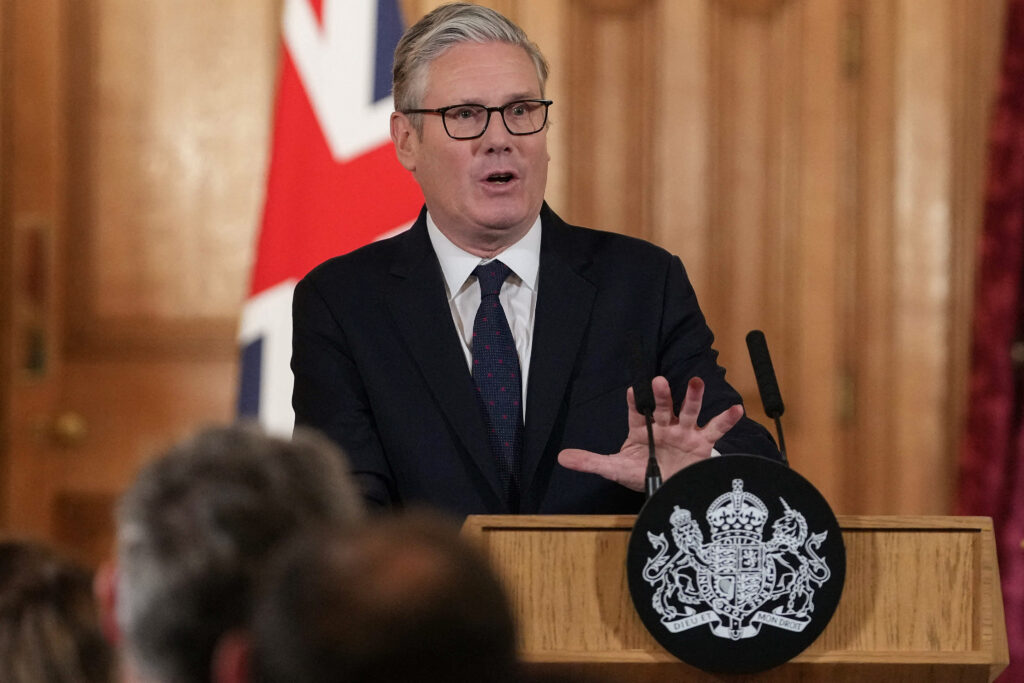
LONDON — Britain will ban children under 16 from major social-media platforms including TikTok, Instagram and YouTube by next spring, Prime Minister Keir Starmer said Monday, making his government the latest to conclude that parents alone cannot hold the line against platforms engineered to maximize the time children spend on them.
The ban would cover 10 platforms — TikTok, Instagram, Facebook, X, YouTube, Snapchat, Threads, Twitch, Kick and Reddit — that dominate the social lives of many teens and preteens but not messaging services such as WhatsApp and Signal.
Starmer said the government already has powers to take initial steps, with regulations expected to pass before Christmas and the full prohibition coming into force around next spring.
The announcement, made at a Downing Street news conference, came as Starmer confronts mounting pressure from within his Labour Party and is widely expected to face a leadership challenge in coming weeks. The timing prompted some critics to question whether the prime minister, who has previously opposed a blanket ban, was driven less by child welfare than political survival.
“It is clear to me a full ban is the right choice,” Starmer said Monday. “This will make our children safer, will make our children happier, will give them more time, more security, more freedom to grow up.”
Britain’s move follows Australia, which became the first country to bar under-16s from social media in December. Since then, several governments, including Brazil, Canada, Denmark, France, Indonesia, South Korea and Spain, have announced or are developing similar measures.
The British plan is more sweeping, extending restrictions to gaming and live-streaming services that allow children to communicate with strangers.
“Is there a situation in the offline world where you would just let your child pair up with a stranger, an adult that you don’t know anything about?” Starmer said. “No.”
Polling suggests Starmer is on safe political ground with the ban, with 7 in 10 adults supporting the idea, according to an Ipsos poll from January. More than 90 percent of respondents to a government request for comments backed prohibition for under 16s.
Within Starmer’s party, a group of 61 Labour members of Parliament, backbenchers whose support Starmer might need in a leadership vote, published a letter pressing for a ban in January.
Experts, however, are divided on whether the move will achieve its aims.
Some researchers say there is no proof that blanket bans reduce harm to children’s mental health. And while some activists hailed the move, others said the proposal risks removing the onus from tech companies to rein in their attention-seizing algorithms.
Blocking access to 10 popular sites could also push young users into even darker corners of the web, said Jon Crowcroft, a communications professor at the University of Cambridge.
“There is a real risk this will drive some users to worse sites,” Crowcroft told the Associated Press. “Policing platforms is far easier, if only regulators would bother.”
The government says it is working on age-verification mechanisms to enforce the ban. Options include facial age estimation, digital ID checks and third-party verification services, some of which Britain now uses to confirm that visitors to pornography sites are over 18.
Some critics said any system robust enough to screen out a determined 14-year-old would effectively require age-verifying every adult user, too, creating what the Open Rights Group, a London-based organization that advocates for privacy and free speech online, has called “your papers please” digital checkpoints.
The post Britain announces sweeping ban on most social media for children under 16 appeared first on Washington Post.