Like you, I want to do the right thing. Really.
My blood type is O-positive — one of the most coveted in blood donation, as it’s not only the most common blood type but also the most commonly transfused in emergencies. Despite that, as an otherwise hale 30-year-old, I can count the times I’ve donated blood on one hand. One finger, actually: In April 2020, in the thick of pandemic helplessness, I felt numb enough to take the leap.
In most cases, however, I’m horrified by the idea of sharp objects anywhere near my veins. Once, while getting hooked up to an IV, I thrashed and grimaced so much the attending nurse cut bait. “I’m going to come back once you’ve calmed down,” she said, coolly.
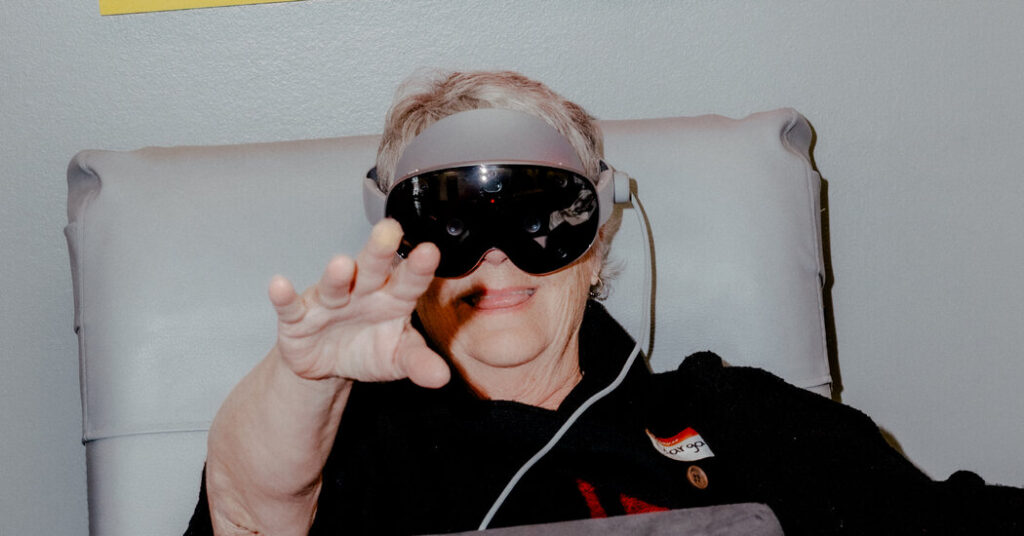
In recent years, Abbott, the medical technology giant outside Chicago, and Blood Centers of America have devised a workaround for people like me — prime donation candidates, but fearful of The Poke. In 32 countries and at 75 sites in the United States, blood donors can put on a Samsung Galaxy XR headset and choose between two interactive, mixed-reality games: the soothing Zen Garden, whose sole objective is to plant trees, and Intergalactica, a minigame-rich side-scroller.
Developed by the San Francisco-based Rock Paper Reality, both games are the brainchild of Miguel Carrazza Morales, a product manager at Abbott and an avid gamer himself. First came Zen Garden; now, Intergalactica is being released on Sunday, World Blood Donor Day.
Carrazza’s goal is to create “an experience for everyone” to bring in as many donors as possible — and, ideally, for them to have enough fun to come back. Abbott hopes the gaming format will especially coax the coveted 19-to-24-year-old demographic, which makes up just 6 percent of blood donations.
“Most donor recruitment campaigns help to bring you into the center, but they don’t affect your actual experience while you’re donating blood,” Carrazza said. “That’s really what we wanted to target here.”
That experience extends to the games’ soundtracks. Abbott commissioned the Chicago Symphony Orchestra — widely considered one of the world’s great orchestras — to record them in a whirlwind, one-day recording session in the spring. It was the first time this august ensemble has ventured into music for video games or interactive media.
Carrazza had long conceived of the games’ music as central to the user experience. An erstwhile trumpet player, he took lessons with a student of Bud Herseth — a venerated former principal trumpet of the Chicago Symphony — in college.
Joe Clark, the composer of both game scores and Carrazza’s teacher when he was at DePaul University, said that Carrazza had asked for “a list of ways we could do this, organized from easiest, fastest and cheapest to the most insane version, which was to hire the Chicago Symphony Orchestra.”
“He literally took the list,” Clark said of Carrazza, “flipped it to the back and said, ‘Yeah, that’s it.’”
As it turns out, the Chicago Symphony was already indebted to Abbott, a longtime corporate partner. In fall 2020, Abbott donated 12,000 of its BinaxNOW Covid-19 antigen tests to the orchestra. Those tests “allowed us to make music,” said Vanessa Moss, the orchestra’s vice president of operations. “There’s no question about that.”
Of course, Abbott’s game design must account for key medical needs. Rather than pursuing a full virtual reality experience — flooding the donor’s field of vision with a fully simulated setting — the developers settled on mixed reality. Donors can see their real-life surroundings at all times, but with graphics superimposed atop them, as if floating in the room.
“You’re not going to get that cyber-sickness or dizziness that some people can get when they’re in a fully closed-off virtual reality,” said Alex Carterson, a clinical pathologist and Abbott’s vice president of medical, scientific and clinical affairs.
That visibility goes both ways. The phlebotomist must be able to see the donor’s eyes to monitor vitals during the draw. At the same time, because at least one of the donor’s arms is occupied, the games have to be operable through eyesight alone. In both Zen Garden and Intergalactica, you usher the game along by either holding or sweeping your gaze on interactive elements.
So far, Abbott’s gambit seems to be working. Carterson said that 68 percent of blood donors who filled out questionnaires after testing the headsets have reported reduced anxiety while playing Zen Garden, the only game available at the time of the study. An even larger share, 89 percent, said using the headset would inspire them to donate blood again.
I recently took both games for a spin at a blood donation site in suburban Chicago. Carrazza booted up Zen Garden for me in the waiting area, easing me into the headset’s mixed-reality graphics. At one point, I realized I couldn’t see someone standing a few feet in front of me; he was blocked by a giant, leafy tree.
As Clark said, the Zen Garden score “could pass the most for a tone poem, in a concert setting.” The game boots up with a gentle, piano-and-strings flourish. When you successfully replenish the forest, the music mounts into a sunshine-bright climax, driven by the Chicago Symphony’s storied brass section.
But for my actual donation, I opted for Intergalactica, the newer title. Compared with Zen Garden, it’s a more involved experience. You assume the role of adorable, bionic space explorers tasked with rescuing crewmates marooned on three planets. Each planet offers a series of puzzles and low-stakes battles with robot foes, a laser beam shooting out from somewhere around my chin. (The player character does not take damage in Intergalactica, by design. “If you’re donating blood, I didn’t really want you to have to worry about losing the game,” Carrazza said.)
The soundtrack of the first level I picked, Fungal Frontier, used the orchestra’s peatiest sounds: subterranean growls in bass clarinet, tuba, contrabass and bassoon, the fibrous twang of an oboe, a drippy-sounding woodblock flourish. The second, Crystalline Canyons, had the radiance and grandeur of a film score. I was reminded of Erich Wolfgang Korngold, whose lush scores crowned Hollywood’s golden age, as well as the brassy orchestrations of Michael Giacchino, the prolific composer of Marvel and Pixar fame.
At times, I tilted my head up to gawk at the totality of the terrain: teeming landmasses that appeared to tower up to the ceiling of the donation site, a path spiraling around them to the top. Maybe it was all too engrossing. My phlebotomist had to keep reminding me to periodically squeeze the stress ball in my palm to maintain blood flow.
It is highly unlikely, even impossible, that a donor would blast through all three Intergalactica planets in one sitting. That makes the game compatible with a longer draw, like a platelet or plasma donation. In the case of shorter, standard donations, Carrazza hopes that patients’ curiosity might be sufficiently piqued to return, donate again and try another level.
I was musing on the similarities between an in-game labyrinth and the shadowy caves of the Pokémon franchise when I felt the expected prick in the crook of my arm. For a moment, my heart leaped into my throat. Did that really just happen? But the usual flare of panic petered out as quickly as it appeared. The music cycled on as usual, the Chicago brass urging me onward like a gale at my back. I had a maze to complete, and friends to save.
The post Coming to a Blood Donation Center Near You: the Chicago Symphony appeared first on New York Times.