Chris Murphy, the Democratic senator from Connecticut, offered the graduates of Wesleyan University wise counsel in his commencement speech a few weeks back. “You are about to step out into a world that prizes efficiency and the annihilation of drift and friction above all else,” he said. “Our entire economy is built on rewarding companies that are efficient at making a profit, not based upon how they treat their workers, the social value of their product or the impact they have on the community.”
“You didn’t design this world,” he continued. “You didn’t choose it. But you will live with the consequences of this cult of efficiency. And you will have to choose which side you are on.”
How do you make the most bread from the least wheat? A classic question of efficiency, but one that can be answered destructively. You can mix the flour with chalk or gypsum, as bakers sometimes did in previous centuries. Weigh the bread, and “more” of it is being made. But then people are eating powdered rock. Or you can use alum to whiten your loaves on the cheap. But alum harms the human digestive system and can kill children who consume it, as happened during the Victorian era.
This leads to a question that we too rarely ask: Efficient for whom? In Victorian England, what could be efficient for the baker was ruinous for the buyer. In modern America, what can be efficient for the factory farmer can be ruinous for the animal and, I’d argue, unwise for us.
In April, the House passed its version of the farm bill. It’s one of those sprawling pieces of legislation that includes many sections sizable enough to be their own bills. One of those sections is the text of a bill that would not stand a chance in the Senate on its own: the Save Our Bacon Act.
My colleague Nicholas Kristof wrote a wonderful column on this last month, but let me recap it: In 2016 and 2018, voters in Massachusetts and California passed ballot initiatives banning, among other things, the sale of pork from pigs confined in gestation crates. These crates confine breeding sows — large animals, often 400 to 500 pounds — in two-by-seven-foot cages in which they cannot so much as turn around, much less root or socialize. Because sows are often reimpregnated about a month after their piglets are born, they can spend years of their lives in these crates.
I watched, in the interest of fairness, a video from an arm of the National Pork Board on why gestation crates are good for pigs. It features row upon row of sows penned between bars so narrow they cannot turn around. It is no way for any animal to live, particularly not one as smart and as social as a pig.
There are studies I can cite on the psychic and physical violence these crates inflict on pigs — the elevated cortisol levels, the sores, the obsessive biting of metal bars — but I think the way Kristof puts it is simpler and more honest: “Think of your dog enduring what pigs face, and you realize that the moral cost is incalculable.” The difference between dogs and pigs is neither their intelligence nor their sentience. It is our willingness to admit their intelligence and their sentience. It is our decision to extend them our compassion and concern.
If you pack pigs into a confined space without room for them to roam, retreat and establish normal group hierarchies, they will bite one another and compete for food, and the weakest pigs will be tormented. The best argument for putting pigs in crates is that it’s kinder than leaving them in overcrowded, confined conditions. But that’s like saying solitary confinement is preferable to an overcrowded prison. It may sometimes be true, but neither is a way for a creature to live.
Proposition 12, the ballot measure in California, took this problem seriously and specified a minimum amount of space per pig. It mandated that a breeding sow must be able to turn around, lie down, stand up and fully extend her limbs, and that there must be 24 square feet of floor space per pig. That’s it. These are not conditions any creature would choose. But they are better than the conditions in which millions of breeding sows lived.
Prop 12 probably made pork between 5 percent and 20 percent more expensive. Some of that reflects the cost of space and management, some of it the cost of rebuilding infrastructure in operations that were previously designed around gestation crates. But Californians heard that argument and passed the measure anyway. They decided that they did not want the low cost of pork to hide the high cost on pigs; they would pay slightly more if it meant a somewhat better life for the animals. The law also helped small and more humane farms, whose operations were not built around gestation crates.
Having lost the argument before the voters of California, the pork industry turned to the courts. They argued that California’s law should be declared unconstitutional because the costs of California’s rules would fall on out-of-state producers, and that California was such a big market, it would act as a de facto national policy. They also argued that the policy would raise the cost of pork without offering sufficient benefits to either pigs or people. They lost.
And so, having lost before Massachusetts’ and California’s voters and the Supreme Court, the pork industry has turned to Congress. The Save Our Bacon Act wouldn’t just override the California or Massachusetts laws. It would also stop any similar law from passing in any state ever again. The bill would make it illegal to set standards that affected out-of-state producers. To expand on an analogy made by the Supreme Court, this would be akin to saying you can ban child labor in your state, but you cannot ban the sale of goods produced with child labor in other states.
“The Save Our Bacon Act reaffirms livestock producers’ right to sell their products across state lines, without interference from arbitrary mandates,” Representative Ashley Hinson, the Iowa Republican who introduced the bill, said. But the mandates were anything but arbitrary. Californians decided that there was more they cared about than the price of pork: They wanted breeding sows to be able to lie down, turn around, walk a little bit. They want low prices for pork, but they didn’t want those low prices to come at the cost of terrible cruelty to animals. Now, in the name of cost and efficiency, Congress might make it illegal for any state anywhere to say that there is a minimal standard of treatment for livestock destined for their market.
In traditional economics, prices are the informational lifeblood of an economy: They reveal the cost of materials and labor, the balance of supply and demand. But much can be hidden in prices. Perhaps it is artificially low because waste is being dumped into the rivers or workers are being robbed of their wages or the burden is borne by animals that will spend years of their lives without the comfort of their herd or the ability to feel grass beneath their hooves or turning around when curious about a sound. When that happens, we have sacrificed compassion for cost.
Most of us know by now that the lives animals lead in factory farms are often hideous. A 2019 survey by the Johns Hopkins Center for a Livable Future found that a majority of Americans wanted stronger oversight of confined animal feeding operations and a plurality wanted a ban on new ones. Those numbers were even higher when the same pollsters asked Iowans and North Carolinians, where majorities favored a ban on new concentrated animal feeding operations, in part because these operations often impose terrible costs on the human beings who live near them.
This is not a partisan issue. A 2022 Data for Progress poll found that 83 percent of Democrats and 77 percent of Republicans considered preventing cruelty to farm animals a matter of moral concern to them personally; when the pollsters described Prop 12, 85 percent of Democrats and 76 percent of Republicans supported it.
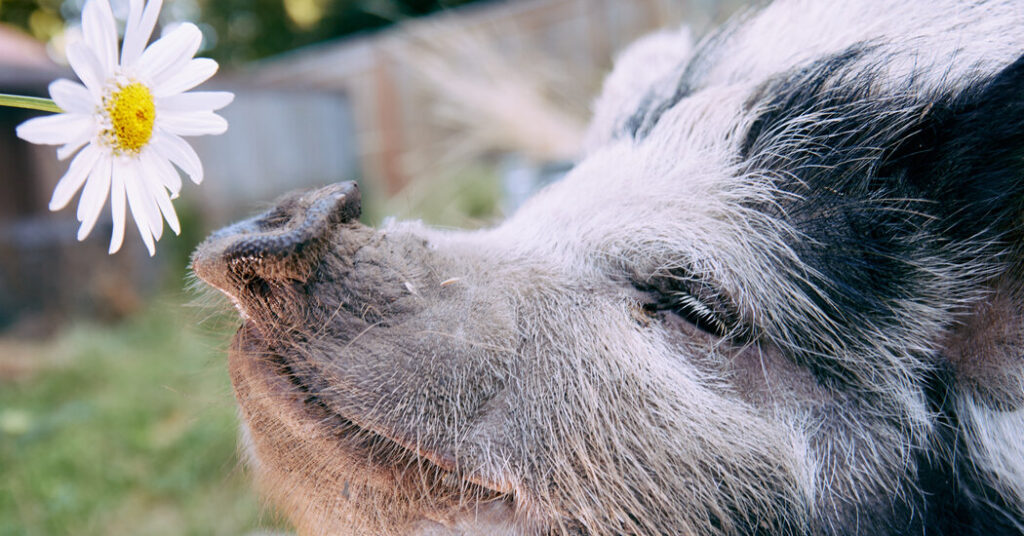
Many of us know that we would rather not know what is happening in these sheds. There is a reason the livestock industry fought so hard for the so-called ag-gag laws, making it illegal to film inside such facilities. It is hard knowledge to hold when our agency is so limited. The plight of an individual dog, cat or even pig is manageable. Plenty of people would go to great lengths to save a potbelly pig they saw wandering near a street corner, even as they consume factory-farmed pork at the dinner table. That pig is an individual. Breeding sows are an abstraction. We can relate to individuals; we feel powerless before systems. And systems fight to keep us that way.
What the ballot measures in Massachusetts and California revealed is that many Americans want the assurance that the meat they buy is not priced so low because the true and terrible cost was borne by the animal. They should be allowed to make that choice. The industry’s answer has been to spend millions in the courts and in Congress seeking to take that power from us.
That would not just inflict harm on sows. It would inflict harm on us. Compassion is a form of attention. Like any other form of attention, it can be strengthened or left to atrophy. To force states and people to participate in practices they find morally objectionable is to deny them the exercise of their moral judgments. That is not an efficiency, even if it lowers prices. It is a loss of collective agency, an enforced atrophying of our compassion, and Congress should reject it.
The Times is committed to publishing a diversity of letters to the editor. We’d like to hear what you think about this or any of our articles. Here are some tips. And here’s our email: [email protected].
Follow the New York Times Opinion section on Facebook, Instagram, TikTok, Bluesky, WhatsApp and Threads.
The post What the Cult of Efficiency Costs Us appeared first on New York Times.