It’s not so easy to harvest the sunshine if you live in America. Homeowners can hire someone to install solar on their rooftops, but it can take many years for it to pay for itself. You might be able to buy a share in a nearby solar farm, but only if you’re lucky enough to live in a place where community solar is available. If you live in an apartment or condo, forget it — in many states, you have no options at all.
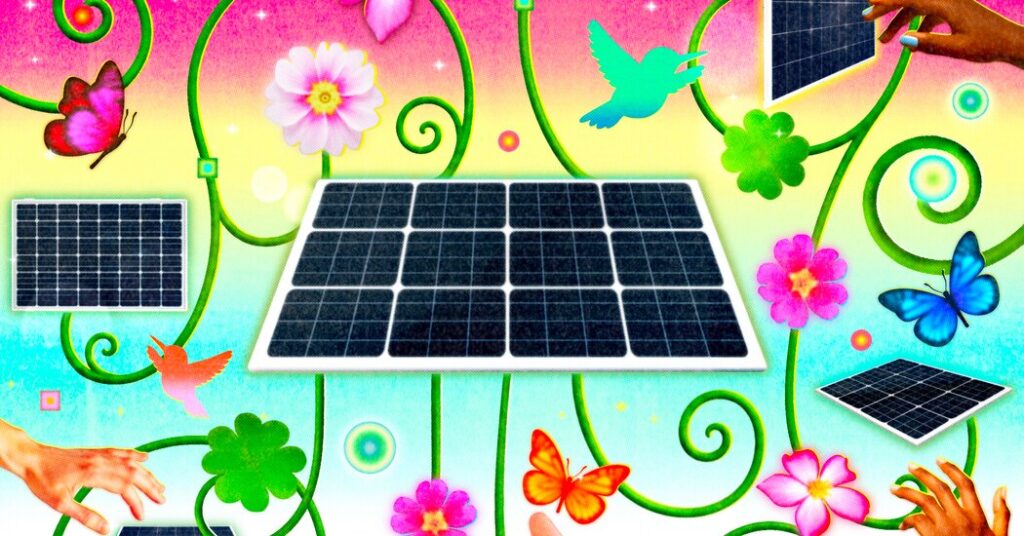
But that might be changing soon in more than half the country. A technology — known as plug-in, balcony or garden solar — is already enormously popular in Germany, in part because you can buy a kit for less than $600 at IKEA. It’s a small solar panel system, often producing up to 1,200 watts of electricity, or a little more than a refrigerator consumes, that you can affix to a wall, hang on a railing or prop up in a garden — and then plug directly into a wall socket. With the help of a small device called a micro inverter, it pumps electricity into your household circuits to offset your power demand.
At least 30 states have passed legislation to legalize these plug-in solar kits or are considering similar bills. The idea has wide appeal: Last year, Republican-led Utah became the first state in the country to allow plug-in solar sales.
Although these kits are modest in scale, they have the potential to change how Americans understand and consume energy. More states should get on board with them as part of a broader campaign to transform how our country harnesses renewable and zero-carbon power.
There are a few good reasons America should embrace balcony solar. For one, it will expand access to a clean power source that’s playing an increasingly important role in the global energy system. After a decade of staggering cost declines, solar has become a powerhouse: Last month, the United States — despite the Trump administration’s meddling with renewable energy projects — generated more electricity from solar than from coal power for the first time ever.
A balcony or backyard solar kit could also recruit a much larger group of people to cut their greenhouse gas pollution — in particular, renters. Climate advocates often coach homeowners to replace the big machines in their homes with cleaner alternatives: Buy a heat pump, not a furnace; an induction stove, not a gas range; an electric vehicle, not an internal-combustion car. But renters like me can rarely make permanent changes to the buildings where we live, and we may not own a car. In most cases, that’s fine, of course: Taking public transit, walking instead of driving and living in an apartment or condo gives us a low-carbon lifestyle, gratis. Balcony solar is a small way that apartment- and condo-dwelling Americans can take ownership of their energy choices and cut down their pollution on the margins.
At the same time, most Americans live in single-family homes, and one of the biggest reasons only about 9 percent of them have solar panels is the price tag. The United States has eye-watering rooftop solar costs compared with those in the rest of the world. A standard 7-kilowatt rooftop solar system that costs $28,000 to install in the United States would cost only $4,000 in Australia or $10,000 in Germany, according to the research and advocacy group Permit Power. What experts call our “soft costs” — marketing and sales, as well as our mishmash of local permitting rules and practices — can add thousands of dollars to the cost of a project.
Many of the countries that have brought down the cost of rooftop solar to low levels rewrote local rules. Here in the United States, the truly transformative reforms for cutting rooftop solar costs would have to happen in the states. Going forward, balcony solar should be able to avoid some of rooftop solar’s creeping costs: It will be bought off-the-shelf like a consumer product, not sold by a team, like a swimming pool; it can be installed by just about anyone, with no special training; and it requires minimal approval.
There are still some technical questions to resolve about how balcony solar will work in the United States, in part because our electricity networks work differently than Europe’s. A plug-and-play balcony solar system has yet to be certified in the United States; testing began only recently. Utah’s law legalizing plug-in solar requires any system to be certified as safe by outside authorities; other states should follow its lead.
There is one concern I have about balcony solar, which is that users could exaggerate its contribution in the future. The little panels have a certain romance to them, suggesting we all might generate our own homespun electricity, the way our frontier forebears baked their own bread or sewed their own clothes. But they are too small to ever replace the power grid. On the year’s coldest mornings and hottest evenings, and on many more days besides, the vast and powerful electricity generation and distribution system will still be needed. And that is OK: We won’t be able to take on climate change, or achieve our greatest economic ambitions, until we work together to build a new power grid.
But if I can dream for a second, I hope balcony solar’s charisma and low cost help us imagine the energy-abundant future we are so close to achieving. Americans and our government have a tendency to treat the current energy system, and the current set of technologies that enliven it, as finished and fixed. In reality, they are always changing. The electricity system of the 2000s relied far more on coal than ours does now. We will not always pump a carcinogenic cocktail of fossil fuels into our vehicles just to run errands or go to work, just as we no longer illuminate our homes with kerosene.
Plug-in solar demonstrates one version of the coming changes: With its small size, it makes balcony and backyard power production possible. But it’s only one messenger of many from that new world. As batteries continue to develop, larger and larger amounts of energy will be stored at ever-smaller sizes and scales, and that will enable innovations and technologies we cannot yet imagine — technologies that will change our world as much as the sextant, the bicycle or the jet engine. Some new zero-carbon energy technologies are already at the cusp of widespread deployment or at least technological feasibility: enhanced geothermal, space-based solar, mined hydrogen, new forms of nuclear fission and even nuclear fusion.
Balcony solar will play one small role in that drama. It is cheap and modular and an affable addition to the energy system. And it may yet teach Americans the importance of adding new energy generation, recruiting ever more Americans to the head-spinning potential of the new technologies that stretches out before us — should we only wish to change.
Robinson Meyer is a contributing Opinion writer and the founding executive editor of Heatmap, a media company focused on climate change.
The Times is committed to publishing a diversity of letters to the editor. We’d like to hear what you think about this or any of our articles. Here are some tips. And here’s our email: [email protected].
Follow the New York Times Opinion section on Facebook, Instagram, TikTok, Bluesky, WhatsApp and Threads.
The post The Tiny Solar Panel That Could Change America appeared first on New York Times.