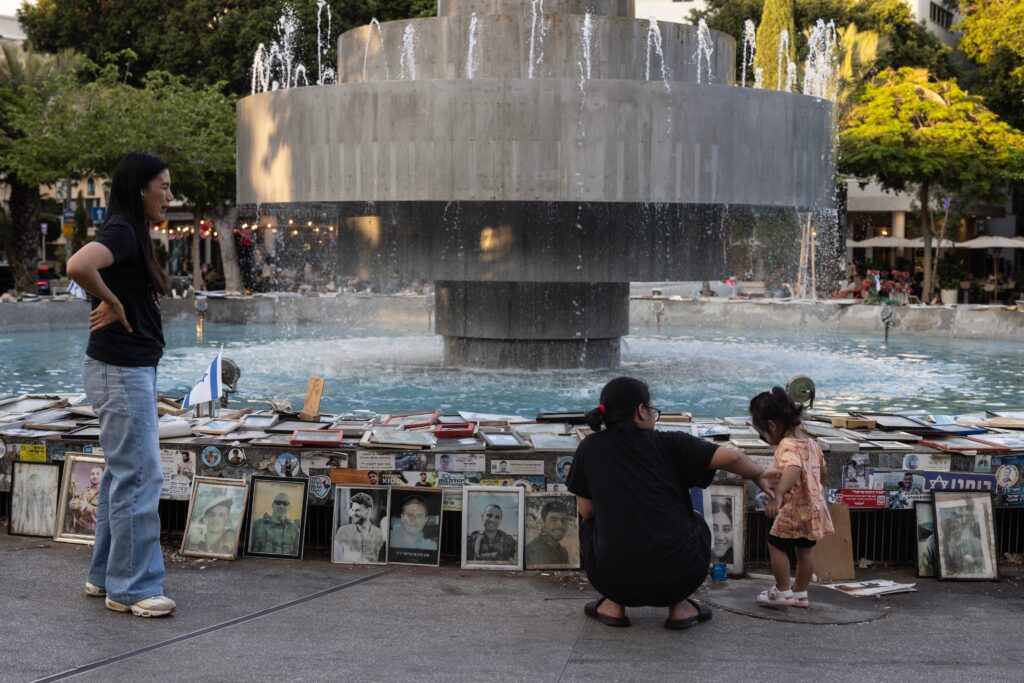
TEL AVIV — Walls in this seaside metropolis once bore stickers promoting shalom — peace. Now they’re plastered with the faces of the dead: Israeli civilians killed in the Hamas-led attack of Oct. 7, 2023, and Israeli soldiers killed since then.
As Israel’s multifront conflict grinds on, the country’s once robust and mainstream peace movement is diminished and sidelined — the culmination, analysts here say, of the long political dominance of Prime Minister Benjamin Netanyahu and a rightward shift among voters decades in the making.
One result: a generation now coming of age whose formative years have been shaped by Netanyahu, Oct. 7, and now wars with Hamas in Gaza, Hezbollah in Lebanon and both groups’ patron, Iran.
“Discourse about peace doesn’t exist enough, especially among youth who are influenced by TikTok and things leaders publish,” said Reut Olswang, 18, a member of the progressive Hashomer Hatzair youth movement. Her friend Shai Eichenbaum, 19, agreed: “Usually this isn’t the voice you hear, that people want peace, and that is disappointing.”
The pair spoke on the sidelines of the People’s Peace Summit, a conference this spring that drew thousands of Jews and Arabs to Tel Aviv to advocate a diplomatic way out of Israel’s long conflict with Palestinians. It was the third annual summit, but the first since fragile ceasefires were reached with Hamas, Hezbollah and Iran.
“After three blood-soaked years, the drive for peace must grow stronger,” Shira Ben-Sasson Furstenberg, director of the New Israel Fund, told The Washington Post. “We saw what brought the hostages back; we saw what can bring us quiet on the Lebanese front. How can a rational person think there is a future here based solely on a military solution?
“This understanding is also sinking in among the Israeli center and right,” she said.
Analysts are skeptical.
“Since the struggle against the Oslo accords in the ’90s, Netanyahu has impressively succeeded in delegitimizing the very idea that the Israeli-Palestinian conflict needs to be solved,” said Assaf Sharon, a professor of philosophy at Tel Aviv University. “The word ‘peace’ or the word ‘left’ sounds like a curse today.”
The attacks of Oct. 7, in which militants killed 1,200 people in southern Israel, “should have triggered a reaction of ‘you led us to catastrophe, and we must change course,’” Sharon said. But instead, the “Israeli center joined the government, and no one challenged the government’s strategic approach.”
The failure of peace initiatives since Oslo has also helped marginalize the movement, former foreign minister Shlomo Ben-Ami told The Post. “The perception has become entrenched among the Israeli public that all this merchandise the left sold has no buyer on the Palestinian side.”
Netanyahu instead speaks of “peace through strength.” He has attempted in recent years to manage the conflict rather than try to end it.
The Abraham Accords, brokered by the first Trump administration, normalized relations between Israel and the United Arab Emirates, Bahrain and Morocco. Peace with Jordan and Egypt remains stable. But for many Israelis, the prospects of reaching a settlement with the Palestinians and achieving peace with Lebanon, let alone Iran, seem very distant.
While 78 percent of Israeli Jews believe continued conflict with the Palestinians is harmful to the state, Tel Aviv University’s Peace Index reported in March, only 26 percent favor negotiations with the Palestinian Authority. That’s down from 30 percent in November.
“Without progress in the Palestinian arena, there will be no normalization with countries like Saudi Arabia or Indonesia, because they view this conflict as a source of instability,” said Ksenia Svetlova, a former member of the Knesset. “This is the core of our conflicts here in the Middle East.”
Negotiators at Oslo envisioned the eventual establishment of a Palestinian state alongside Israel. But support among Israeli Jews for this two-state solution has fallen to 23 percent, according to the Peace Index. Annexing the occupied territories to create a single state under Israeli rule, with limited rights for Palestinians, and maintaining the status quo are both more popular.
Ben-Ami was a member of the Israeli team that negotiated with the Palestinian Authority at Camp David in talks convened by President Bill Clinton in 2000. The summit, at which the sides discussed an independent Palestinian state, Israeli settlements in the occupied territories, Palestinian refugees and the status of Jerusalem, ended without an agreement.
“The two-state solution has passed from this world,” Ben-Ami told The Post. “We are wasting energy on reviving a corpse.”
President Donald Trump’s 20-point peace plan for Gaza promises a “pathway to Palestinian self-determination and statehood,” subject to reforms in the Palestinian Authority. Israel and Hamas agreed to a ceasefire in October and the exchange of hostages and detainees. But there’s been no discernible progress on larger questions, including the disarmament of Hamas, an international stabilization force and postwar reconstruction, and violence continues, each side accusing the other of violating the truce.
Attendees at the peace summit proposed a range of ways forward.
Svetlova is now executive director of ROPES, an organization that promotes regional cooperation. She called for strengthening the Palestinian Authority and integrating friendly Arab nations into future negotiations. Following the Abraham Accords, she told attendees, the region “is becoming more friendly toward the State of Israel. Anti-Israeli expressions exist … but the resistance is constantly shrinking.”
Omer Zanany, head of the foreign and security team of the Mitvim Institute and the Berl Katznelson Foundation, accused Netanyahu of strengthening Hamas at the expense of the Palestinian Authority and its president, Mahmoud Abbas. “He did everything he could to prevent an alternative to Hamas,” Zanany said. “On one hand, we must drain Hamas militarily and economically, and on the other, there must be an alternative.”
Maoz Inon, a Jew, and Aziz Abu Sarah, a Palestinian, describe a shared journey through Israel and the Palestinian territories in their book “The Future Is Peace,” published in April. Each has lost family to the conflict: Inon’s parents were killed on Oct. 7; Abu Sarah’s brother was killed during the first intifada.
On the second day of Shiva, the seven days of Jewish mourning, Inon’s family decided against seeking retribution. “Revenge will only deepen the cycle of bloodshed in which we have been trapped for a hundred years,” he told The Post. “What was proven on October 7 is that war does not bring security.”
“Yes, there’s a lot of pain,” Abu Sarah said. “That doesn’t mean we have to continue to live in that trauma. We can shape our future to be different than the present we live in.”
Ben-Ami said initiatives such as the peace summit are unlikely to have much impact. “I’m in favor of us loving each other, but this is not about love, it is about peace. These are two different things,” he said. “In the end, at the moment of truth, it is a decision by leaders, who must make difficult choices.”
(Ben-Ami‘s choice would be to connect the West Bank to Jordan: “I am convinced that if Israel begins a unilateral process of convergence, dismantling problematic settlements and establishing a border unilaterally, it will awaken the need in Jordan for a Jordanian-Palestinian-state solution.”)
Ayman Odeh, who leads the Arab-majority Hadash-Ta’al bloc in the Knesset, said the focus now should be on the next election, scheduled for October. “All nations that fought and struggled eventually reached compromises,” he told The Post. But “at this time,” he said, “the priority is to prevent Netanyahu and this group from continuing for another term.”
The peace summit drew a mostly older crowd — a reflection, Sharon said, of an emerging generational divide among Israelis. “These are people who grew up in a period where being in favor of peace was not only legitimate, but mainstream,” he said. “Younger people live in a world where, for 30 years already, this concept has suffered such abuse that they don’t encounter it at all.”
Event volunteer Shahar Baruch, 19, agreed.
“After wars, people move to the right, especially in our generation,” she said. “One must be optimistic, but it will take a long time before something begins to change.”
The post Amid years of war, these Israelis are still pushing for peace appeared first on Washington Post.