When Brad Lander opened his Democratic primary bid for New York’s 10th Congressional District late last year, he made a promise that would once have meant political suicide: He would not do “AIPAC’s bidding” in Washington.
Now the June 23 primary is almost here, and AIPAC has been a recurring theme throughout the campaign. A progressive Jew and self-described liberal Zionist, Lander challenged his opponent, the pro-Israel incumbent Dan Goldman, to take a “people’s pledge” to limit money from super PACs. He has sent a steady stream of text and email blasts comparing AIPAC with Wall Street and crypto — a new, unholy trinity of corrupting influences in democratic politics.
Goldman, meanwhile, has tried to assert his independence from AIPAC. He accepted its endorsement but has refused money from all political action committees. And he has said he urged AIPAC to break ranks with Israel and criticize its government when appropriate.
The 10th Congressional District, which stretches from downtown Manhattan into parts of brownstone Brooklyn, is one of the country’s most Jewish districts. It would be easy to dismiss AIPAC’s prominent role in the campaign as a parochial, only-in-New York phenomenon. But different versions of it have played out across the country during this primary cycle.
AIPAC — the American Israel Public Affairs Committee — exerts its influence by encouraging members to reject anti-Israel candidates and to support pro-Israel ones through fund-raising emails and its website, where a portal lets donors give the legal maximum to any political campaign. But the group also has a super PAC, the United Democracy Project. Donors can give as much as they want to super PACs, and those PACs can spend as much as they want promoting or attacking individual candidates. AIPAC’s has spent money freely in the Democratic primaries, with mixed results.
It wasn’t so long ago that AIPAC was bipartisan and untouchable, the guardian of America’s close relationship with a key moral and geopolitical ally. For decades after its founding in 1948, most Americans saw Israel as the best of post-World War II liberalism, a democratic Jewish state born out of the ashes of the Holocaust. And AIPAC was its proud American ambassador.
Now, this perception of Israel is unraveling, and AIPAC is under attack from both political sides. On the right, it is drawing fire from “America First” pundits like Tucker Carlson, who argue that Israel wields too much power in politics.
On the left, its position is even more precarious. In a party that is undergoing a tectonic generational shift, AIPAC has become a symbol of the old guard. “It’s about protecting the old, conservative Democratic establishment against the young, progressive upstarts,” says Matt Duss, executive vice president at the Center for International Policy and a former foreign policy adviser for Senator Bernie Sanders. “We are in an anti-system moment, and AIPAC is saying: We are here to defend the system against you crazy progressives.”
AIPAC argues that it’s not protecting “the system” against these anti-Israel progressives; it’s protecting the Democratic Party’s pro-Israel majority whose views, it believes, are in danger of being drowned out. “There is a fringe left of the Democratic Party that is trying to to use the primary system to exert an outsize and pernicious influence in politics,” says Patrick Dorton, the spokesman for the United Democracy Project.
But at a time when Democrats increasingly question unconditional military aid to Israel, here is an organization using the power of big donors and dark money (already liberal boogeymen) to defend it. Once an unassailable voice of quiet influence in American politics, AIPAC is now both a victim and a cause of the unraveling consensus on Israel.
Created several years after Israel’s founding, AIPAC leaned Democratic and liberal during its early decades, reflecting both Israel’s labor Zionist roots and the political preference of most American Jews.
It began moving to the right during the 1980s and early ’90s, with the rise of Ronald Reagan and Israel’s Likud party, naming its first Republican board president and executive director. But AIPAC retained its power on both sides of the political aisle. That power was built on a simple idea: that America and Israel shared the same values and strategic interests.
As the only liberal democracy in the Middle East — and a vital source of intelligence from the region — Israel was a critical ally during the Cold War and the global war on terror. Ensuring Israel’s security, Washington believed, was tantamount to ensuring America’s security. AIPAC had its occasional critics in politics, but they were typically well outside the mainstream.
But during Barack Obama’s presidency, the bipartisan consensus over Israel — and AIPAC — started to fracture. The precipitating event was Obama’s nuclear deal with Iran. The Israeli government opposed the agreement, arguing that it didn’t go far enough to restrict Iran’s nuclear program or to stop it from funding terrorist groups like Hamas and Hezbollah.
AIPAC spent $30 million trying, and failing, to defeat the deal. It quickly turned into a bitter partisan dispute, with the Republican House speaker, John Boehner, inviting Prime Minister Benjamin Netanyahu of Israel to inveigh against the deal before a joint session of Congress.
Netanyahu accepted the invitation over Obama’s objections. It was an unforgettable political moment: a foreign leader inside the House chamber, lobbying lawmakers to reject an agreement that the sitting president had negotiated, arguing that it would protect America’s national security. Netanyahu did not visit the White House on that trip — but he did make time to speak at AIPAC’s annual policy conference.
In the years that followed, many Democrats turned away from the hard-line positions of the Netanyahu government, like its persistent settlement construction in the West Bank and its perpetual (and erroneous) insistence that Iran was moments away from finishing a nuclear bomb.
In the face of this emerging divide, AIPAC continued to back Israel almost unconditionally. “AIPAC’s mission is to support the Israeli government no matter what, and there are hardly any members of Congress on the Democratic side who support this Israeli government,” says Matt Bennett, the executive vice president of Third Way, a centrist Democratic think tank.
With the emergence of “the Squad” in 2018, AIPAC’s defense of the Jewish state took on a new urgency. There had been isolated critics of Israel in Congress in the past, but here was a bloc of young, progressive legislators — some of whom supported boycotts and economic sanctions on Israel.
Concerned that it was losing control of the conversation, AIPAC answered a few years later. Its old methods of persuasion — lobbying lawmakers, showing them around Israel, funneling relatively small donations to individual campaigns — had become anachronistic in the age of big-money politics. It created its super PAC ahead of the 2022 midterms, now able to guide unlimited and anonymous donations to political campaigns. The United Democracy Project spent $26 million in that cycle, mainly targeting Democrats whom it considered insufficiently pro-Israel. At the same time, AIPAC endorsed more than 100 pro-Israel legislators who had voted to overturn the 2020 election results, sending the message that it would choose Israel’s perceived interests even over American democratic norms.
Two years later, the stakes were still higher. The Hamas-led terrorist attacks of Oct. 7, and Israel’s military response to them, had heightened the passions of Israel’s American supporters as well as its detractors. The United Democracy Project poured $23 million into unseating two members of the Squad in the 2024 primaries.
This year, the United Democracy Project’s war chest bulged with nearly $100 million to shape races around the country. “We are not going to let the Democratic Party go the way of the Labour Party in the U.K. on Israel,” Dorton says, referring to Britain’s governing party, which recently suspended some arms sales to Israel and recognized a Palestinian state.
By then, the AIPAC backlash was already underway.
AIPAC remains a bipartisan organization. Many of the group’s largest donors are pro-Trump Republicans, but its ranks are also full of Democrats, a legacy of American Jewish voters’ historical preference for liberal leaders and policies. The problem is that a lot of Democrats are starting to rethink their views of Israel, especially after the deaths of tens of thousands of Palestinians during the Gaza war.
One example is Tom Malinowski, a former New Jersey representative who was seeking to return to the House. Malinowski is by no means in sync with the Squad; he declines to call Israel’s war in Gaza a “genocide” and believes that the United States should safeguard Israel’s security. But he also says that Netanyahu went much too far in retaliation for the terrorist attacks of Oct. 7, and he wants America to make case-by-case decisions about Israel’s requests for military aid. In February, the United Democracy Project spent more than $2.3 million to defeat him, arguing that some of his opponents were more supportive of the U.S.-Israel relationship. (As in other races, its ads did not mention Israel. In this case, they focused mostly on Malinowski’s support for ICE funding while he was in Congress.)
The effort backfired: Malinowski lost, but so did the candidates AIPAC preferred. Instead, Democrats nominated Analilia Mejia, a progressive candidate far to Malinowski’s left on Israel.
Daniel Biss, a Democratic congressional candidate in a Chicago-area district, was next. Biss saw AIPAC coming. The grandson of Holocaust survivors, he told AIPAC’s officials that he disliked the current Israeli government but was not anti-Israel; if he were elected to Congress, he said, his door would always be open to the group. But Biss wouldn’t back unrestricted military aid for Israel, which appears to have been a deal-breaker for AIPAC.
“We believe that adding new political conditions or restrictions on lifesaving security assistance to Israel, beyond the substantial conditions that already exist, is misguided, harms America’s interests and is not pro-Israel,” says Deryn Sousa, a spokeswoman for AIPAC. The United Democracy Project spent millions of dollars attacking Biss and supporting one of his opponents, Laura Fine, funneling much of the money through an innocuously named group called Elect Chicago Women.
Biss did some polling and discovered that three times as many Democratic voters in his district viewed AIPAC unfavorably as favorably, 51 percent to 17 percent. And so, having failed to persuade AIPAC to stay neutral, he highlighted its involvement in a TV spot. He credits the move with helping to deliver his primary victory in March.
This isn’t an easy line for candidates to walk. Israel and AIPAC are popular targets for conspiracy-mongers. A Democratic House candidate in Texas, Maureen Galindo, recently pledged to turn a former ICE detention facility into a prison for “American Zionists,” most of whom she says are probably pedophiles. (She denies she is antisemitic.) Criticizing AIPAC may now be good politics on the left, but it remains fraught, especially at a time of rising anti-Jewish sentiment around the world. “I feel queasy talking about it, given the antisemitic tropes at play here about Jews and money and power,” Lander says. “But I have to.”
As AIPAC sees it, the organization and its super PAC have been unfairly demonized by the left. They say that they are no different from any of the other single-issue interest groups — including anti-Israel ones — that make their voices heard in primaries. In New York, for instance, a new super PAC recently pledged to spend $2 million supporting candidates who are critical of Israel, including Lander.
But in a sense, mainstream Democrats like Biss and Malinowski pose a bigger threat to America’s pro-Israel consensus than overtly anti-Israel progressives. The Squad’s views on Israel are well to the left of most Democrats’. By contrast, Democrats who call themselves pro-Israel — while also criticizing the policies of the Netanyahu government — are harder for Israel’s defenders to dismiss. Netanyahu, after all, is not well-loved in Washington. Even President Trump called the prime minister “crazy” for his ingratitude on a call this month.
For years, AIPAC helped define what it meant to be pro-Israel in America. But in setting such an uncompromising standard for that support, it has inadvertently accelerated a debate about it, especially on the left. AIPAC argues that it is working to strengthen and expand the American-Israeli relationship. But to the group’s pro-Israel critics, like its Washington rival J Street, the hard-line stance is having the opposite effect, endangering this historic alliance. As J Street’s president, Jeremy Ben-Ami, puts it: “AIPAC is playing with fire and runs the risk of burning our whole house down.”
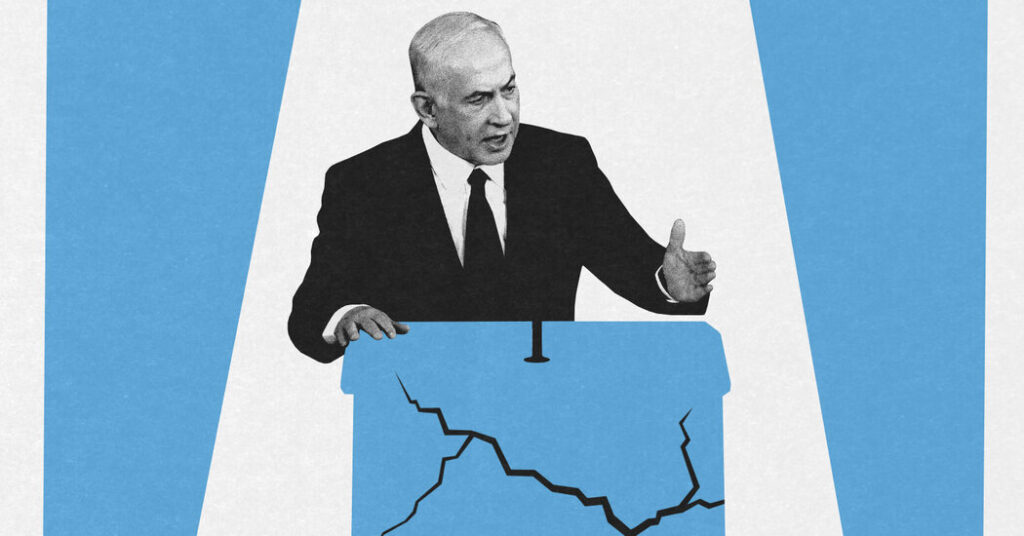
Source images for illustration above: Kent Nishimura/Getty Images; Alex Wong/Getty Images
The post AIPAC Wants Democrats to Back Israel. Instead, They’re Turning on AIPAC. appeared first on New York Times.